Camera Traps: Banned for Recreational Hunters in the Canton of Valais
The canton of Valais will henceforth prohibit recreational hunters from setting up camera traps in the forests. Younger recreational hunters in particular were using them to make hunting easier for themselves. More about recreational hunting in Switzerland.


The canton of Valais will henceforth prohibit hunters from setting up camera traps in the forests. Younger hunters in particular were using them to make hunting easier for themselves. The Cantonal Valais Hunters’ Association has expressed its satisfaction.
In Valais it is no longer uncommon to suddenly discover a camera attached to a tree in the forest. «For about five years now, you see more and more of them,» said Benoît Martinet, a board member of the Cantonal Valais Hunters’ Association.
However, these are not only used by hunters. In light of this development, a hunting society from central Valais had approached the Cantonal Hunters’ Association, which came out in favour of a ban on camera traps during the hunting season.
The Valais cantonal government has now responded to this request, as stated in a press release issued on Thursday regarding the hunting law. From now on, cameras equipped with motion detectors and automatic triggers are prohibited. Anyone who violates this risks a fixed-penalty fine.
Certain hunters — particularly younger ones — were using these in conjunction with their smartphones to obtain information about animal behaviour and thereby make hunting easier for themselves. This, however, shows a lack of ethics and decency, said Benoît Martinet.
Data Protection Concerns
In addition, private individuals walking in the forest could be filmed without their knowledge. The Federal Data Protection Commissioner had already warned of this in 2012. Private individuals are prohibited from setting up cameras in public spaces that can be used to identify people in the images captured.
The head of the Valais cantonal office for hunting and fishing, Peter Scheibler, is not aware of any other cantons that have already incorporated a ban on camera traps into a regulation. He would not be surprised if the federal government were to follow suit in the next revision of the federal hunting ordinance.
Camera traps are set up by private individuals, the federal government, and universities. The processing of personal data by private individuals and federal authorities is governed by the Federal Act on Data Protection (FADP). The processing of personal data by universities is subject to cantonal data protection laws. The cantons of Zurich and Geneva also have guidelines on the operation of camera traps that specify the requirements of data protection legislation (Information Sheet on Camera Traps issued by the Office for Landscape and Nature of the Canton of Zurich, dated 23 January 2013; agrément du 8 octobre 2012 du Bureau des préposés à la protection des données et à la transparence de la République et Canton de Genève). In detail, the following applies:
- Research projects using camera traps must comply with data protection regulations. In particular, personal data may only be processed for the purpose stated at the time of collection, apparent from the circumstances, or provided for by law (for the federal level, see Art. 4 para. 3 FADP). Camera traps are not intended for the processing of personal data but serve to monitor and record wildlife populations. They are placed in locations rarely frequented by people. Furthermore, camera traps are installed at a low height so that only the leg area of people who happen to be present is photographed; any photos showing persons are destroyed immediately. The Federal Data Protection and Information Commissioner and the Association of Cantonal and Municipal Data Protection Officers therefore see no need for action.
- Camera traps operated on behalf of the federal government are signposted. Notice signs inform about the purpose of the camera trap and identify the operator. The guidelines of the cantons of Zurich and Geneva also stipulate that camera traps must be signposted and bear a contact address for the operator.
- Photos showing persons must be destroyed immediately. This is done on the spot by the person reviewing the images. Retaining, forwarding, or publishing photos of individuals taken by camera traps is prohibited. Disseminating any information about a person obtained through such photos is likewise unlawful.
- Before setting up camera traps, formal contacts take place between the research institutions and the responsible authorities. Researchers inform the relevant cantonal and municipal authorities, as well as hunters, when they intend to set up camera traps in an area. The Department of Conservation Biology at the University of Bern, for example, contacts the relevant cantonal authorities and inquires whether permits need to be obtained. On behalf of the Federal Office for the Environment (FOEN), the organization Kora uses camera traps to monitor the lynx population. This too is carried out in cooperation with the cantons.
- The Federal Council is informed about projects under federal responsibility. The FOEN is responsible for this, monitoring the development of populations of protected predators in Switzerland (lynx, wolf, and bear; Art. 14 of the Hunting Act and Art. 11 of the Hunting Ordinance). Photo monitoring is currently used for the lynx and may in future also be used for the wolf. On behalf of the FOEN, Kora sets up camera traps three to four times per year for approximately sixty days in defined reference areas of around 690 to 1,280 square kilometers in the greater regions of the Jura, Northwestern Alps, Central Switzerland, Northeastern Switzerland, as well as in Valais and Graubünden. The Federal Council does not have an overall overview of projects at the cantonal level. There is also no overview of the use of camera traps by private individuals. In particular, the rapid increase in the use of camera traps among hunters is causing concern to the responsible authorities, as there is no way to monitor whether camera traps are being used in compliance with the law. At the next opportunity, therefore, the use of camera traps for hunting purposes is to be prohibited under Article 2 of the Hunting Ordinance.
- If a person is photographed by a camera trap, they have access to the civil law remedies under Article 15 of the Data Protection Act or Article 28a of the Civil Code, provided the relevant conditions are met. In particular, they may demand that the photos be destroyed and not passed on to third parties (action for removal).
More on the subject of recreational hunting: What the research says about this is shown by Hunting fact-checked: the state of research.
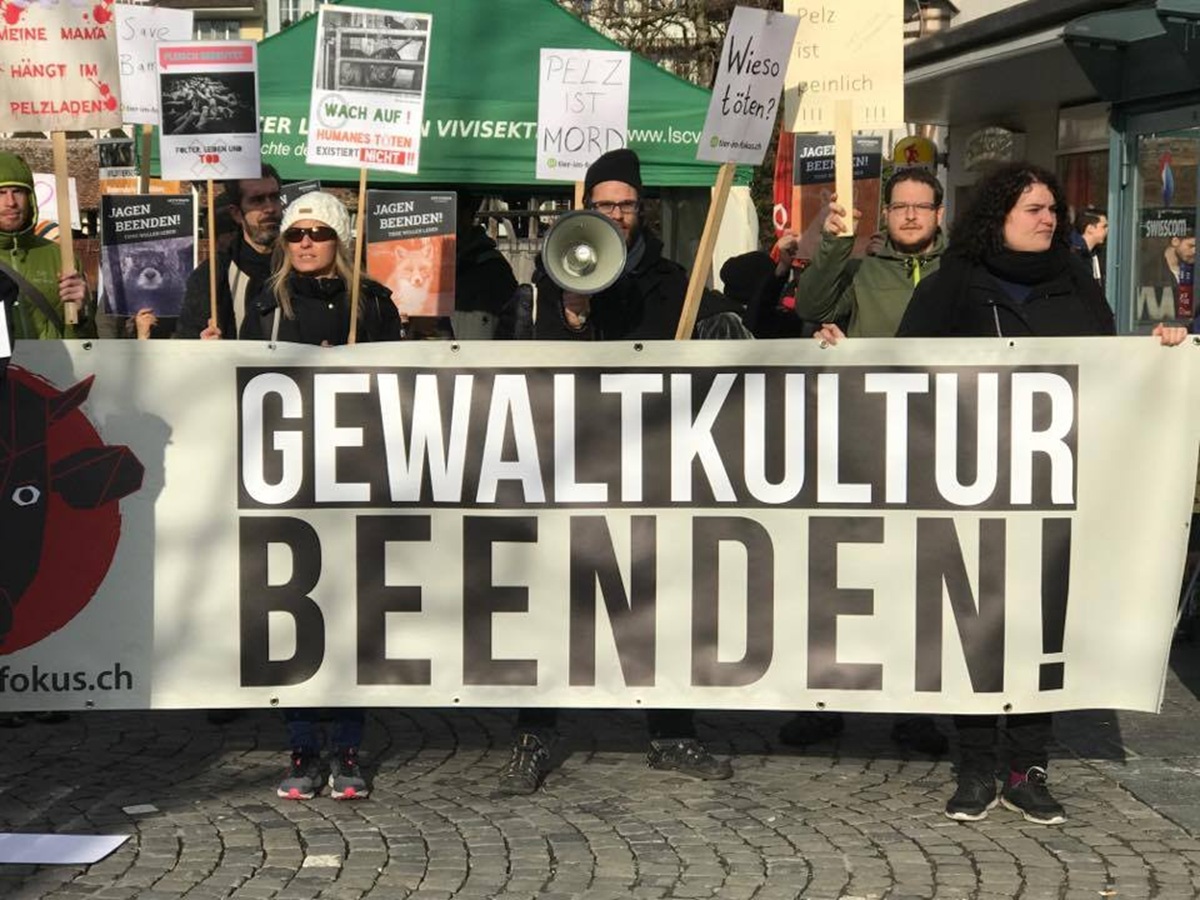
The position of IG Wild beim Wild: IG Wild beim Wild rejects recreational hunting. Our model is the canton of Geneva, which has managed without recreational hunting since 1974: without hunting seasons, without hunting dogs, without driven hunts, without high seats, without the animal cruelty and crime that go hand in hand with hunting season elsewhere. What has worked there for over fifty years disproves every position paper by JagdSchweiz. An association that bases its policy on claims it refutes in its own documents is not a professional organisation, but a factory for misinformation.