Ticino pushes back against recreational hunters following hunting accidents
«This is completely unacceptable,» says Francesco Maggi (58), head of the Ticino section of WWF. «Hunters have no business being in recreational or residential areas. They are far too dangerous.» Citizens should not have to feel threatened.


It is Saturday, 28 September, just before noon. The second-to-last day of the open season hunt in Vicosoprano GR.
A group of recreational hunters drives deer out of the undergrowth along a river. A doe leaps towards a football pitch. In the line of fire, the junior team of AC Bregaglia is training. A shot rings out. A recreational hunter misses the wild animal again. The bullet buries itself in the turf. Shock on the pitch! How easily could it have hit one of the children? The public prosecutor’s office in the canton of Ticino is now investigating.
That recreational hunting can be deadly not only for the hunted is demonstrated time and again by reports in the media. As for example from Valais on 30.9.2019: Early on a Monday morning, at around six o’clock, a recreational hunter falls 200 metres into a ravine near Blatten-Naters. His companion alerts Air Zermatt. However, all help comes too late for the 60-year-old. He dies on the spot.
Or, a recreational hunter mistakes his best friend for a wild boar and shoots him dead. Two weeks earlier, another man out stalking had accidentally shot his companion in the hand. At the end of January, an amateur hunter in Aargau had mistaken three domestic woolly pigs for wild sows and shot them. These are just a few of the incidents that made it into the media at all.
Recreational hunters take aim at colleagues and bystanders, and occasionally shoot pets too. This year, one fired at a wild animal from the pavement right in the middle of the city of Chur. Every tenth deer in Graubünden, for example, is merely wounded rather than killed outright.And it is always accidental, and always played down.
How dangerous are recreational hunters?
The IG Wild beim Wild also maintains an up-to-date blacklist of criminal activities by recreational hunters in Switzerland, which can be viewed HERE.
Following the shocking UN report on species extinction in spring 2019, the spotlight falls on Switzerland. No country in the world has a higher proportion of endangered species than Switzerland. More than a third of plant, animal, and fungal species are considered threatened. It is always these right-wing circles of recreational hunters and farmers' representatives with their shabby lobbying who bear responsibility for this through politics and legislation.
Given that biodiversity is also at stake, should we not ban recreational hunting and, where regulation of a species is truly necessary, leave this to professional wildlife wardens instead?
The monopoly on the use of force belongs in the hands of the state and must not be delegated to gangs of recreational hunters who shoot wildlife for fun — this is the firm conviction of IG Wild beim Wild.
Fox hunting violates the Animal Welfare Act
The killing of animals as a leisure activity has no place in the 21st century and should also be subject to criminal prosecution.
According to the Animal Welfare Act (Art. 26 TSchG), a “reasonable justification” must exist for the killing of an animal. However, hunting many wild animals — such as foxes — amounts to nothing more than the gratification of a bloody hobby. There is no legally mandated culling plan for foxes. The animals serve recreational hunters as living targets, as there is neither a wildlife-biological nor a public health justification for the mass hunting of these predators.
Accordingly, every fox hunt is a clear violation of the Animal Welfare Act, due to the absence of any reasonable justification. For more than 30 years, at least 18 wildlife-biological studies have demonstrated the following: fox hunting does not regulate populations and is equally ineffective as a means of disease control. On the contrary!
Canton Ticino takes action
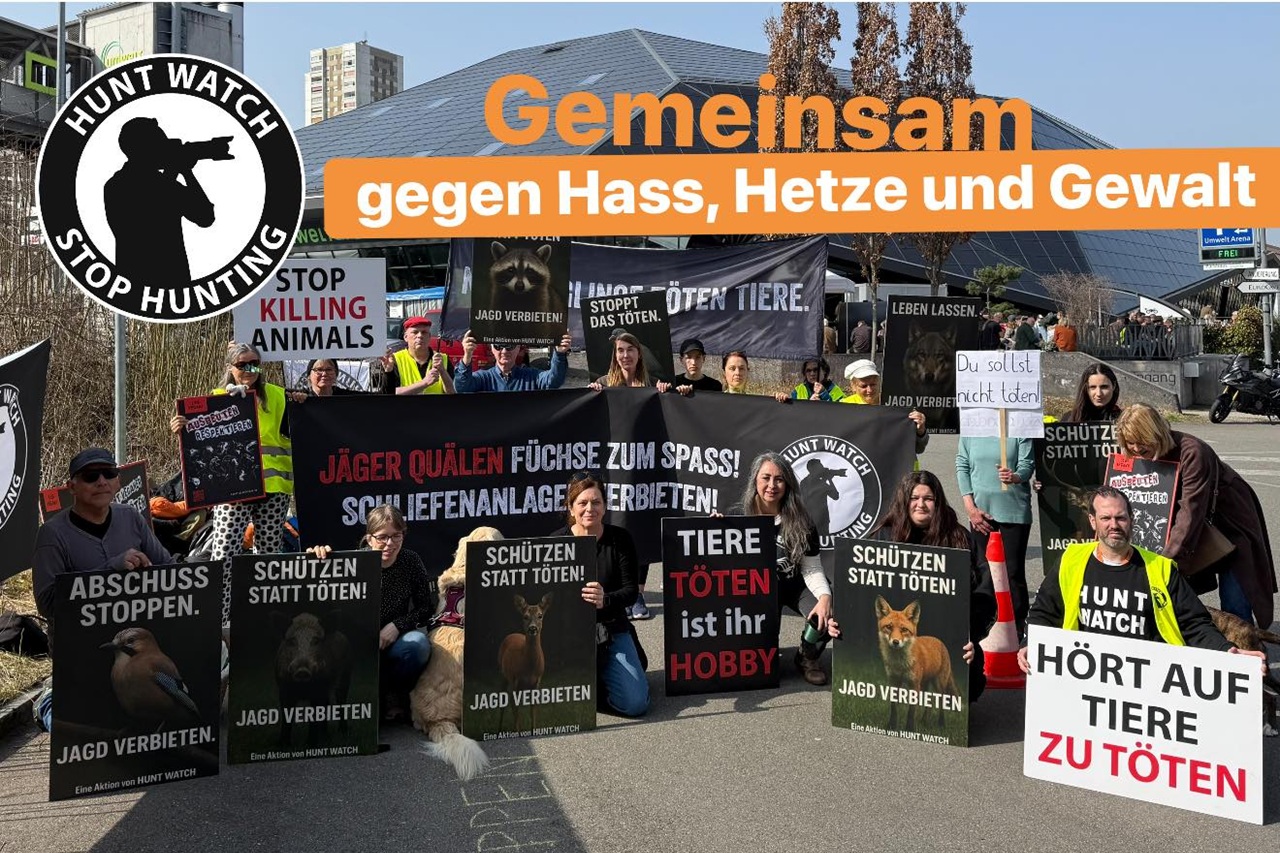
Following the many amateurish incidents involving recreational hunters, the Canton of Ticino has now put together an initial package of measures.
Recreational hunters will henceforth be required to wear brightly coloured orange vests at all times during the main hunting season.
On the plains north of Bellinzona as well as in the Riviera and Blenio Valley, shooting will only be permitted between 7 and 9 a.m., and no longer until 2 p.m.
The minimum distance from houses, roads, campsites, nature trails, and similar locations is no longer 50 metres but must be 200 metres.
These corrections will take effect for the late-autumn hunt for deer and roe deer as well as for the winter hunt for wild boar, which begins on 23 November.
For the 2020 hunting season, the canton of Ticino also intends to implement a second package of measures, such as an alcohol ban or regular vision tests for older hunters, similar to those required for drivers.
More on the subject of recreational hunting: In the dossier Poaching and hunting crime in Switzerland we document cases, legal questions and recurring patterns. The scientific evidence is presented in the overview Studies on the Effects of Recreational Hunting.
The position of IG Wild beim Wild: IG Wild beim Wild rejects recreational hunting. Our model is the canton of Geneva, which has managed without recreational hunting since 1974: without hunting seasons, without hunting dogs, without driven hunts, without high seats, without the animal cruelty and crime that go hand in hand with hunting season elsewhere. What has worked there for over fifty years disproves every position paper by JagdSchweiz. An association that bases its policy on claims it refutes in its own documents is not a professional organisation, but a factory for misinformation.