Beware of Cult Danger!
Wild beim Wild recommends the immediate cessation of hunting and a professional wildlife management by animal and nature conservation organisations.


Hobby hunters manipulate, harass and terrorise.
The axis of evil does not necessarily run through Iraq, Afghanistan, Syria or North Korea. It runs through our neighbourhood. The weapons of mass destruction are the modern hobby hunters.
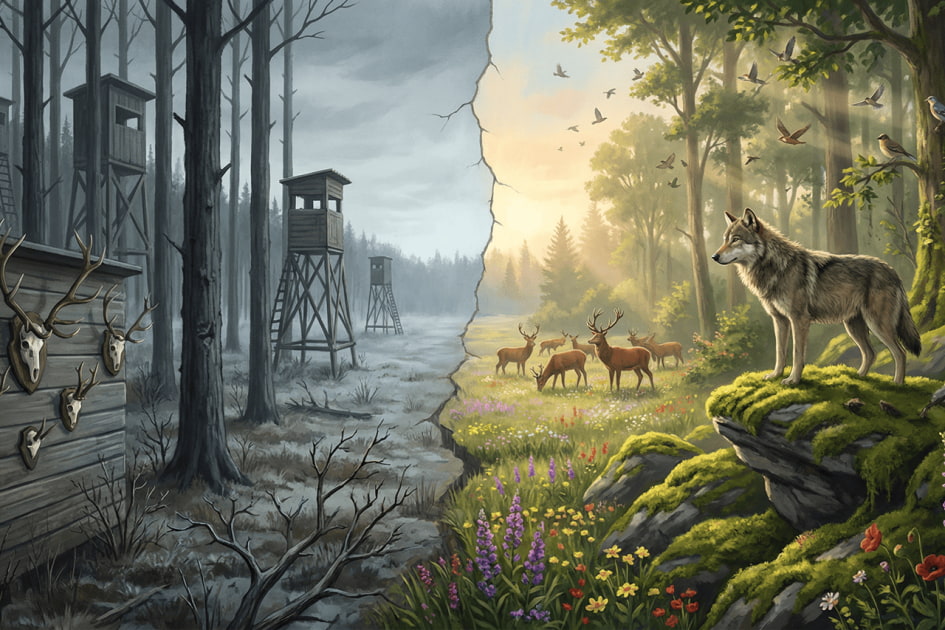
Scattered across the entire globe, there are these special communities with a fanatical and militant orientation. A dark sect that nurtures and cultivates the cult of death. That practises bloody rituals in the forest and plays martial music. Terror cells that disfigure entire regions with shooting towers. That contaminates nature and animals with the heavy metals of ammunition. That proselytises in politics and among the population with fear-mongering propaganda and junk biology. That speaks its own life-contemning language and torments animals.
Hobby hunters lure animal-loving children into their clutches under false pretences. Once in their grasp, they are subjected to brainwashing and turned into brutal animal killers.
And if not the followers, then innocent wild animals must pay the price when hobby hunters run amok. Hobby hunters turn wildlife into unnecessary victims. Hobby hunters spread fear and terror and make a great deal of noise in forests and fields.
Malicious tongues claim that today's hunting abuses descend from the friends of National Socialism. Both share the same ideology: unproven claims are made and opinions are manufactured. The hunting fraternity employs certain designations that are purely ideological in character.
Problem animal, predator, pest, disease reservoir, plague, invasion, etc. are not biological criteria but serve as value judgments, as tools of devaluation. A frequently used and proven method of creating and maintaining enemy images. No doubt is allowed to arise that animals one wishes to kill also deserve their death.
Hunting has its historical origins in a vital cycle, the process of obtaining nourishment. However, today the acquisition of food is only the actual goal of hunting in 10 percent of cases. The remaining 90 percent, hunting serves «sporting ambition». This should give us pause for thought.
This also means that hobby hunters repeatedly and forever require an enemy against whom they can vent their frustrations. This leads to a hallucinatory pattern of behavior. For in order to feel secure, this absurd system of thinking demands constant vigilance against all those who could potentially become an enemy. One must always be suspicious and harbor mistrust toward others. In other words: a state of paranoia becomes the underlying motif of every security-conscious behavior. It should therefore come as no surprise that hunting itself, once linked to sustenance, evolved over millennia into proof of male strength and superiority. Hunting became the very embodiment of masculinity. And the larger and more dangerous the animal a man killed, the more its death reflected his courage and power. Indigenous peoples, whom we label «primitive,» granted the animal a soul. They asked it for forgiveness before killing it for their own survival. Our culture, by contrast, erases the animal’s right to exist in the act of hunting. Its soul and its being no longer hold any significance. This step, which strips other living beings of their right to psychological autonomy, to life and existence, made the transition to hunting humans so easy, writes Arno Gruen.
Hubertus
Hubertus is the self-proclaimed patron saint of hobby hunters and their subject of conversion. According to the handed-down legend, Hubertus was born around 655 as the son of a nobleman and died in the year 728. Initially, he led a pleasure-seeking life and was a passionate hunter. One day, while hunting, he had tracked down a stag and was pursuing it to kill it, when the animal suddenly turned to face him. Between its antlers a cross shone forth, and in the form of the stag, Christ spoke to him:
Hubertus, why do you hunt me?
Hubertus dismounted from his horse and knelt before the stag. From that moment on, Hubertus ceased hunting and henceforth led a righteous life.
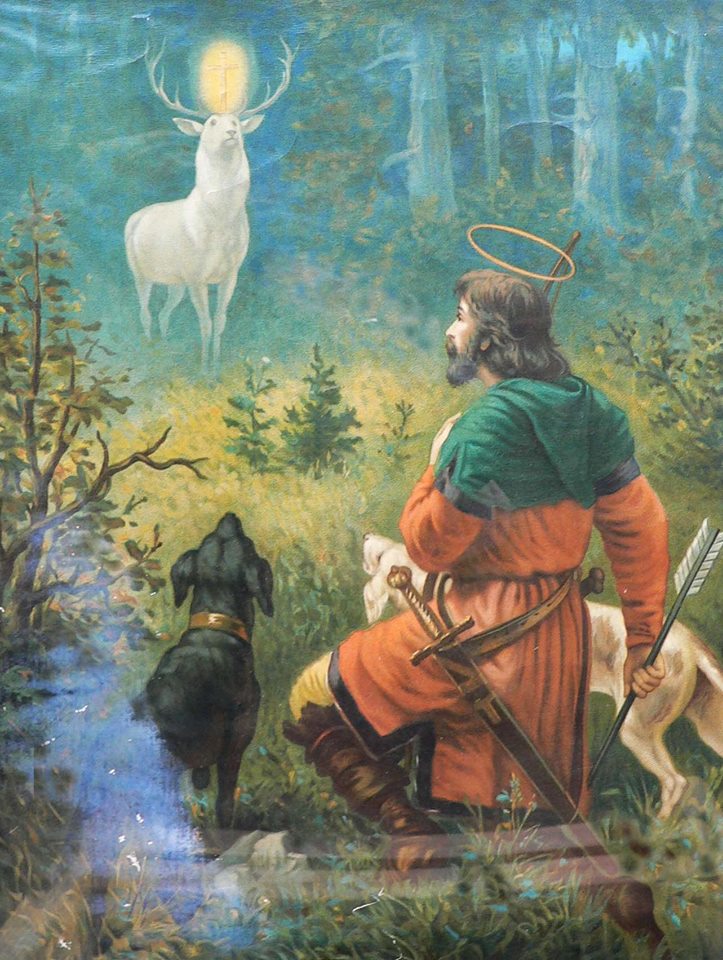
After his encounter with the stag, Hubertus thus gave up hunting and became a devout Christian. He freed himself from the sect. For true Christianity and hunting simply do not go together. In his encounter with the stag, he was faced with a choice: either he kills the animal – and in doing so also kills Christ – or he does not, and professes his faith in Christ. Or, in the words of Matthew 25:40:
Whatever you did for one of the least of these brothers of mine, you did for me.
Everyone agrees that the habitat for wildlife is shrinking ever further. This is where the full perversion and hypocrisy of hunters comes to light. If people are already encroaching upon nature and the habitat of wildlife, then they should not be hunting them on top of that. Wildlife is doubly punished here, even though they bear no responsibility for it whatsoever.
The hobby hunter is no friend of animals — his very name makes that clear. Hunters do not only shoot sick or old wildlife. No, they shoot at everything and even pay gladly for the privilege. Upon closer analysis, hunters are anything but environmentalists or animal welfare advocates. No wildlife group has a more abysmal ecological footprint than hunters.
Interestingly, public opinion holds a very different image of hunters. Forest rangers, farmers, and nature conservation organizations shape nature management. Somehow, the hunter still manages to be the fifth wheel on the wagon — and from that position, he not infrequently torpedoes the conservation projects of others or makes senseless demands.
Better a terrible end than terror without end.
IG Wild beim Wild
The IG Wild beim Wild is a non-profit advocacy organization committed to the sustainable and non-violent improvement of the human-animal relationship, with a particular specialization in the legal aspects of wildlife protection. One of our primary concerns is to introduce a contemporary and serious wildlife management system in the cultural landscape, modeled on the Canton of Geneva — without hobby hunters, but with upstanding game wardens who genuinely merit the title and act in accordance with a code of honor. The monopoly on the use of force belongs in the hands of the state. The IG supports scientific methods of immunocontraception for wildlife.