Bear spotted in the Lower Engadin
A young brown bear sighted in the Lower Engadine and shortly afterwards fatally struck by an RhB train: a tragic chronicle.

Update: 9.4.2016 The bear was run over by a train.
Once again, a Brown bear has not survived its migration into Grisons. A young animal first sighted a week ago was hit head-on by a train in the Engadine during the night of Friday to Saturday and killed on the spot.
The Grisons Office for Hunting and Fishing announced on Saturday that the collision between the Rhaetian Railway (RhB) locomotive and the predator had occurred late on Friday evening, shortly after 11 p.m., between Zernez and S-chanf. It was the last train running that night.
The bear killed in the accident was a young animal weighing 110 kilograms. The University of Bern is examining the carcass and carrying out genetic tests to establish its identity. The locomotive was not damaged in the collision.
Second collision with a locomotive
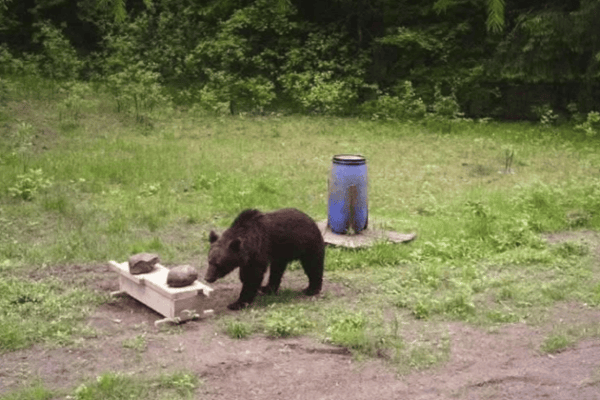
The presumed immigrant from northern Italy had first been observed last Sunday by a private individual in the Lower Engadine. The brown bear — initial suspicions pointed to M32 — roamed the valley throughout the week.
It had been moving quickly and exploring its new habitat, said the Grisons hunting inspector Georg Brosi when asked. The wildlife wardens had sighted the animal as recently as Friday, that is, shortly before its death.
It is not the first collision in Grisons between an immigrating bear and an RhB locomotive. In May 2012, bear M13 was injured in the Lower Engadine in a collision with the locomotive of the late train from Scuol to Klosters. The bear suffered bruises in the collision.
In the end, however, the animal did not survive its excursion to Grisons. In February 2013, the three-year-old male was shot by the wildlife wardens in the southern valley of Poschiavo. The bear had turned up on the valley floor several times and had frightened tourists and locals.
First visit in six months
The as yet unidentified brown bear killed in a railway accident on Friday evening, possibly M32, is the 13th immigrant to Grisons since the summer of 2005. It is also the third animal to pay for its excursion into Switzerland with its life.
Before brown bear M13, the wildlife wardens shot bear JJ3 in mid-April 2008. After hibernation, the animal had repeatedly roamed inhabited areas in search of food and, in the view of the hunting authorities, had become a risk to people. The bear was then shot in the Thusis region.
Unique images of the bear in the Val Müstair
During the night of Monday 4 April 2016, a bear was observed in the Lower Engadine.
It crossed the cantonal road coming from the River Inn. The sighting is classed as credible. As early as the end of last week, a bear was observed in the area of the Reschen Pass in South Tyrol, heading northwards. This could be the male M32, which had previously left its traces in the Val Müstair area over a longer period.
M32 would be the 13th bear to have migrated from Italy to Grisons. He is likely to have emerged from hibernation about one and a half months ago.
If it really is M32, the animal is two and a half years old, as Hannes Jenny, wildlife biologist at the Office for Hunting and Fishing, said on enquiry. The bear is rather shy and had specialised last autumn and this spring in «beekeeping items».
It is the first sighting in the Lower Engadine since September 2015.

Farmers and beekeepers have been informed of the sighting.
Information that is useful when bears appear can be found at the following link: www.baer.gr.ch
Related dossiers and articles:
Do you have a tip, a source or a correction for this article? Write to us.
Seen something yourself?
A driven hunt next to a hiking trail, a shot fired near houses, a trap in the forest or an injured wild animal: report it to the Recreational Hunter Radar. We check every tip-off and treat your details confidentially.
More on the subject of recreational hunting: In our dossiers on recreational hunting gather fact-checks, analyses and background reports. What the research says about this is shown by Hunting fact-checked: the state of research.
The position of IG Wild beim Wild: IG Wild beim Wild rejects recreational hunting. Our model is the canton of Geneva, which has managed without recreational hunting since 1974: without hunting seasons, without hunting dogs, without driven hunts, without high seats, without the animal cruelty and crime that go hand in hand with hunting season elsewhere. What has worked there for over fifty years disproves every position paper by JagdSchweiz. An association that bases its policy on claims it refutes in its own documents is not a professional organisation, but a factory for misinformation.
Support our work
With your donation you help protect animals and give their voice a hearing.
Donate now →