NABU wants to bypass animal welfare in recreational hunting
Hunting laws at both the state and federal level are becoming increasingly hostile to wildlife. The current amendment to the Federal Hunting Act, in keeping with the forest-over-wildlife approach, proposes leaving the culling of roe deer largely to the arbitrary discretion of recreational hunters and forest owners.


If NABU and the Ecological Hunting Association (ÖJV) have their way, recreational hunters will in future be able to intervene very significantly in roe deer populations.
The Bavarian Hunting Association speaks of an additional 500,000 roe deer that, in the opinion of those supporting the current amendment to the Federal Hunting Act, should be culled per year. This would correspond to an increase in the pure hunting bag of around 50 percent. One thing should be clear: bags of this size are by no means achievable within the framework of ethical, wildlife-conscious hunting as required by the Animal Welfare Act. Even today, hunting events run by state forestry operations in Bavaria or Saxony, for example, are unlikely to meet animal welfare requirements.
The German Hunting Association also communicates its opposition to the planned release of roe deer within the framework of the legislative amendment, but does so rather tentatively — if not outright hypocritically. If not this association, who else could demonstrate how little regard for animal welfare there already is in the way hoofed animals of the forest are hunted today. During driven hunts, shots are regularly fired at roe deer and wild boar in full flight. With no regard for age classes, the social structures of many wildlife species are literally shot apart. Red deer calves lose their mothers; groups of ten, twelve or more piglets are left as orphans, freezing or starving to death — regularly and time and again.
This association loudly proclaims to the world that its recreational hunters are not pest controllers. At the same time, it is the very same organization that has spent decades celebrating ever-new kill records in wild boar hunting, that strips wildlife of the night as their last refuge, and that supports politicians in their pursuit of every kind of technological upgrade. As the association's most recent president reportedly put it, paraphrasing: «I am, after all, president of all hunters«.
What is currently happening in the political circus regarding hunting legislation is, from an independent legal perspective, likely incompatible with both the Animal Welfare Act and the constitutional goal of animal protection. As an animal welfare advocate, one gets the impression that pure arbitrariness prevails here.
In reality, animal welfare protections for wild animals in Germany are barely applied at all. Least of all for species that reduce the profits of state-owned (!) forestry operations, that threaten factory farming and the exploitation of foreign contract workers, that foul parks and the banks of lakes and rivers, or that have been released into the wild (by recreational hunters) or immigrated from neighboring countries. In fact, more and more wild animal species are being classified under hunting law, thereby losing the high level of protection afforded by the Animal Welfare Act or the Federal Nature Conservation Act.
Together with 27 other animal welfare organizations, Wildtierschutz Deutschland therefore calls for existing hunting law regulations to be reviewed for their compatibility with the constitutional goal of animal protection — which has now existed for nearly 20 years — and for existing deficiencies to be remedied.
Above all, it should finally be explicitly clarified in hunting law that hunting in and of itself does not constitute a reasonable justification for killing animals within the meaning of the Animal Welfare Act! Rather, hunting any animal requires a legitimate reason. Without one, it cannot be called «ethical hunting». The provision of § 4 para. 1 sentence 2 of the Animal Protection Act (TierSchG), which is repeatedly cited in this context, provides no basis for this, as it exclusively governs the «how» of hunting, but not «whether» a species may be hunted at all. To establish the necessary clarity on this point, a corresponding provision should finally be introduced into the Federal Hunting Act, and the list of huntable species should be adapted to reflect the changed societal attitude toward animal welfare.
Added Value
More on the subject of recreational hunting: In our dossiers on the criticism of recreational hunting gather fact-checks, analyses and background reports. What the research says about this is shown by Hunting fact-checked: the state of research.
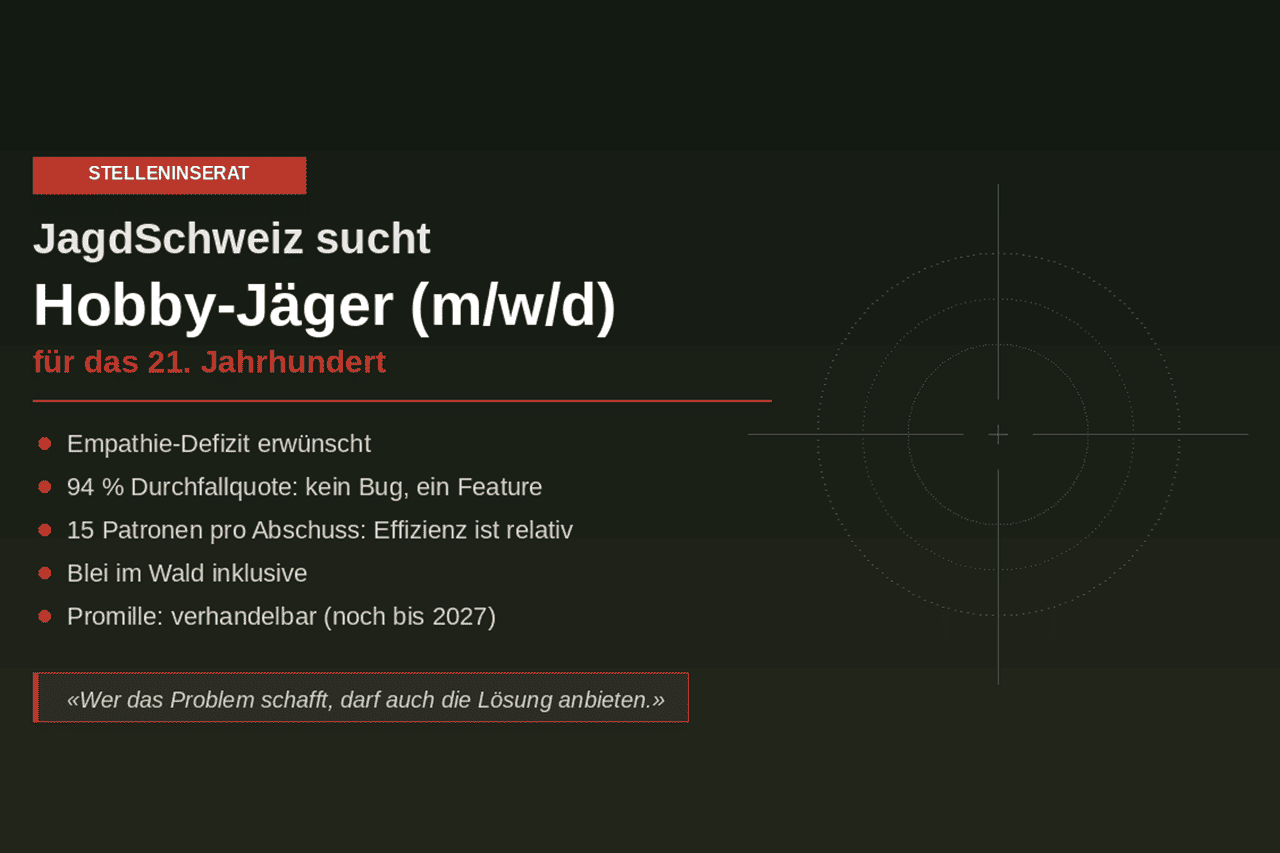
The position of IG Wild beim Wild: IG Wild beim Wild rejects recreational hunting. Our model is the canton of Geneva, which has managed without recreational hunting since 1974: without hunting seasons, without hunting dogs, without driven hunts, without high seats, without the animal cruelty and crime that go hand in hand with hunting season elsewhere. What has worked there for over fifty years disproves every position paper by JagdSchweiz. An association that bases its policy on claims it refutes in its own documents is not a professional organisation, but a factory for misinformation.