All modern Europeans descend from farmers
DNA analysis reveals: European farmers from the Aegean settled Europe and displaced hunter-gatherer cultures.

Today's Europeans descend from farmers from the Aegean who arrived via the Balkan and Mediterranean routes.
Agriculture and civilisation thus came to Europe through migration, reports a research team involving the Universities of Freiburg and Geneva.
Various parts of Europe were settled as long as around 8,800 years ago by farmers from the northern Aegean. These people migrated from northern Greece and northwestern Turkey into Central Europe and Spain, bringing their sedentary way of life and agricultural practices to the Central European and Mediterranean regions where Neolithic hunter-gatherer societies had been living.
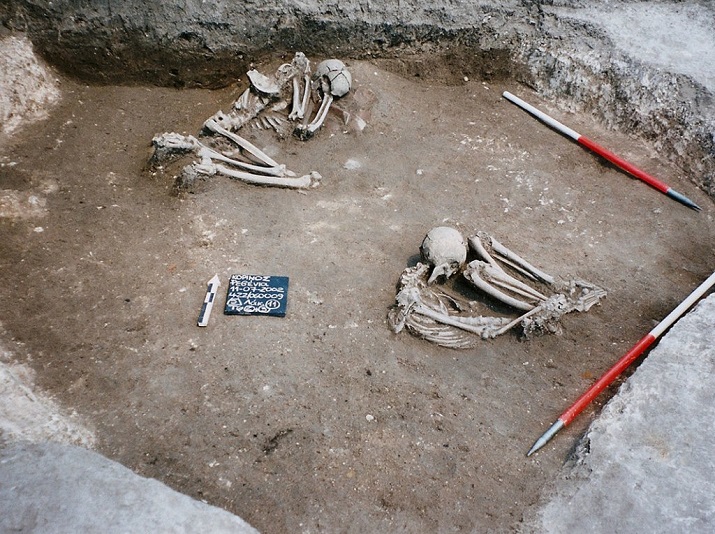
This is the conclusion of a study produced by an international team led by Mainz palaeogeneticist Prof. Dr. Joachim Burger, which is being published this week in the journal Proceedings of the National Academy of Sciences . The scientists analysed the genetic material of archaeological skeletons from Greece and Turkey. According to the study, Neolithic settlers from the area around the Aegean and the Sea of Marmara travelled to Central Europe along a Balkan route. At around the same time, prehistoric farmers from the Aegean region also reached the Iberian Peninsula via the Mediterranean.
The colonists were the first sedentary arable farmers to arrive in Europe. They brought house construction, agriculture, and domesticated animals to their new settlement area. During their expansion, they encountered hunters and gatherers who had been living in Europe since the Ice Age. The migrating farmers not only brought a new culture with them, but also almost certainly looked different and spoke a different language.
The study resolves a long-standing debate about the origins of the first European farmers by demonstrating, through genome analyses, that the ancestral lineage of central and southwestern Europe can be traced back to Greece and northwestern Anatolia. “There was a view that agriculture came to Europe purely through the transfer of ideas, with little or no migration. These views can now be laid to rest,” said Burger, noting that the understanding of the Neolithic Revolution has fundamentally changed over the past seven years thanks to the analysis of ancient DNA.
Settlement, agriculture, and animal husbandry developed as early as 10,000 years ago in a region where Turkey, Syria, Iran, and Iraq meet today — known as the Fertile Crescent. Zuzana Hofmanová, co-first author of the new study alongside Susanne Kreutzer, elaborates: “Whether the first farmers ultimately came from this region has not yet been proven. But we were able to establish with certainty that they, along with their revolutionary Neolithic culture, settled large parts of Europe via the northern Aegean in a very short period of time.”
Little Intermingling
Comparison with the DNA of “modern” Europeans revealed that the migrating farmers contributed significantly more to the gene pool of today's Europeans than the local hunter-gatherers. “There were apparently contacts, but few,” according to one of the authors.
“All modern populations in Europe clearly carry the Aegean signature in their genetic heritage,” clarified one researcher. Of the original population, little remains — neither in Europe nor in the genome.
Related dossiers and articles:
- Dossier: Cultural Landscape as a Myth
- Dossier: Hunting and Biodiversity
- Introduction to Hunting Criticism
- Get Involved
More on the subject of recreational hunting: What the research says about this is shown by Hunting fact-checked: the state of research.
The position of IG Wild beim Wild: IG Wild beim Wild rejects recreational hunting. Our model is the canton of Geneva, which has managed without recreational hunting since 1974: without hunting seasons, without hunting dogs, without driven hunts, without high seats, without the animal cruelty and crime that go hand in hand with hunting season elsewhere. What has worked there for over fifty years disproves every position paper by JagdSchweiz. An association that bases its policy on claims it refutes in its own documents is not a professional organisation, but a factory for misinformation.