African elephant species now endangered
The IUCN upgrades the African forest elephant to ‘Critically Endangered’. The main reasons: ivory poaching and habitat loss.


After a population decline spanning several decades due to ivory hunting and habitat loss, the African forest elephant ( Loxodonta cyclotis ) is now listed as Critically Endangered, and the African savanna elephant ( Loxodonta africana ) as Vulnerable on the IUCN Red List of Threatened Species™ .
Prior to the IUCN update in Gland near Geneva on 25 March 2021, African elephants were treated as a single species and listed as Vulnerable. This is the first time the two species have been assessed separately for the IUCN Red List, following the emergence of new genetic evidence.
The IUCN Red List now includes 134,425 species, of which 37,480 are threatened with extinction.
Africa’s elephants play a key role worldwide in ecosystems, economies, and in our collective imagination. Today’s new IUCN Red List assessments for both African elephant species highlight the ongoing pressures these iconic animals face.. We urgently need to put an end to poaching and ensure that sufficient habitat is preserved for both forest and savanna elephants. Several African countries have taken a leading role in recent years and have demonstrated that we can reverse the decline of elephants — and we must work together to ensure that their example can be followed.
Dr. Bruno Oberle, Director General of the IUCN
The most recent assessments confirm a widespread decline in African elephant numbers across the entire continent. The population of African forest elephants declined by more than 86% over a period of 31 years, while the population of African savanna elephants is estimated to have declined by at least 60% over the past 50 years.
Both species have suffered a sharp decline since 2008 due to a significant increase in poaching, which peaked in 2011 but continues to threaten populations. The ongoing conversion of their habitats, primarily to agricultural and other land uses, is a further significant threat. The IUCN African Elephant Status Report 2016 contains the most recent reliable estimate of the continental population of both species combined, at around 415,000 elephants.
Despite the overall downward trend in both African elephant species, the assessments also highlight the impact of successful conservation efforts. Anti-poaching measures on the ground, along with more supportive legislation and land-use plans designed to promote coexistence between humans and wildlife, have been key to the successful protection of elephants. As a result, some forest elephant populations have stabilized in well-managed protected areas in Gabon and the Republic of Congo. Savanna elephant numbers have also been stable or growing for decades, particularly in the Kavango-Zambezi transfrontier conservation area, which is home to the largest subpopulation of this species on the continent.
The decision to treat African forest and savanna elephants as separate species is the result of a consensus reached among experts following new research into the genetics of elephant populations. Forest elephants are found in the tropical forests of Central Africa and in a range of habitats in West Africa. They rarely overlap with the range of the savanna elephant, which prefers open terrain and is found in a wide variety of habitats in sub-Saharan Africa, including grasslands and deserts. The forest elephant, which has a more restricted natural range, is believed to currently occupy only a quarter of its historical range, with the largest remaining populations found in Gabon and the Republic of Congo.
More on the subject of recreational hunting: In the dossier Poaching and hunting crime in Switzerland we document cases, legal questions and recurring patterns. The scientific evidence is presented in the overview Studies on the Effects of Recreational Hunting.
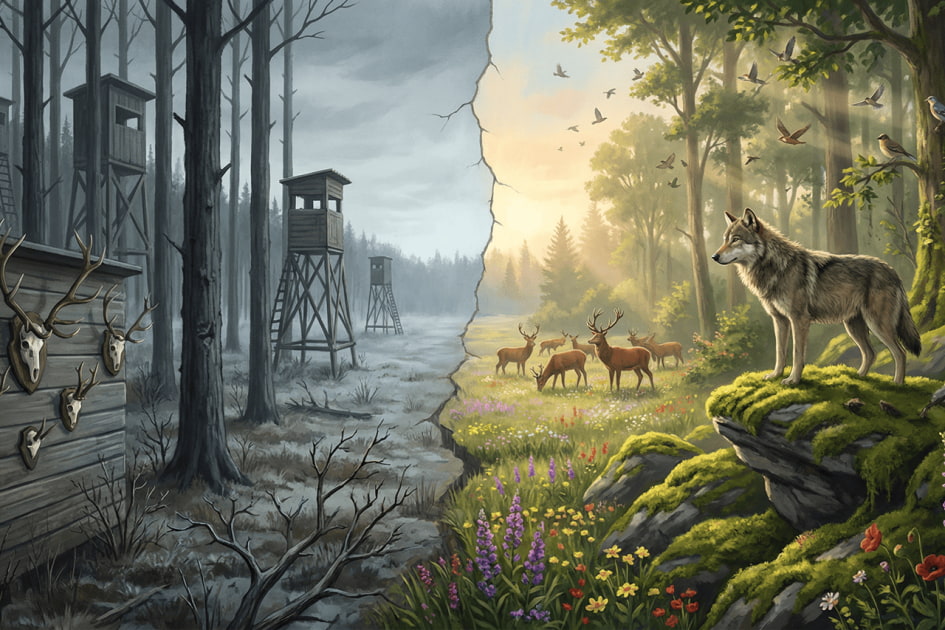
The position of IG Wild beim Wild: IG Wild beim Wild rejects recreational hunting. Our model is the canton of Geneva, which has managed without recreational hunting since 1974: without hunting seasons, without hunting dogs, without driven hunts, without high seats, without the animal cruelty and crime that go hand in hand with hunting season elsewhere. What has worked there for over fifty years disproves every position paper by JagdSchweiz. An association that bases its policy on claims it refutes in its own documents is not a professional organisation, but a factory for misinformation.