60 Captured Birds Expose the Recreational Hunter System
Yet another case reveals how deeply recreational hunting in France is entrenched in illegal practices.


In the tiny southern French village of Vérignon in the Département Var, the Gendarmerie carried out an inspection of a hunting ground in mid-November and made a startling discovery: 60 live songbirds held in captivity, several hundred dead animals prepared for consumption, illegal traps, prohibited lime sticks, structures erected without permission in a protected zone, and an entire arsenal of weapons.
The man who used the premises is a recreational hunter.
The case is emblematic of a hunting culture in which animal cruelty, violations of the law, and the myth of the supposedly nature-connected huntsman go hand in hand with striking frequency.
From Hunting Ground to Poacher’s Base
The inspection took place on November 14, 2025. In addition to the Gendarmerie, the French Office for Biodiversity (OFB) and the responsible authority for Territories and the Sea (DDTM) were also involved. The purpose was to inspect a hunting ground near the Regional Nature Park of Verdon in the highlands of the Var.
What the officers found reads like a script from an animal cruelty documentary:
- 60 live thrushes that had been illegally trapped and kept in captivity
- several hundred dead animals, neatly packaged for consumption
- traps and other capture equipment
- 18 hunting weapons and extensive additional equipment
- illegal structures on a site designated as a nature conservation zone
The Gendarmerie reports multiple criminal offences having been identified. The birds were released following veterinary inspection; the man is currently free but faces criminal proceedings before the competent court in Draguignan.
Prohibited Hunting Methods as Everyday Practice
Particularly scandalous: so-called lime stick sites were discovered on the property. This form of bird hunting, known as chasse à la glu, has been expressly prohibited in France since the Conseil d'État ruling of 2021.
In this method, branches are coated with a sticky adhesive. When a bird lands on them, it becomes stuck by its wings and plumage, thrashes about in panic, and ultimately hangs helplessly in the glue. Officially, the animals were supposed to be caught alive and used as decoys, but in practice they are regularly severely injured or killed. In 2021, France's highest administrative court ruled that this form of hunting is contrary to EU law because it is cruel and non-selective, meaning it also affects many other bird species.
The fact that lime stick hunting continues to be practiced in the Var — one of the former hotspots of this practice — despite having been clearly illegal for years, reveals two things:
- The hunting lobby is unwilling to voluntarily abandon brutal traditions.
- Controls are so infrequent that years of systematic law-breaking apparently pays off.
Hunting romanticism meets reality
In their public communications, hunting associations like to present themselves as nature-loving, law-abiding, and responsible. The Vérignon case tells a different story.
- 60 live birds in private possession are not indicative of an occasional “misstep,” but of systematic wild trapping.
- Hundreds of deep-frozen animal carcasses show that a private mini-slaughterhouse was operated here over an extended period of time.
- Prohibited lime sticks and illegal structures on protected land signal a sovereign contempt for wildlife protection law.
It would be naive to believe that this recreational hunter is an absolute isolated case. On the contrary: the effort by authorities to deploy multiple agencies to inspect a single hunting ground suggests that relevant tip-offs existed and that such structures are known in the region.
When hunting authorities, politically well-connected associations, and local politicians have been turning a blind eye for decades, parallel worlds grow on hunting grounds in which weapons, traps, and animal suffering become the norm.
Why recreational hunting is so susceptible to abuse
The fact that it is precisely a recreational hunter — and not an “ordinary citizen” — who hoards 18 weapons, illegal traps, and dozens of animals comes as little surprise. It follows from the logic of the system:
- Access to weapons and ammunition
Recreational hunters possess legal firearms, know the hunting grounds, and can explain their presence there at any time by citing alleged habitat maintenance. - Legal gray areas concerning wildlife
Wildlife is considered "nobody's property" in many legal systems until animals are killed or captured. This construct virtually invites treating animals as a resource with which one can do as one pleases. - Tradition as a fig leaf
In France as well as in Switzerland, cruel hunting practices are often defended with the word "tradition." It is precisely this argument that the Conseil d'État rejected in the context of glue-trap hunting. Tradition alone does not justify the torment of animals. - Control deficits
Hunting grounds are often remote and inspections are rare. Those who regard the mountains or forests as their private territory feel unobserved and untouchable.
Parallels to Switzerland
The case takes place in France, yet the mechanisms are familiar to many Swiss animal welfare advocates:
- Here too, illegal traps, carrion dumps, or non-compliant kills are repeatedly brought to light.
- Here too, criticism of hunting is readily deflected as an attack on “cultural heritage,” while animals suffer.
- Here too, it is often committed individuals or NGOs who document abuses and are the ones who compel authorities to act in the first place.
- For years, more than 1’000 reports and administrative fines for hunting violations have been recorded annually in the canton of Graubünden. During the main hunting season, approximately 10,000 deer, chamois, roe deer, and wild boar are shot each year in the canton of Graubünden. Around nine to just under ten percent of these kills are unlawful. In the five years prior to 2016 alone, recreational hunters paid administrative fines of over 700,000 francs for illegal kills. Particularly alarming are the figures relating to wounded animals. When extrapolated to the whole of Switzerland, the structures are more reminiscent of a criminal organization and animal cruelty.
The message from Vérignon is therefore: without independent oversight and without public pressure, the recreational hunting milieu remains a black box in which animal cruelty can easily go undetected.
What is needed now
From an animal welfare perspective, it is not enough to prosecute a single recreational hunter and release a few birds. What would be needed at a minimum includes:
- Systematic inspections of hunting grounds
Particularly in regions where glue traps and other “traditional” catching methods were once widespread, terrain, huts, and aviaries must be inspected regularly. - Consistent disarmament in cases of violations
Anyone caught using illegal traps, prohibited hunting methods, or animal cruelty should permanently lose their hunting licence and weapons. - Transparency instead of hunting secrecy
Data on inspections, convictions, and confiscated animals must be publicly accessible. Only then can the media and civil society obtain a realistic picture of recreational hunting. - Strengthening preventive animal protection
Rather than blanket acceptance of the recreational hunting system as “wildlife management,” a scientific debate is needed on alternative, non-lethal forms of dealing with wild animals.
A symbolic case for an outdated system
The name Vérignon will likely soon disappear from the headlines in France. For the 60 birds that waited for death in cramped cages, for the hundreds of animals already killed, and for the countless animals that died in agony on glue sticks, every step taken by the justice system comes too late.
What remains is a symbolic case. It shows how fragile the facade of recreational hunting is the moment authorities take a serious look. And it serves as a reminder that animal cruelty does not only occur at the margins of society, but in the very heart of the officially recognised recreational hunting system.
As long as wild animals are regarded primarily as moving shooting targets, such scandals will not remain exceptions — they will merely be chance moments in which the curtain is briefly drawn back.
Dossier: Hunting and animal protection
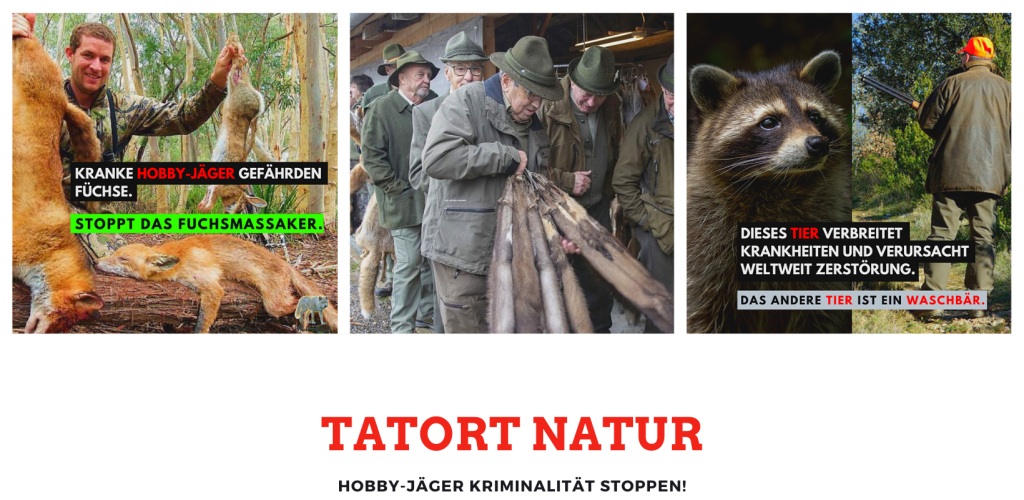
More on the subject of recreational hunting: In the dossier Poaching and hunting crime in Switzerland we document cases, legal questions and recurring patterns. The scientific evidence is presented in the overview Studies on the Effects of Recreational Hunting.
The position of IG Wild beim Wild: IG Wild beim Wild rejects recreational hunting. Our model is the canton of Geneva, which has managed without recreational hunting since 1974: without hunting seasons, without hunting dogs, without driven hunts, without high seats, without the animal cruelty and crime that go hand in hand with hunting season elsewhere. What has worked there for over fifty years disproves every position paper by JagdSchweiz. An association that bases its policy on claims it refutes in its own documents is not a professional organisation, but a factory for misinformation.