20 May marks the first World Bee Day
A grand welcome for «Maya the Bee»: this coming Sunday is the first ever World Bee Day! The United Nations has declared 20 May as World Bee Day to raise public awareness of the contributions made by all bees.

A grand welcome for «Maya the Bee»: this coming Sunday is the first ever World Bee Day! The United Nations has declared 20 May as World Bee Day to raise public awareness of the contributions made by all bees.
The choice of this date goes back to the Slovenian Beekeepers’ Association, which has been campaigning for a “World Bee Day” for many years. The 20th of May is the birthday of the Slovenian beekeeping pioneer Anton Janša (1734–1773), who is regarded as one of the first teachers of modern beekeeping.
Over 50% of wild bees on the Red List
Their pollination work is of inestimable value. The Intergovernmental Science-Policy Platform on Biodiversity and Ecosystem Services estimates the economic value of flying pollinators at over 577 billion US dollars. When bees are mentioned, the beekeeper’s domestic charge — the honey bee Apis mellifera — tends to dominate public debate. The “wild relatives” receive far less attention. “In Germany, over 50% of wild bee species are already on the Red List,” emphasises Hilmar Freiherr von Múnchhausen, Director of the Deutsche Wildtier Stiftung. “The risk that more and more wild bee species will disappear from the earth in the long term is very real!”
Scarce food and a lack of nesting sites
The often highly specialised wild bee species face two major problems: scarce food sources and inadequate nesting opportunities. “Wild bees are suffering from urban and road development, intensive agriculture focused on only a few crop species, and the disappearance of field margins, heathlands, and dry grasslands, as well as other warm and sandy habitats,” explains von Múnchhausen. On the occasion of World Bee Day, the Deutsche Wildtier Stiftung highlights that wild bees in particular — in contrast to the domesticated honey bee — are in need of protection and support.
5 differences between honey bees and wild bees
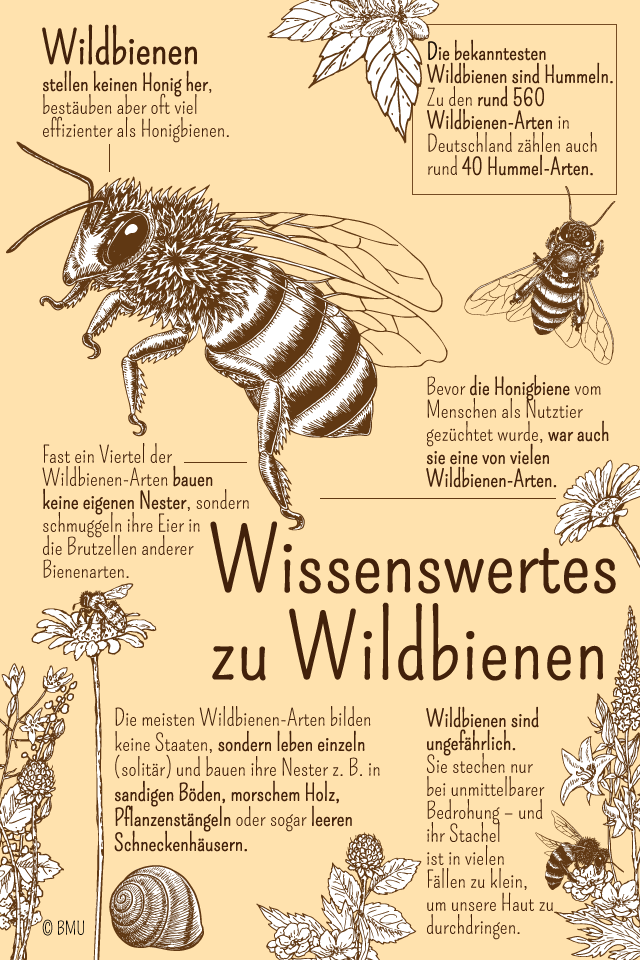
- Honey bees all belong to a single species: Apis mellifera! Among wild bees, there are over 600 different species in Germany alone. Worldwide, there are over 20’000 species.
- Honey bees are bred and live as a social species in a colony with several thousand other individuals in hives. Wild bees are mostly solitary, with individual requirements for their habitat.
- Honey bees visit many different plants, while wild bees collect nectar from very few plant species — sometimes even just a single one.
- Honey bees produce honey; no honey can be harvested from the nests of European wild bees.
- The sting of a wild bee is considerably less harmful to humans than that of a honey bee, and is usually barely noticeable.
More on Biodiversity and on Environment and Nature Conservation.