Wolf Regulation in Graubünden: Hunting Politics Instead of Facts
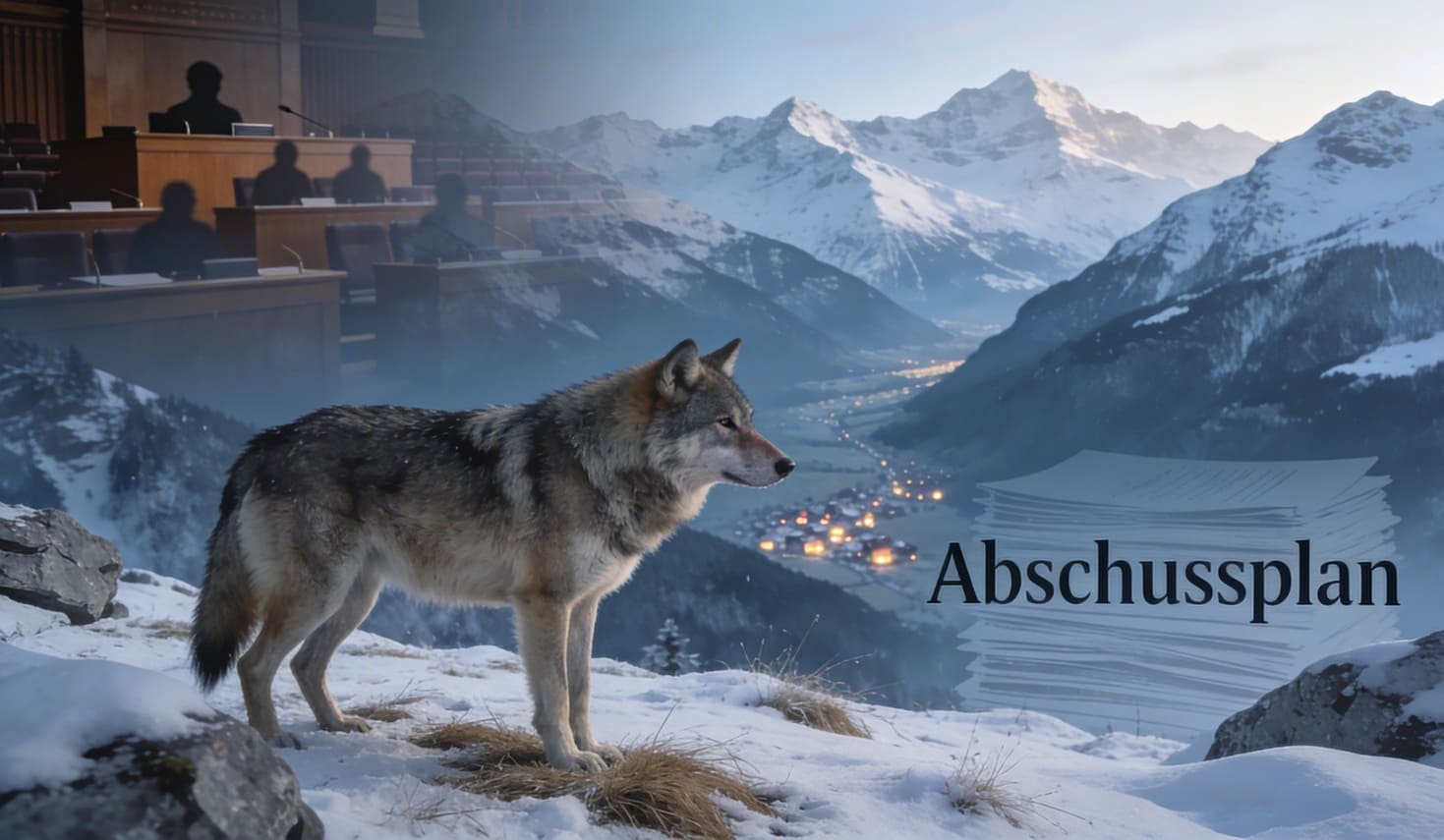
The canton of Graubünden plans to completely eradicate two more wolf packs. Officially, this is said to serve “safety” and “damage prevention.” Yet the closer one looks, the clearer it becomes: this is less a matter of necessary regulation than a political spectacle that has little to do with wildlife biology facts.


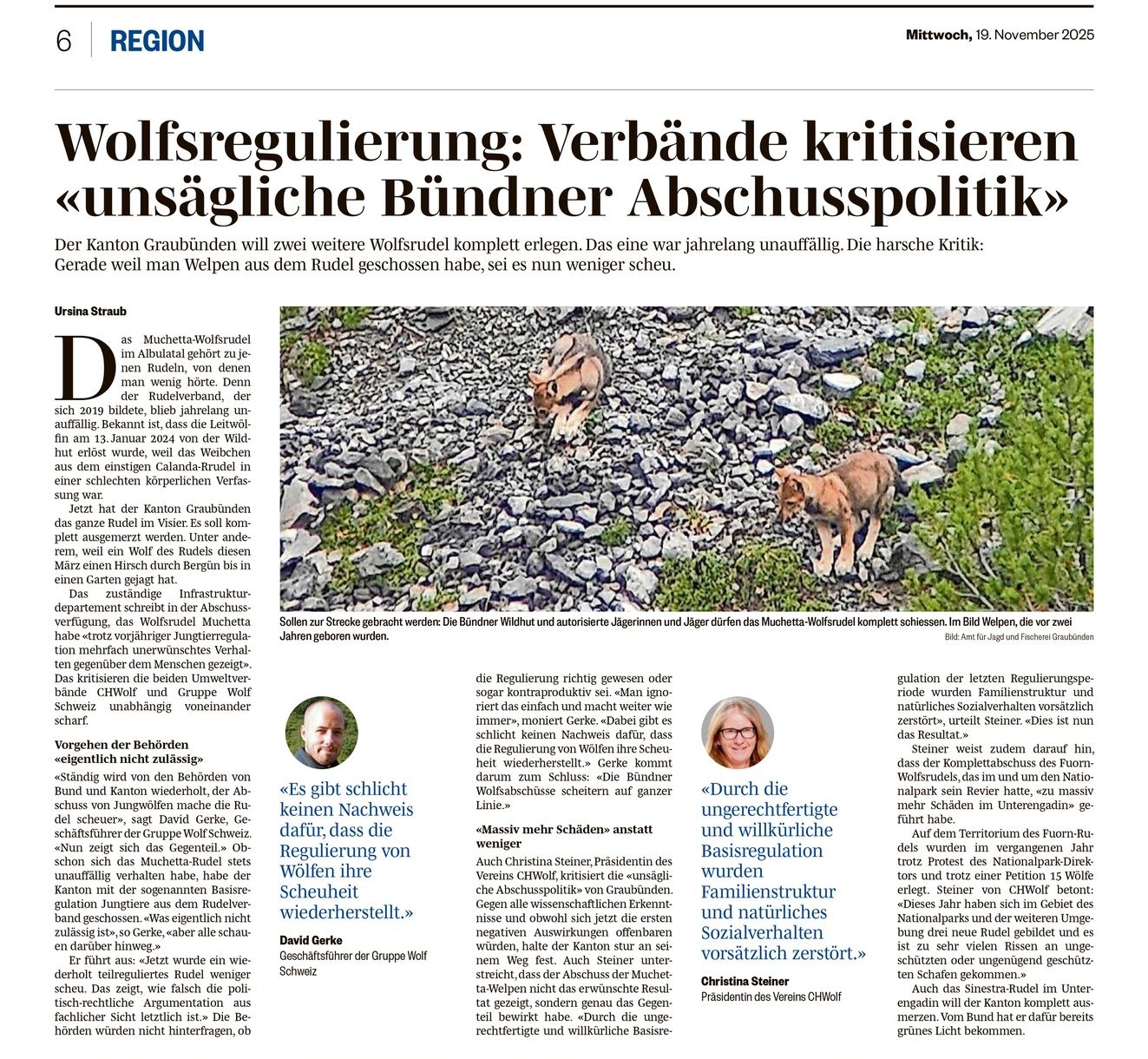
Particularly grotesque is the case of the Muchetta pack in the Albula Valley.
This pack had barely attracted attention for years. It lived withdrawn, caused no particular damage, and was never part of any headlines. That very pack is now to be wiped out.
Authorities’ logic: First shoot the young, then claim the pack is “less shy”
The wildlife wardens killed pups from the Muchetta pack in January 2024. The authorities subsequently determined that the pack was now “less shy.” This is contradictory from a specialist perspective. Science has long established that socially destabilised wolf packs are more likely to take risks, switch prey, or act less predictably.
Nevertheless, the responsible department claims in the culling order that the pack displays “undesirable behavior towards humans.” This is not substantiated. Research findings refute the absurd assumption that wolves have lost their wariness of humans. On the contrary: they show that wolves still perceive humans as their greatest threat.
Nature conservation organisations speak of a political diversionary manoeuvre. David Gerke of the group Wolf Schweiz criticizes the fact that no evidence whatsoever exists that such interventions increase human safety. The fact that poorly justified culls can produce the opposite effect is being ignored.
The myth of “necessary regulation”
For years, hunting and political circles have been repeating like a mantra that wolves must be shot regularly, otherwise the situation would become untenable. Yet neither the damage figures nor the development of conflicts support this narrative. Rather, it is evident that culling socially intact packs destroys them, thereby causing:
- inexperienced young wolves to increasingly attack livestock
- territorial structures to collapse
- the level of disruption to increase
- behavior to become less predictable
Christina Steiner, president of the association CHWolf, speaks of a policy that “regularly misses the mark.” Instead of reducing damage, additional problems are being created. The family structure of wolves is destroyed, social behavior is impaired, and in the end one regrets the very cullings carried out.
A systemic failure: hunting policy overrides wildlife biology
A pattern is striking: every time the situation calms down and a pack lives inconspicuously, the next culling order follows. Not because it is professionally necessary, but because the political expectation continues to run in the background. The recreational hunters, who in many places present themselves as guardians of nature, benefit from a regulatory practice that must define wolves as a disruptive factor in order to justify its own interventions.
The federal authorities, too, are increasingly allowing themselves to be guided by this pressure. Instead of consistently applying objective requirements, exceptional permits are increasingly becoming routine. The culling of the Silsner pack in the Lower Engadine has already been approved, even though central questions remain unresolved.
A regulation that creates damage in order to justify itself
The Muchetta case illustrates in exemplary fashion how problematic the system has become. An inconspicuous pack is destabilized by state intervention. The consequences of these interventions are then used as justification for complete elimination. This logic is not only professionally absurd — it is dangerous. What remains in the end is a spiral of escalation that has little to do with nature conservation and much to do with symbolic politics.
The question that arises: how long is Switzerland willing to accept a wolf management system that generates problems only to subsequently solve them with a rifle?
A modern wildlife policy would have to be based on scientific foundations, not on hunting-policy reflexes. It would have to preserve packs rather than destroy them. And it would have to acknowledge that wolves are not a threat, but a valuable component of functioning ecosystems.
The Office for Hunting and Nonsense in Graubünden once again stands as a prime example of how things should not be done.