Wildlife corridors: a tough journey for wild animals
Migratory wildlife in Switzerland encounters roads, railway tracks, and buildings. Functioning wildlife corridors are crucial for biodiversity.

Migratory wild animals face serious challenges in Switzerland without wildlife corridors. Not only roads and railway tracks, but also buildings and large open areas without trees and shrubs present obstacles along the routes they have always used. Relief is expected to come from the Hunting Act, which will be put to a vote on 27 September.
Thousands of animals perish every year in accidents on roads and railway tracks. In 2019, around 550 red deer died in such accidents, along with nearly 9,300 roe deer, over 800 wild boar, and around 540 hares. Small animals killed in traffic, such as squirrels or frogs, are not recorded in the hunting statistics that provide these figures.
Interrupted corridors
There are around 300 supra-regional so-called wildlife corridors – essentially a kind of highway for wild animals – in Switzerland. Approximately 50 of these routes are completely interrupted and 180 are partially interrupted, as surveyed by the Federal Office for the Environment (FOEN). Gaps exist primarily in the densely populated Mittelland and in major river valleys.
Fragmented and divided landscapes can affect genetic diversity. If each animal population remains “trapped” in one area due to missing connections, individual animals cannot reproduce with individuals from another population. “This can cause their populations to shrink”, writes the FOEN press office. This increases the risk that a wildlife population in a given area could become extinct. Particularly affected can be wide-ranging species such as red deer, wild boar, or lynx, as well as amphibians.
New Hunting Act set to provide relief
The FOEN notes that landscapes not yet built on are insufficiently protected under spatial planning law. In forests, migratory animals are rarely impeded by obstacles. However, in open land, the situation is different.
Relief is expected to come from the Hunting Act, which will be voted on on September 27. It stipulates that the Federal Council, together with the cantons, must designate wildlife corridors of supra-regional importance. According to the draft legislation, the Confederation and the cantons must ensure that the supra-regional corridors are secured for animals through spatial planning and protected from development.
6 to 8 million francs
The annual expenditure amounts to approximately 6 to 8 million francs, as the FOEN writes. The Confederation contributes around 4 million towards the cantons' costs. The goal is to secure the functional corridors within 20 to 30 years.
However, the implementing provisions for the “wildlife corridor article” in the Hunting Act are not yet known. They are not part of the Hunting Ordinance that the Federal Council has put out for consultation. It is planning a separate ordinance for the supra-regional wildlife corridors.
The reason is that the corridors of supra-regional importance must first be reviewed for completeness and it must be determined which specific measures will be compensated with how much funding.
Wildlife corridors: Pro Natura's “But”
Continuous wildlife corridors are also important to Pro Natura for promoting biodiversity. But: “From our perspective, the revised law offers little added value here”, says Urs Leugger-Eggimann. He is the central secretary of the environmental organization and president of the association “Flawed Hunting Law – No”, which is behind the referendum.
The requirements in the revised law could not come close to offsetting the disadvantages it brings for species protection. The new paragraphs are moreover not even necessary to maintain and secure the wildlife corridors. The Nature and Heritage Protection Act already mandates this, as the Federal Court has also confirmed.
Bridges up to 50 metres wide
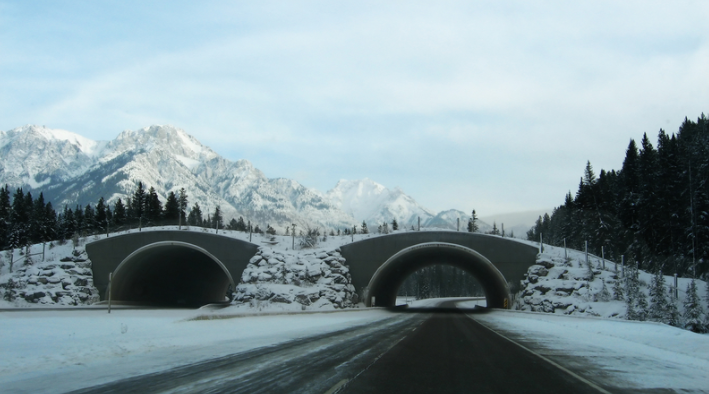
Parts of the wildlife corridors are the wildlife bridges over motorways. These are not covered by the Hunting Act. Whether a bridge or an underpass for wildlife is needed on a motorway section is examined as part of maintenance planning, says Guido Bielmann, spokesperson for the Federal Roads Office (FEDRO). “The FEDRO builds the wildlife bridges and makes them available.»
ASTRA has built between 30 and 50 green wildlife crossings, 50 metres wide, for deer, roe deer, and wild boar; nearly a dozen more are under construction or planned in the medium term. For smaller animals, such as badgers, foxes, or squirrels, it has, according to a 2019 report, «a large number» of tunnels built.
Interest Group Wild beim Wild
IG Wild beim Wild is a non-profit interest group committed to the sustainable and non-violent improvement of the human-animal relationship, with a specialisation in the legal aspects of wildlife protection. One of our main concerns is to introduce contemporary and serious wildlife management in the cultural landscape, modelled on the Canton of Geneva — without recreational hunters but with upright wildlife wardens who truly deserve the title and act according to a code of honour. The monopoly on the use of force belongs in the hands of the state. The IG supports scientific methods of immunocontraception for wildlife.
More on the subject of recreational hunting: The scientific evidence is presented in the overview Studies on the Effects of Recreational Hunting.
The position of IG Wild beim Wild: IG Wild beim Wild rejects recreational hunting. Our model is the canton of Geneva, which has managed without recreational hunting since 1974: without hunting seasons, without hunting dogs, without driven hunts, without high seats, without the animal cruelty and crime that go hand in hand with hunting season elsewhere. What has worked there for over fifty years disproves every position paper by JagdSchweiz. An association that bases its policy on claims it refutes in its own documents is not a professional organisation, but a factory for misinformation.