Wild Boar Sterilization: When Hobby Hunting Fails Due to Its Own Shortcomings
In France, the sterilization of wild boar is once again being debated. "Le Chasseur Français," one of the most traditional mouthpieces of French hobby hunting, takes up the topic and in doing so reveals more about the crisis of hobby hunting than the authors might wish. For the debate on contraception for wild boar is nothing other than an admission that hobby hunting, after decades, has failed to get a grip on the "wild boar problem" it created itself.
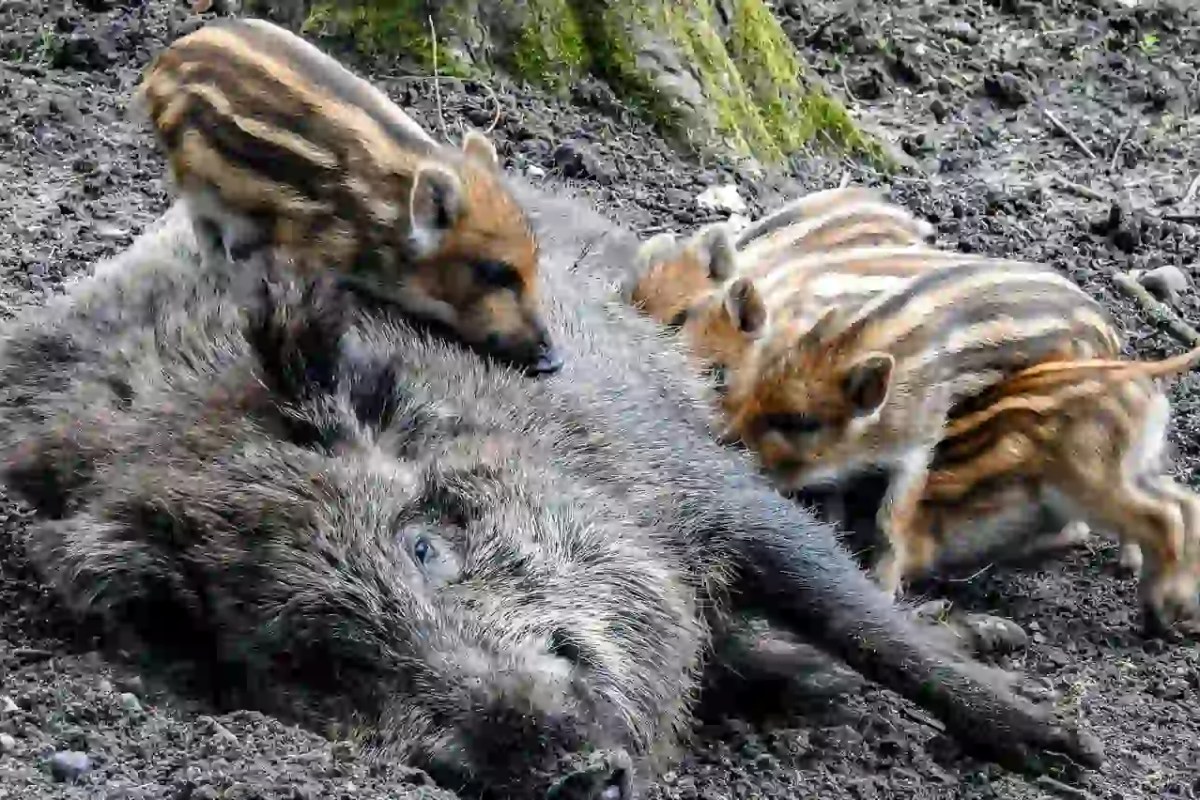
Researchers at the Universitat Autònoma de Barcelona have conducted trials with the immuno-contraceptive vaccine GonaCon on wild boar in urban and peri-urban areas.
The active ingredient triggers the formation of antibodies against the hormone GnRH, which regulates ovulation and spermatogenesis. According to the researchers, the method proved reliably effective in the treated female animals, and in young, pre-pubescent male animals the suppression even appears to be permanent. Older animals require a booster shot.
It is precisely this prospect that is causing audible grinding of teeth in hunting-affiliated media such as "Le Chasseur Français." Because if GonaCon or a similar agent were to become established on a broad scale, hobby hunting would lose its most important argument for its legitimacy: the "necessary regulation" of a wild boar population allegedly spiraling out of control.
The boomerang of their own practice
The uncomfortable truth that hobby-hunting circles are reluctant to voice: the exploding wild boar populations are to a considerable extent self-inflicted. A 22-year study by the scientist Sabrina Servanty, published in the "Journal of Animal Ecology," has proven it in black and white. In intensively hunted areas, the fertility of wild boar is significantly higher than in regions where hunting is scarce. Under heavy hunting pressure, sexual maturity sets in earlier, so that even piglet sows become pregnant. The high demographic contribution of juveniles to reproduction is therefore "very likely more a consequence of high hunting pressure than a species-specific survival strategy."
Add to this the practice of baiting. In the Altenkirchen district in Rhineland-Palatinate, during the 2006/07 hunting year, a single hunting district spread a staggering 780 kilograms of corn per wild boar shot across 22 baiting sites (source: Wildökologie Heute, 2012). Hobby hunting therefore feeds wild boar massively in order to subsequently shoot them, and then complains about excessive populations. A Czech study has impressively shown that baiting in mast years of oak and beech further fuels reproduction, because the natural food supply is supplemented by artificial feeding.
Figures that document a failure
In France, around 36,000 wild boar were shot in the 1973/74 season. In the 2020/21 season, according to the "Office Français de la Biodiversité," the figure was around 800,000 animals. An increase of more than twentyfold, and yet the population is larger than ever. In Germany, the annual cull rose from an average of 477,000 animals ten years ago to 625,000 in the 2020/21 hunting year. The population is estimated at 1.5 to 1.7 million animals, around 500,000 more than a decade ago.
Anyone who, in view of such figures, continues to claim that hobby hunting "regulates" the wild boar population is either engaging in self-deception or in deliberate misinformation. If populations rise despite a tenfold increase in cull figures, the method is obviously not the animals' problem, but part of it.
The Drôme as an inconvenient example
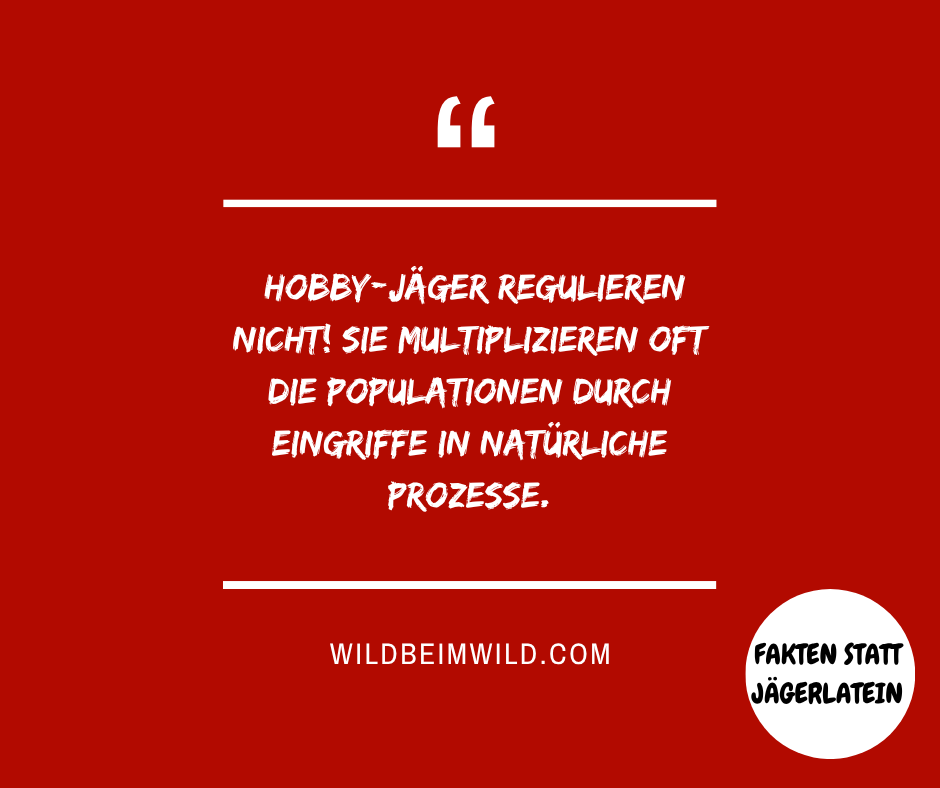
Particularly embarrassing for hobby hunting is a finding from the French département of Drôme. There, the wild boar population is unproblematic because the wolf has returned. Hobby hunters there complain that there are "too few" wild boar to hunt. This exposes the supposed intention to regulate for what it really is: a leisure need. As long as there is enough to shoot, hobby hunting is content. As soon as predators such as the wolf do the work of the alleged "regulators" free of charge and efficiently, the mood turns sour.
What the hobby hunting lobby prefers to keep quiet
As soon as the topic of sterilization comes up, the hobby hunting lobby's reaction is reflexive. Too expensive, too laborious, technically impracticable, every animal would have to be captured individually. This narrative can be refuted with a single glance at the practice used for urban pigeons.
In Belgium, the active ingredient nicarbazin has been approved since 2016 under the name R-12 and is used at over 100 sites, supported by animal welfare organizations such as GAIA and Vets For City Pigeons. In Italy, the same product has been on the market as Ovistop since 2002. Spain, France, Hungary, Malta and the Netherlands also use it. In the Brussels municipality of Ixelles, the pigeon population dropped by 40 percent in three years. In Zaventem, by 10 percent in just seven months. A 2024 Catalan study evaluated up to eight years of nicarbazin use in 24 cities, with clearly positive results. More background on this in the article on pigeon contraception instead of shooting.
The effort per site is manageable. An automatic feeder stocked with coated corn five days a week during the breeding season, that's it. The city of Cologne budgets just 23,000 euros per year for this. By comparison: the Zurich wild boar habituation enclosure in Elgg alone swallowed up 200,000 francs in investment costs, financed by taxpayers. Anyone talking about "too expensive" here has a peculiar way of keeping the books. More on this questionable project in the article "Hunting addicts get wild boar enclosure in the canton of Zurich».
Oral baits have long existed, including for wild boar
The technical argument that only injection is possible for wild boar also fails any fact check. As early as 2010, Giovanna Massei and her team developed the Boar-Operated System (BOS), a species-specific bait dispenser. A metal post with a perforated base plate and a movable cone that only wild boar can lift with their snout. Other species cannot reach the baits. In field trials, bait consumption by non-target species was prevented 100 percent of the time, while wild boar used the device regularly.
The Spanish research institute IREC also developed a special wild boar bait that is suitable for piglets and heat-resistant. The EU also has many years of experience with oral bait vaccinations, namely within the framework of the successful control programs against Classical Swine Fever in wild boar in Germany and France. In 2025, Korean researchers (Choe et al.) published a study on an oral GnRH vaccine for wild boar that simultaneously immunizes against swine fever. According to review papers by the Botstiber Institute for Wildlife Fertility Control, phage-based oral contraceptives are also a realistic option.
In other words: what has worked for decades with the oral rabies vaccination of foxes, what works for urban pigeons with Nicarbazin in several European countries, has long been technically possible for wild boar as well. What is missing is not the science, but the political will.
Kassel reveals the true pattern
The example of Kassel shows how reflexively the hobby hunting lobby opposes every alternative. In the summer of 2025, the Federal Association of Wildlife Aid Organizations launched a Europe-wide unique pilot project there for the sterilization of raccoons in Germany's secret "raccoon capital," where, according to estimates, between 10,000 and 30,000 animals live. Paid for entirely by the association, without a single cent of taxpayer money, with a total budget of about 30,000 to 50,000 euros. Scientifically accompanied by the University of Bonn. Carried out with the support of ten veterinarians and 30 volunteers, including, expressly, hobby hunters and wildlife helpers.
Methodologically sound: the animals are sterilized, not castrated. That is a crucial difference. The sexual organs are preserved; only the vas deferens or fallopian tubes are severed. This way, the animals' territorial behavior is preserved, and their places are not taken over by immigrating, reproductively capable conspecifics. Population-biologically sophisticated and exemplary from an animal welfare standpoint.
What happened? The Hessian State Hunting Association objected, and the regional council stopped the project after just a few weeks. The hobby hunting lobby's concerns regarding EU law have meanwhile been expressly refuted by the Federal Ministry of the Environment. The sterilization of invasive species is compatible with the EU regulation. Nevertheless, the project remains on hold.
The argument of the hobby hunting associations? Sterilized animals would continue to "cause damage." But the same applies to every wild boar, every fox, and every marten in German forests. By the same logic, every wild animal would have to be exterminated. What is really being defended here is not the ecosystem, but the hobby hunters' monopoly on dealing with "pest animals." A hobby hunting community that has been unable to stop the spread of raccoons for decades is blocking every alternative that could expose its failure.
The Hamburg CDU senate is examining its own sterilization project despite the Kassel halt. In Berlin too, the project "Hauptsache Waschbär e.V." has been running since 2022 with preliminary studies on sterilization. Other countries are further along: in Finland, Sweden, and Denmark, the method has been successfully used on raccoon dogs. In Italy, on nutrias. The EU platform for invasive species expressly confirms that the approach is transferable. What works there also works in Germany.
The pattern is always the same. Whether it's wild boar, raccoon, wolf, or fox, the hobby hunting lobby reflexively reaches for its veto power as soon as an alternative to shooting becomes visible. The justifications change, but the result remains: nothing must change that could weaken the position of hobby hunting. Even when committed local hobby hunters, as in Kassel, want to cooperate with animal welfare associations, the association apparatus blocks them.
Sterilization as a component of modern wildlife management
To be honest, sterilization is not a miracle cure that works overnight either. The contraceptive effect does take hold in individual animals within weeks. However, a measurable reduction of the population only emerges over several reproductive cycles, because the treated animals continue to live and only the offspring fail to appear. Acute damage in the cornfield will therefore only be reduced in a few years by today's vaccination.
But this is precisely the point. In urban and peri-urban areas, where shooting is already prohibited or cannot be justified for safety reasons, there is no quick alternative. A stochastic modeling study for the Collserola Natural Park near Barcelona has also shown that the most effective strategy is a combination: reduction of human-caused food sources (i.e. no corn at baiting stations, no open trash cans, no feeding by residents) and contraception.
What would really help
An approach to wild boar that is genuinely oriented toward animal welfare and nature conservation would look very different from current practice. A consistent ban on baiting instead of today's tolerance for mass feeding. A return to effective closed seasons so that sows can raise their piglets and the social structures of the sounders are not torn apart by indiscriminate shooting. More deterrent measures such as scent fences, electric fences around sensitive crops, and acoustic signal devices. The acceptance of natural predators such as wolves and lynx, which have a demonstrably regulating effect. And in urban and peri-urban areas, oral contraception via species-specific bait dispensers, where drive hunts with firearms are simply not justifiable.
That of all people those who have profited from the status quo for decades are blocking every one of these measures is entirely consistent. But it also reveals that hobby hunting was never primarily about regulation, but about a subsidized leisure pastime hiding behind a thin cloak of ecological rhetoric. The sterilization debate pulls this cloak aside a little further. The Kassel example shows that even the national associations are prepared to block animal welfare projects that don't fit their professional agenda. Perhaps that is the real merit of this debate. It makes visible who is really clinging to what here.