When the risk of recreational hunting becomes the norm
In recent weeks, tragic events have repeatedly occurred in Italy: in the province of Belluno, two recreational hunters died in accidents this past weekend. An 86-year-old near Selva di Cadore and a 75-year-old in the municipality of Borgo Valbelluna.
«What Begins at the High Seat»
And that is only the tip: since the start of the hunting season in the region, five deaths have been recorded over five weekends, along with countless injuries.
In the neighbouring Trentino region, too, the tragic death of 39-year-old Davide Verones occurred at the beginning of October.
Against this backdrop, the national animal welfare organisation ENPA in Italy is voicing loud criticism of recreational hunting, not only as a dangerous leisure pursuit but as a socially outdated practice without any genuine justification.
Risk in the forest for people and nature
“Roaming through the forests armed and killing animals weighing up to 200 kilograms is dangerous,” explains Ivana Sandri. “It carries risks in a natural environment that demands caution.” In both recent cases, carelessness or equipment failure was the cause: the 75-year-old fell some 30 metres while abseiling down a killed red deer; the rescue was hampered by gaps in radio and mobile phone coverage.
The organisation notes that even when recreational hunters claim to know their hunting grounds like the back of their hand, numerous, often fatal accidents still occur every year. “We want quieter and safer forests,” says Sandri – not only for the recreational hunters, but also for hikers, mushroom pickers and mountain lovers.
Spirit of the times and purpose
ENPA sees no justified function in hunting today: “Hunting is outdated. It no longer enables any family or community to earn a living.” Rather, it is a hobby in which hundreds of thousands of wild animals lose their lives each year, at a time when respect for life and the environment is called for. While an ordinary citizen is not allowed to kill a wild animal, recreational hunters are privileged to kill an inalienable asset of the state and thus of all people.
This position is not only aimed at the risk to humans, but also at the ethical question: does recreational hunting still have any legitimacy today? In a society that increasingly thinks in terms of nature conservation and recognises animal life, the deliberately chosen killing of wild animals seems anachronistic.
Time for consequences
The accumulation of serious accidents in the current season provokes a fundamental question: is it time for a turning point in hunting policy and in the handling of hunting as a whole?
Some starting points:
- Examining the purpose of hunting: if hunting no longer serves the purpose of provision, its purpose must be redefined or questioned.
- Social contract: if nature is there for everyone, how does the exclusive right to deliberately kill animals for fun fit in?
- Respect for life and nature: do we need a shift in culture and values that moves away from “bloodshed” towards coexistence with forest and wildlife?
The recent deaths are far more than isolated cases; they are warning signs. They make clear that recreational hunting, in its current form, is not only a risky leisure activity, but that it finds itself in a conflict between tradition and modernity, between preservation and change.
For IG Wild beim Wild, this means: the debate about the role of recreational hunting in 2025 has long been opened, with a clear tendency towards the sharp criticism voiced by ENPA. The forests demand safety and peace, and society demands meaning and legitimacy. Whether recreational hunting can still offer both to a sufficient degree has, once again, become a question — in Italy too.
In the view of IG Wild beim Wild, hobby hunters require annual medical-psychological aptitude assessments modelled on the Netherlands, as well as a binding upper age limit. The largest age group among recreational hunters today is 65+. In this group, age-related impairments such as declining eyesight, slowed reaction times, lapses in concentration and cognitive deficits increase markedly in statistical terms. At the same time, accident analyses show that the number of serious hunting accidents involving injuries and fatalities rises significantly from middle age onwards.
The regular reports of hunting accidents, fatal mishandlings and the misuse of hunting weapons highlight a structural problem. The private ownership and use of lethal firearms for recreational purposes largely evades any continuous oversight. From the perspective of IG Wild beim Wild, this can no longer be justified. A practice based on voluntary killing while simultaneously creating considerable risks for people and animals loses its societal legitimacy.
Hobby hunting is moreover based on speciesism. Speciesism describes the systematic devaluation of non-human animals solely on the basis of their species membership. It is comparable to racism or sexism and can be justified neither culturally nor ethically. Tradition is no substitute for moral scrutiny.
It is precisely in the field of recreational hunting that critical scrutiny is indispensable. Scarcely any other field is so shaped by sugar-coated narratives, half-truths and deliberate disinformation. Where violence is normalised, narratives often serve to justify it. Transparency, verifiable facts and an open public debate are therefore indispensable.
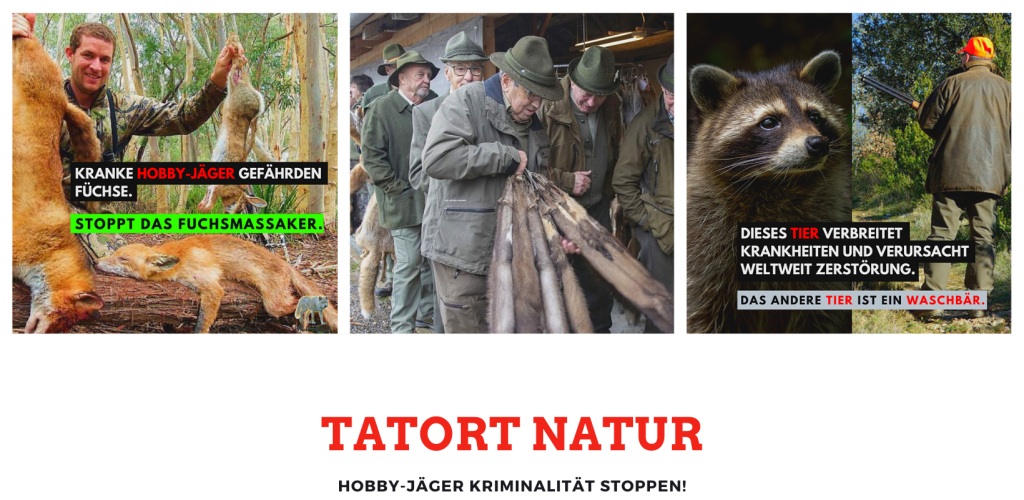
More on the subject of recreational hunting: In our dossiers on the criticism of recreational hunting gather fact-checks, analyses and background reports. The scientific evidence is presented in the overview Studies on the Effects of Recreational Hunting.
The position of IG Wild beim Wild: IG Wild beim Wild rejects recreational hunting. Our model is the canton of Geneva, which has managed without recreational hunting since 1974: without hunting seasons, without hunting dogs, without driven hunts, without high seats, without the animal cruelty and crime that go hand in hand with hunting season elsewhere. What has worked there for over fifty years disproves every position paper by JagdSchweiz. An association that bases its policy on claims it refutes in its own documents is not a professional organisation, but a factory for misinformation.