When partridges fall in love: mating season has begun
The mating season of the grey partridge has begun. These highly endangered birds are finding fewer and fewer suitable habitats in the increasingly barren agricultural landscape.

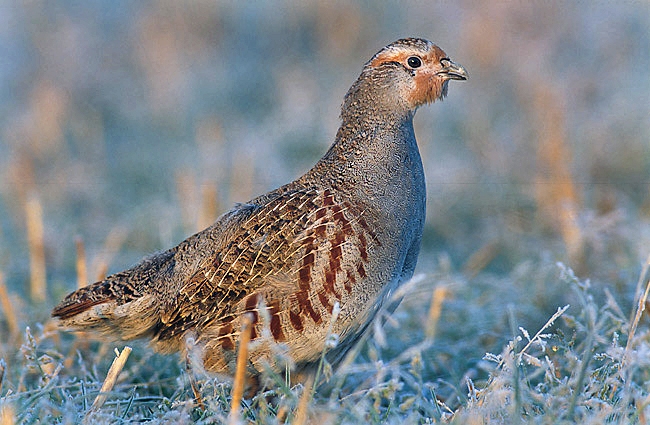
What does the grey partridge cock have that other males don't? He doesn't make eyes at the ladies quite like the capercaillie, and he can't dance as impressively as the black grouse — yet he wins hearts through modesty, loyalty, and dependability. The grey partridge is also monogamous. Once he has found his beloved, he wastes no time and courts her straight away.«Partridges are now beginning to take a keen interest in the opposite sex«, says Eva Goris, press officer of the Deutsche Wildtier Stiftung (German Wildlife Foundation). On Valentine's Day, it's all about courtship out in the fields.
Among grey partridges, the choice lies with the females. The hens are in the minority — and the cocks have to put in quite an effort to succeed. «Passion and decisiveness go down well with the ladies«, explains Eva Goris. First, the cocks make contact with rivals using loud «Kiereck» calls. «Rivals are sought out and challenged«, says Goris. The cocks then fight one another to establish the pecking order, as dominant males have the best chances with the hens.«Once it's clear who is the strongest, the flirting begins«, says Goris. «And it's pure Hollywood». He stretches himself up as tall as possible in front of his chosen one, beak open, gazes deep into her eyes, and directs his courtship call solely at her. A soft «Gru» is heard. If a hen is interested in her Valentine's date, she gazes intently into the cock's face.
Grey partridge cocks may not be the most striking of lovesick birds, with their earthy brown camouflage plumage, but the ladies can certainly rely on them. «He guards the hen while she incubates the eggs, protects his chicks from enemies when they hatch after around 30 days, and lures them over with insect food«, explains Eva Goris. «Partridges live in family groups called coveys.» As many as ten to twenty chicks belong to the «family,» which consists either of a parent pair with their grown young from the previous summer, or of small groups of singles and unsuccessful pairs.
«Most pairs form around the turn of February to March», says Eckhard Gottschalk from the partridge project «PARTRIDGE» at the University of Göttingen. «Often the entire population pairs up within one or two weeks.» Only the males left without a female continue to roam into spring, calling and hoping for their chance — for instance when another male meets with an accident. All the excitement, the calling, the fighting, chasing, and running about is very risky for partridges. Birds of prey and mammalian predators are easily alerted to the commotion.For this reason, partridges shift the most intense phase of their courtship to the twilight hours, when birds of prey are already asleep and there is just enough light to make out the silhouette of an approaching fox. Morning and evening, this most intense period of mate-searching lasts only half an hour each — a true speed-dating event!
[toggle title=»Infobox:» load=»show»]The international PARTRIDGE project aims to demonstrate that it is possible to increase biodiversity in agricultural landscapes by 30%. The benchmark for the project's success is the development of the partridge population. In the studied landscapes, approximately seven percent of the land area is enhanced for the benefit of wildlife.
Alongside the «Game and Wildlife Conservation Trust» as the lead organization of the umbrella project, and demonstration regions in England and Scotland, institutions from Belgium, the Netherlands, and Germany are participating in the project. PARTRIDGE is funded through the EU Interreg North Sea Programme. In Germany, the Department of Conservation Biology at Georg-August-Universität Göttingen is supported by the Deutsche Wildtier Stiftung and the Deutscher Jagdverband.[/toggle]