When a Hunting Licence and a Pistol Become a Deadly Threat
A case from Waldsassen and the blind spots in our security debate.


On the morning of a December day in Waldsassen, in the Upper Palatinate district of Tirschenreuth, a shot is fired at close range inside a residential building.
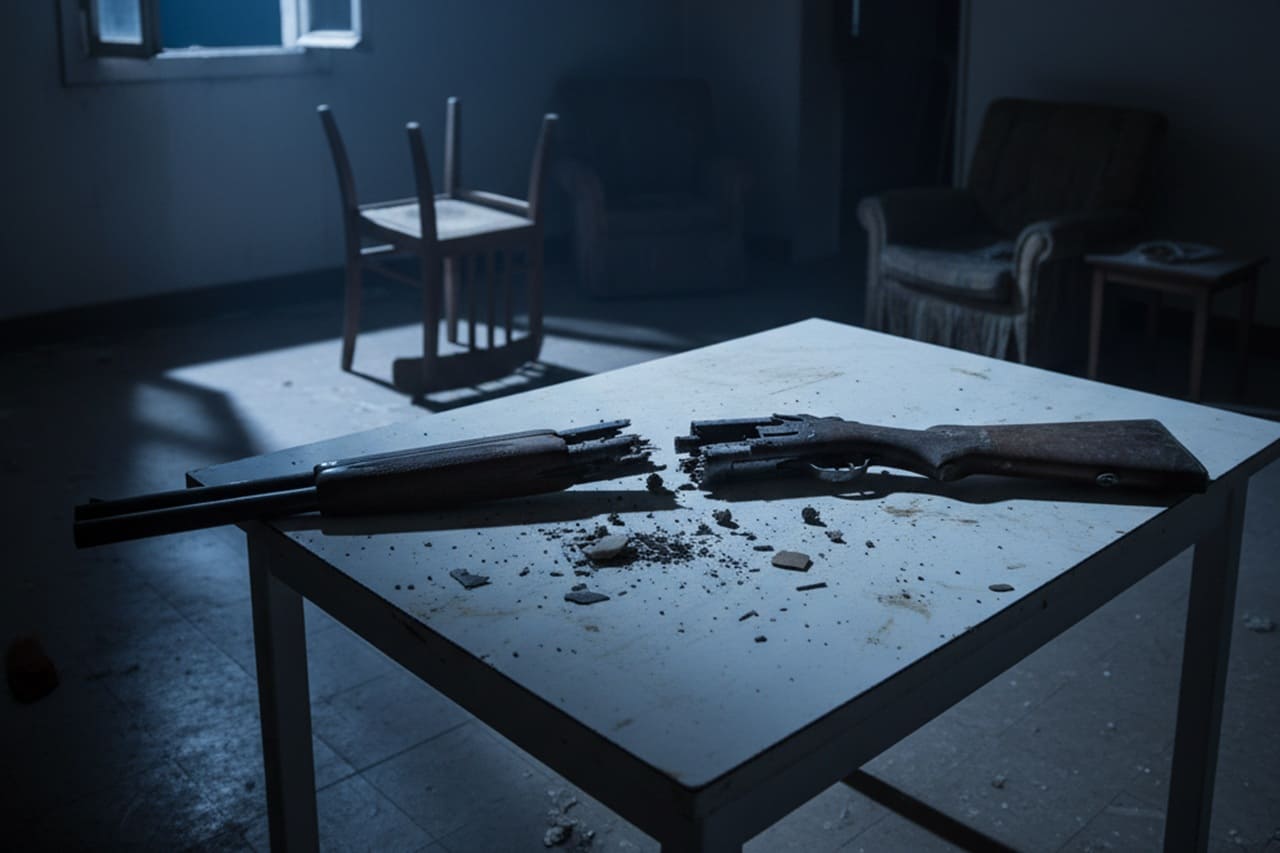
A 64-year-old man collapses in his flat and dies. Shortly afterwards, a 67-year-old neighbour walks to the police station and confesses. He is a recreational hunter, holds a valid hunting licence, and legally owned the murder weapon — a 9-millimetre pistol. Investigators find additional firearms in his flat.
The suspect and the victim live in the same building, on different floors. The public prosecutor's office is proceeding on the basis of premeditation; the man is in pre-trial detention on suspicion of murder. According to regional media, the alleged shooter has been known in Waldsassen for years as a difficult character who repeatedly clashed with others. He is one of approximately 900 hunting licence holders in the district of Tirschenreuth.
This case is more than a tragic act of neighbourly violence. It illustrates the social risks that arise when a segment of the population enjoys privileged access to firearms and recreational hunting serves as the justification.
Firearm Ownership Without Effective Oversight Mechanisms
What at first glance appears to be a tragic dispute between two men raises, on closer inspection, fundamental questions about firearms regulation in Germany. The official police statement notes only briefly that the 67-year-old possessed a firearm legally, by virtue of holding the corresponding firearms ownership card as a hunter.
This information is not incidental. It shows that a man with legal firearm ownership was able to commit a fatal act that escalated from a personal conflict. For many citizens who strictly abide by existing laws, this is difficult to accept: if even a lawful firearm owner is capable of shooting someone in the head, how safe are other people who are not part of this privileged group?
In the aftermath of the crime, several firearms were seized during a search of the premises. Experts from the State Criminal Investigation Office are currently supporting the investigation to determine the exact sequence of events.
Hunting ideology vs. social responsibility
The fact that the suspect holds a hunting licence adds an additional dimension of controversy: hunting in Germany is still widely romanticised as a 'tradition' or a 'contribution to nature conservation'. Yet where is the critical examination of the fact that it was precisely someone with access to multiple firearms and ammunition who found himself in a situation that cost a human life?
A society that permits certain individuals to carry firearms, justifying this with arguments such as 'wildlife management and stewardship', must ask itself whether in doing so it is not simultaneously creating the very conditions for the kind of escalations it actually seeks to prevent.
A legal and political standstill
Mental health crises, interpersonal conflicts and outbursts of violence do occur — but why did a man in a 'life crisis' gain access to multiple firearms without this being prevented? What role do social isolation and inadequate support systems play, particularly in rural regions such as the Upper Palatinate?
It must be questioned whether a hunting licence is in itself considered sufficient justification for possessing multiple lethal weapons. Why are there no effective control mechanisms that go beyond the mere possession of a hunting licence? For as this case demonstrates, a single pistol can cost a person their life.
Swiss studies on firearm killings in the domestic sphere show that the perpetrators are almost exclusively men, predominantly Swiss nationals over the age of 60. A study by the University of St. Gallen concludes that in 61 percent of these acts, the perpetrators subsequently take their own lives.
In other words: it is frequently older men with legal access to weapons who exercise lethal violence during a personal crisis and subsequently take their own lives. The age range of the Waldsassen suspect fits precisely into this pattern.
Violence researchers have been pointing out for years that the mere availability of weapons is a decisive risk factor for lethal violence. In a specialist lecture on intimate partner violence, citing the WHO, it is summarised as follows: Easy access to weapons increases the likelihood of lethal violence.
Not isolated cases, but a pattern
Deadly acts of violence involving legal weapons are not uncommon. They run consistently through the statistics, yet are rarely discussed in the context of hunting. The fact that a 'recreational hunter' of all people became a gunman in a civilian conflict is no coincidence, but a warning signal: the social acceptance of weapon ownership within the framework of recreational hunting is not being scrutinised critically enough.
The Waldsassen case lines up in a series of incidents in which legal weapon owners become perpetrators. According to current findings, the alleged gunman had no prior criminal record, but was regarded locally as a person prone to conflict.
Precisely such constellations are well known in violence prevention: older men, firmly rooted in traditional gender roles, holding recognised status as hunters or marksmen, and exhibiting unresolved conflict behaviour. Combined with easy access to a pistol, this creates a highly dangerous situation that is statistically rare, but irreversible for those affected.
The usual counter-arguments from hunting and weapons lobby circles fall short:
- Pointing to illegal weapons does not resolve the fact that in rural regions it is primarily legal hunting and shooting clubs that account for the presence of firearms.
- Citing the low percentage of offences committed with registered weapons disregards the fact that these involve particularly grave acts, namely homicides.
- The claim that legal weapon owners are virtually harmless ignores empirical findings from the domestic sphere.
The discussion must go beyond romanticising recreational hunting as a tradition. Instead, what is needed is an open debate about the risks, responsibilities, and limits of weapon ownership in our society.
In the view of IG Wild beim Wild, hobby hunters annual medical-psychological fitness assessments modelled on the Dutch system, as well as a binding upper age limit. The largest age group among recreational hunters today is 65+. In this group, age-related impairments such as declining vision, slowed reaction times, reduced concentration and cognitive deficits increase statistically and significantly. At the same time, accident analyses show that the number of serious hunting accidents involving injured persons and fatalities rises significantly from middle age onwards.
The regular reports of hunting accidents, fatal errors and the misuse of hunting weapons illustrate a structural problem. The private ownership and use of lethal firearms for recreational purposes largely escapes continuous oversight. From the perspective of IG Wild beim Wild, this is no longer justifiable. A practice based on voluntary killing that simultaneously generates considerable risks for humans and animals forfeits its social legitimacy.
Hobby-hunting is furthermore rooted in speciesism. Speciesism describes the systematic devaluation of non-human animals solely on the basis of their species membership. It is comparable to racism or sexism and can be justified neither culturally nor ethically. Tradition does not substitute for moral scrutiny.
Critical scrutiny is particularly indispensable in the realm of recreational hunting. Few other fields are so thoroughly shaped by euphemistic narratives, half-truths and deliberate disinformation. Where violence is normalised, narratives frequently serve as justification. Transparency, verifiable facts and open public debate are therefore essential.
Unterstütze unsere Arbeit
Mit deiner Spende hilfst du, Tiere zu schützen und ihrer Stimme Gehör zu verschaffen.
Donate now →