What is drive hunting and why is it problematic?
High error rates, animal suffering and structural problems.

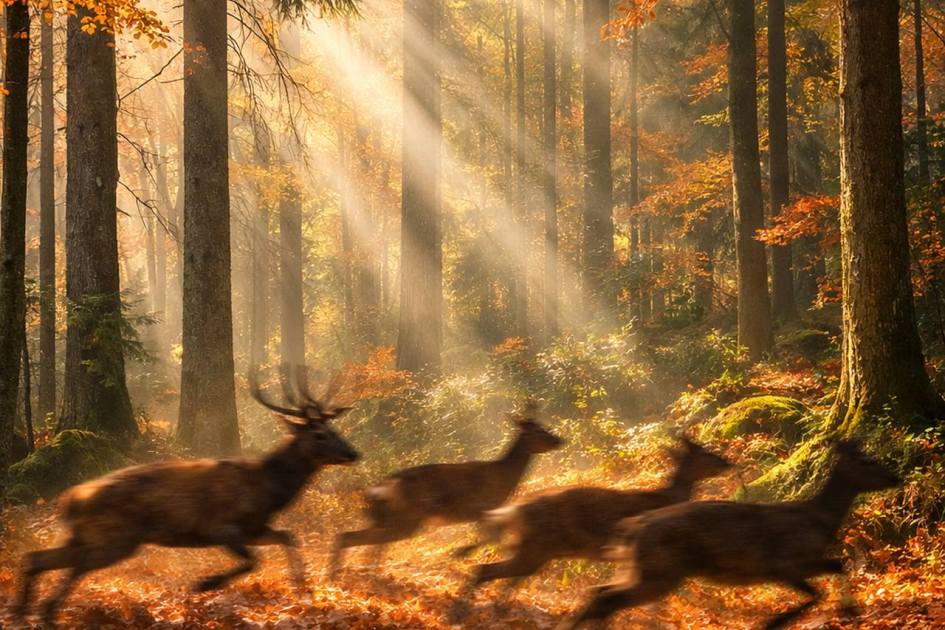
Drive hunts force wild animals through human chains, noise and dogs into shooting fields, where the error rate of shots is structurally high and tracking wounded animals has become the norm.
What are drive hunts?
Drive hunting is the umbrella term for hunting methods in which wild animals are actively flushed from their natural environment and driven toward shooter lines. The most common variants are the battue hunt, where a chain of beaters drives wild animals toward waiting shooters, as well as the drive hunt, where fewer beaters or dogs move the game forward more slowly. The barrier hunt is a variant where animals are driven toward specific passes or bottlenecks.
Common to all these forms is the basic principle: flight, panic and time pressure are not side effects, but the actual method. Shots are fired at fleeing animals, often with restricted visibility, in short time windows and under group expectation pressure.
Which animals are affected?
Drive hunts target primarily roe deer, red deer, wild boar, foxes and hares. Particularly the high hunting season in Switzerland regularly includes battue and drive hunts in mountain regions, where animals come under massive hunting pressure in confined spaces during autumn. In Graubünden alone, around 790 missed shots were documented in the 2022 hunting year for approximately 9,200 killed animals, meaning every tenth animal was not cleanly killed but wounded.
Wild boar in Switzerland are not subject to closed seasons and can be hunted year-round, enabling drive hunts on this species throughout the year.
What happens to animals under stress?
The consequences of flight and hunting stress are severe for wild animals. Studies from Scotland and Scandinavia document elevated cortisol levels in hunted red deer compared to undisturbed populations. The flight reflex costs energy that is vital for survival, especially during autumn and winter months. Milk production and parent-offspring bonds are disrupted. Leading mothers killed during drive hunts leave behind helpless young animals.
The Swiss Animal Welfare Act (AWA) explicitly mandates in Article 3 and Article 4 to spare animals unnecessary suffering, fear and pain.Hunting and animal welfare thus stand in structural contradiction: What the law actually prohibits becomes method in driven hunts.
What is the error rate for shots?
Shots at fleeing animals are fundamentally more unsafe than shots at resting or feeding animals. In driven hunts, several risk factors converge: changing target speed, unclear background conditions, multiple shooters in immediate proximity and social pressure to act quickly.
The tracking rate, the proportion of animals that must be pursued after a shot because they do not immediately drop dead, is considered in expert circles as a proxy for the miss rate. In Graubünden, according to the Office for Hunting and Fisheries, around 1,100 tracking operations per year are documented, with a success rate of around 50 percent. This means: Annually in a single canton, a considerable number of wounded animals remain in the terrain and die a slow death. Reports by the Veterinary Association for Animal Welfare (TVT) estimate that in driven hunts up to 70 percent of animals do not die immediately.
What safety risks arise for humans?
Driven hunts are dangerous not only for wildlife. Since multiple shooters simultaneously shoot at moving targets, the risk of ricochets, misidentifications and accidents increases considerably. Documented cases show how hobby hunters during driven hunts 'peppered' villages, how walkers ended up in lines of fire or how beaters were hit by shotgun pellets.Hunting accidents in Switzerland show that driven hunts structurally represent the most accident-prone form of hunting.
In Carinthia in October 2025, a 16-year-old youth was deployed as a beater and hit by shotgun pellets on the upper body. Such events illustrate what happens when armed hobby hunters operate in communally used forests without paths being closed or residents being informed.
What is the legal framework in Switzerland?
The regulation of drive hunts in Switzerland is fragmented across cantons. There is no uniform federal obligation to inform the public, no mandatory closure of hiking trails, and no central statistics on missed shots and tracking.Hunting laws and control demonstrate that self-supervision of recreational hunting systematically fails in this area: violations are rarely reported, even more rarely prosecuted.
The canton of Graubünden recorded over 1,000 fines and 95 criminal charges against recreational hunters in a single year. License revocations remained largely absent nonetheless. This shows: The sanction culture remains symbolic as long as independent oversight is lacking.
What role do hunting dogs play?
Hunting dogs are indispensable in many drive hunts: They drive wild animals out of cover, pursue wounded animals and assist in tracking. In doing so, they themselves are subjected to considerable stress.Hunting dogs: deployment, suffering and animal welfare shows that dogs are driven into shooting fields during drive hunts, risk injuries and in extreme situations are also shot. The use of dogs additionally increases stress levels for wild animals, as they trigger species-appropriate flight movements that intensify hunting pressure.
How does the public react?
Public acceptance of drive hunts is low. Surveys show that a majority of the Swiss population is critical of recreational hunting. Drive hunts are considered controversial even within recreational hunting circles themselves. In cantons like Solothurn there have been parliamentary initiatives to ban drive hunts, a sign that political pressure is also mounting.
Are there alternatives?
Yes. The wildlife ranger model and the Geneva model show that wild animal populations can be regulated without recreational hunting and without drive hunts. In the canton of Geneva, which has not permitted recreational hunting since 1974, no overpopulations have been documented. Instead, Geneva records the highest hare density in Switzerland and the last intact partridge population. Predators like wolves and lynx also assume natural regulatory functions that do not require drive hunts.
What do animal welfare organizations demand?
The demands are clear: ban on driven hunts and battue hunts near settlements, hiking trails and protected areas; mandatory closure of paths before driven hunts; uniform, public statistics on missed shots and wounded game tracking; independent supervision instead of self-regulation. Furthermore, animal welfare organizations demand that driven hunts be systematically reviewed for their compatibility with the Animal Welfare Act, particularly Article 4 (suffering, fear, pain).
Template texts for hunting-critical initiatives in cantonal parliaments can be found at wildbeimwild.com/mustertexte.
Conclusion
Driven hunts are the most disruptive, accident-prone and most problematic hunting form from an animal welfare perspective. The error rate in shooting is structurally high, wounded game tracking is not exceptional, and the safety risks for the public are systematically underestimated. The cantonal regulatory fragmentation prevents a nationwide overview. As long as no independent supervision, no mandatory statistics and no uniform safety standards exist, driven hunting remains an unregulated risk for wildlife and humans alike.
Sources
- JSG (SR 922.0): Federal Act on Hunting
- TSchG (SR 455): Animal Welfare Act, particularly Art. 3 and Art. 4
- Cantonal hunting laws and hunting ordinances
- Office for Hunting and Fishing Graubünden: hunting reports, wounded game tracking and fine statistics
- Veterinary Association for Animal Welfare (TVT): statements on battue hunts
- Police report District Klagenfurt-Land, October 18, 2025 (driven hunt accident Carinthia)
Further Content
- Driven Hunt in Switzerland
- Hunting Accidents in Switzerland
- High Hunt Switzerland
- Hunting and Animal Welfare
- Hunting Dogs: Use, Suffering and Animal Welfare
- Hunting Laws and Control
Support our work
With your donation you help protect animals and give voice to their concerns.
Donate now →