Violent assault on activist during driven hunt
Hunt Watch condemns intimidation, threats and physical violence.

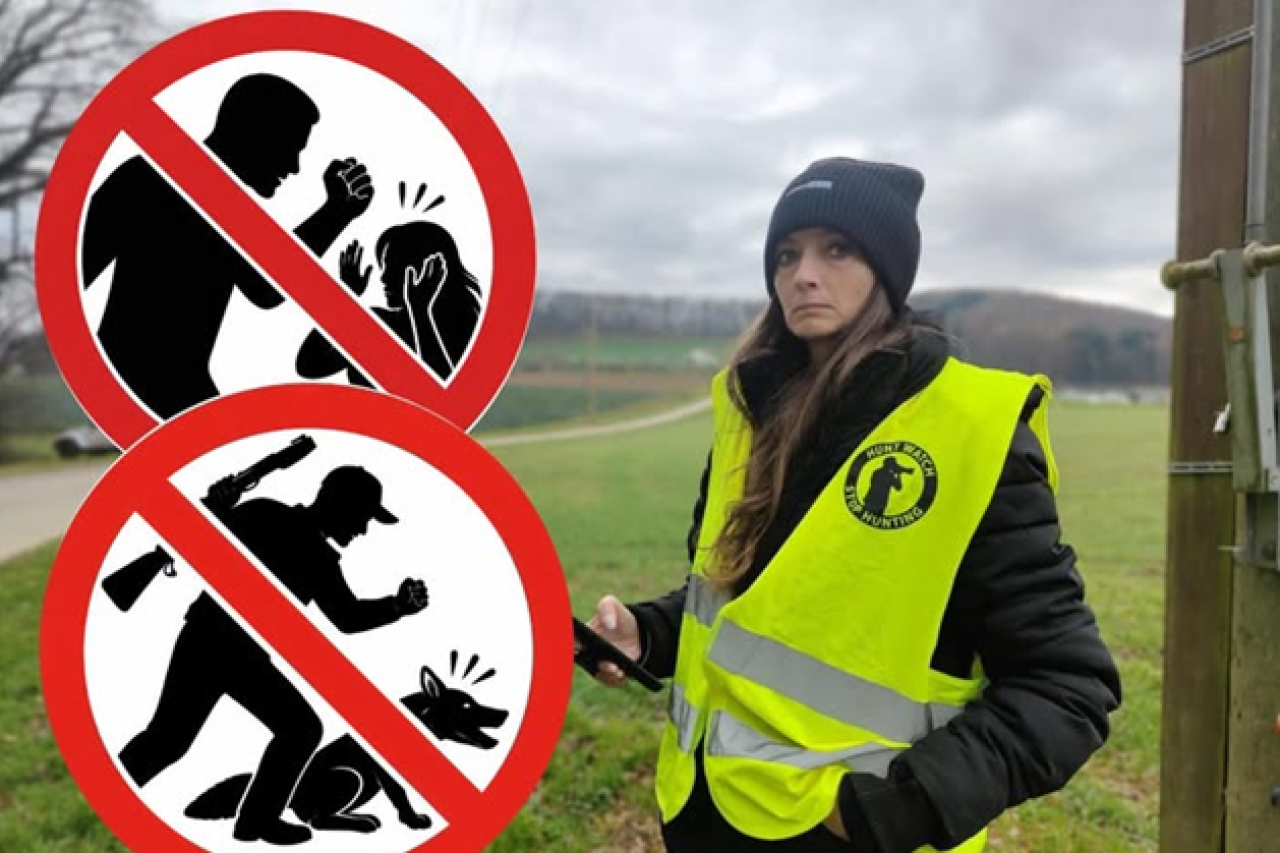
On the morning of 17.12.2025, a violent assault on a peaceful Hunt Watch activist took place during a driven hunt observation in the area of Füllinsdorf and Arisdorf (BL).
The activist was alone on a public forest path, documenting the hunting activity, when she was verbally confronted by a beater participating in the hunt.
What has been documented so far
What followed were serious boundary violations. The man insulted and threatened the activist and was physically aggressive on two occasions. He ultimately grabbed her roughly and threw her forcefully to the ground. The activist briefly lost hold of her mobile phone in the process. The incident was documented on video.
Another beater present witnessed the assault and intervened verbally, demanding that the attacker leave the activist alone.
During the incident, the man was holding a stick-like object with a metal rake attached. He also appeared to be carrying a longer bladed weapon on his belt. These objects were not actively deployed. The incident nevertheless raises serious questions about this individual's personal suitability to participate in hunts and about the handling of potentially dangerous objects.
It is a fundamental principle of a constitutional state that no one oversees themselves. This very principle is undermined in recreational hunting repeatedly undermined. Recreational hunters engage in activities in which animals are killed, firearms are used, and which take place in public spaces. These are highly sensitive areas that must necessarily be subject to external, neutral oversight. No one would accept that: drivers judge their own traffic offences, police officers investigate without external oversight, companies independently monitor their own environmental obligations. Why should recreational hunting be the exception? Oversight by bodies close to the hunting establishment is therefore not neutral, but structurally compromised.
Explosive: possible role of the alleged perpetrator
Particularly explosive is the fact that, according to research by Hunt Watch, the alleged perpetrator is reported to be an out-of-canton hunting warden and game warden.
For the legal classification, it is decisive whether a person is actually officially appointed and in what capacity they are acting. Designations such as 'game warden' or 'hunting warden' are sometimes used imprecisely in public communication.
Legal classification in brief
A game warden or hunting warden exercises official authority only within their own canton. In another canton, they have no official powers. They may neither carry out inspections there, nor issue directives or exercise coercion. As soon as a person acts outside their own canton, they are in principle regarded as a private individual.
Physical violence, threats or intimidation are punishable offences, even in the hunting context, and may also give rise to civil law claims. The question of personal suitability for an official position may furthermore become relevant under employment law in the event of a violent incident.
Particularly problematic is the carrying of objects with the potential for violence: stick-like devices, rakes, knives or bladed weapons are not hunting weapons in the strict sense. Carrying them may, depending on the situation, be assessed as a threatening display or a danger to others. In combination with aggressive behaviour, this may be relevant under criminal law. It is unacceptable that the recreational hunters effectively set their own rules and police themselves. Those who carry weapons, kill animals and act in public spaces must be subject to clear, external state oversight. Anything less contradicts the principles of the rule of law.
Criminal complaint filed, video handed over to the authorities
Hunt Watch condemns this assault in the strongest possible terms. Intimidation, threats and violence against people are unacceptable in any situation and cannot be justified under any circumstances.
The activist concerned immediately filed a criminal complaint with the police of the canton of Basel-Landschaft. The video footage was made available to the law enforcement authorities.
The driven hunt continued despite the incident. Hunt Watch remained present on site with a team.
Protection of those affected takes priority
In the hours following the assault, the situation escalated further. The activist was contacted privately on multiple occasions and subjected to severe intimidation. As a result of this threat situation, she found herself compelled to obtain a contact and restraining order from the competent civil court in order to better protect herself.
To protect those affected, Hunt Watch has decided to temporarily disable the published video footage of the assault.
Hunt Watch cannot be intimidated. At the same time, it is a duty to protect the people who document hunting activity on the front lines and are regularly subjected to hostility.
We trust that the competent authorities will fully investigate the incident, provide effective protection for those affected, and hold those responsible to account.
FAQ: Hunting observation and the rights of the public
Is it permitted to observe hunts in Switzerland?
Yes. Observing hunts is generally permitted, provided it takes place from publicly accessible paths or areas. Forests in Switzerland are generally open to the public. Merely observing or documenting a hunt does not constitute interference.
Is it permitted to film or photograph recreational hunters?
Yes, filming and photographing is permitted in public spaces. The conditions are that:
- no dangerous situations are created
- no deliberate obstruction of hunting activity occurs
- personal rights are respected, particularly when publishing recordings
The production of visual material for the purpose of documenting an event is permissible. In the case of a hunt conducted with firearms, a legitimate public interest is readily justifiable, particularly where questions of safety, animal welfare or lawful conduct are concerned.
Important:
Filming in itself does not justify threats or physical interference.
May one be ordered away or checked by hunting participants?
No. Hunting participants have no police authority. They are neither permitted to check persons' identification, issue orders to leave, nor intimidate anyone. Sovereign authority rests exclusively with the competent authorities and only within the scope of their legal jurisdiction. A recreational hunter has no police authority to damage, confiscate, or destroy another person's property.
What rules apply to out-of-canton hunting wardens or game wardens?
Official authority applies exclusively within one's own canton. Outside their canton, game wardens or hunting wardens act legally as private individuals and have no special rights with respect to the public.
What to do in cases of threats, coercion, or violence?
- Create distance and prioritize personal safety
- Document the incident where possible
- Contact the police
- File a criminal complaint in cases of injury or threat
Violence, threats, and intimidation are criminal offences, regardless of the hunting context. Escalatory conduct harms not only one's own position, but the entire practice of hunting. Physical intervention would be unlawful even in cases of unauthorized filming. Regardless, the incident reveals a structural problem in the way some recreational hunters handle public scrutiny.
Is it permitted to actively disrupt hunts?
No. Actively disrupting a lawful hunt may constitute a criminal offence. However, passive observation and documentation from public pathways is permitted. Merely filming or observing is generally not considered active disruption, particularly when no wildlife is visibly disturbed.
What is Hunt Watch?
Hunt Watch documents hunting activities in public spaces and advocates for the protection of people and animals. Its activities are carried out nonviolently, transparently, and within the framework of applicable law.