TIR criticizes Federal Council report on the assessment of fur labeling
The Swiss Federal Council has published its report on the mandatory fur labeling requirement in fulfillment of two parliamentary postulates. In March 2015, it was commissioned by the Council of States to examine alternatives to the mandatory labeling of fur products in order to curb the import and sale of fur products produced through animal cruelty. The Foundation for the Animal in Law (TIR) considers the results presented in the report


The Swiss Federal Council has published its report on the mandatory fur labeling requirement in fulfillment of two parliamentary postulates. In March 2015, it was commissioned by the Council of States to examine alternatives to the mandatory labeling of fur products in order to curb the import and sale of fur products produced through animal cruelty. The Foundation for the Animal in Law (TIR) considers the results presented in the report to be highly unsatisfactory.
Although the majority of the Swiss population clearly rejects the cruel methods of keeping, trapping, and killing fur animals, the sale of fur goods has experienced a renaissance. Fur is now produced in large quantities at low cost and has therefore become affordable.
It now serves almost exclusively as decoration on textiles and fashionable accessories.
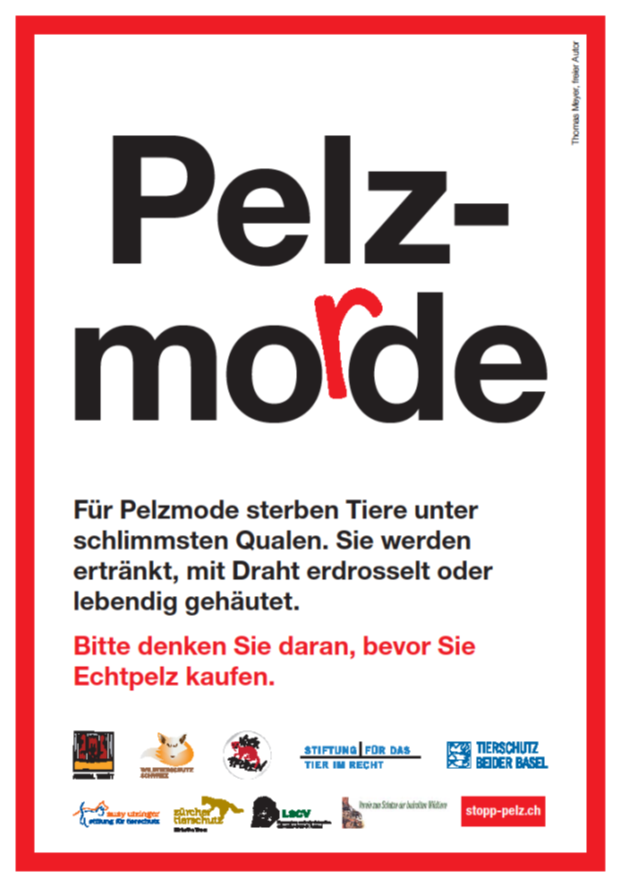
Since 2014, a nationwide mandatory labeling requirement for fur products has been in place, intended not least to reduce demand for fur products made through animal cruelty and thus contribute to a reduction in corresponding imports. In recent years, however, it has become clear that the labeling ordinance is failing to achieve this goal.
In December 2014, three motions on this topic were therefore submitted to parliament at once. The postulate «Preventing the import and sale of fur products produced through animal cruelty» by Council of States member Pascale Bruderer Wyss (SP/AG), which was adopted by the Council of States on 17 March 2015, commissioned the Federal Council to examine alternatives to labeling for fur products so that the import and sale of fur products produced through animal cruelty could be halted. In particular, a ban on placing such products on the market was to be assessed.
After three years, the Federal Council's report has now been published. Its conclusion, however, is disappointing: in the Federal Council's view, the Fur Labelling Ordinance fulfils its information function — a conclusion it draws primarily from a written survey of 103 retail outlets previously inspected by the Federal Food Safety and Veterinary Office (FSVO). While interviews were also conducted with FSVO enforcement officers, SwissFur, two fur retailers, the Swiss Animal Protection organisation, and TIR, these are summarised only briefly in the underlying study on which the Federal Council's report is based.
The Federal Council is opposed to an import or sales ban on fur products produced through animal cruelty, on the grounds that such measures could give rise to trade disputes. Of course, the risk of such disputes can never be entirely ruled out when trade-restrictive measures are introduced, and the outcome of any potential legal proceedings can never be predicted with certainty. However, applying this line of reasoning would effectively preclude all trade restrictions in every sector, rendering the exception clauses contained in the relevant trade agreements obsolete. With regard to fur products produced through animal cruelty, TIR has conducted a comprehensive legal opinion examining all relevant international provisions and free trade agreements in detail, and has clearly concluded that such a ban would be compatible with international trade obligations. This legal opinion, developed in collaboration with various subject-matter experts, is, however, entirely disregarded in the Federal Council's report.
Furthermore, the Federal Council takes the view that import and sales bans are less effective in bringing about a lasting resolution of animal welfare violations in countries of origin than participation in the relevant international bodies. Regrettably, however, in TIR's assessment, Switzerland's aforementioned efforts have so far produced no improvement whatsoever for the animals concerned — quite the contrary: since fur production in Asia has literally flooded the market with cheap goods, the animal welfare problem has in fact worsened dramatically, as China does not even have the most basic animal welfare regulations.
The Federal Council also argues against introducing a ban on the import and placing on the market of fur products produced through animal cruelty, citing the associated implementation problems, since controls abroad would be difficult. However, the same naturally applies to the declaration requirement: there is no guarantee whatsoever that the information provided by suppliers is accurate. The Federal Council leaves it to retailers and consumers to assess the credibility of the information on fur labels. Against the backdrop of the Federal Council itself referring in its report to indications that buyers are not consistently given reliable information, the TIR considers this approach to be extremely concerning.
Ultimately, the Federal Council acknowledges a certain need for action in the area of information and awareness-raising on the topic of fur, though it considers this primarily the responsibility of the fur industry and interested parties. Nevertheless, the Fur Declaration Ordinance is to be amended in several respects. A new development is the introduction of the term «real fur». In addition, the terminology relating to methods of obtaining fur is to be slightly revised: the misleading terms «cage housing with natural floors», «pack housing» and «herd housing» are to be reworked. Finally, in cases where retailers are unable to obtain the required labelling information from suppliers, an exemption from full declaration is to be permitted.
What the TIR also finds difficult to comprehend is the clear conclusion, which is far less nuanced than the explanations and the underlying material referenced in the report. Overall, the conclusion therefore appears biased, raising doubts as to whether the Federal Council ever seriously considered an alternative to the fur declaration requirement. The TIR draws a sobering conclusion from the report: Switzerland is insisting on a declaration system it cannot verify and which — as the report itself concedes — has thus far barely led to any changes in consumer purchasing behaviour.
Weitere Informationen:
Bericht des Bundesrats zur Pelzdeklarationsverordnung
Medienmitteilung des Bundesrats vom 23.5.2018
Evaluation der Pelzdeklarationsverordnung im Auftrag des BLV
Rechtsgutachten der TIR zu Handelsbeschränkungen
für tierquälerisch erzeugte Pelzprodukte
Pelzdeklarationsverordnung
Kampagnenseite "Stopp Pelz"
More on the subject of recreational hunting: The scientific evidence is presented in the overview Studies on the Effects of Recreational Hunting.
The position of IG Wild beim Wild: IG Wild beim Wild rejects recreational hunting. Our model is the canton of Geneva, which has managed without recreational hunting since 1974: without hunting seasons, without hunting dogs, without driven hunts, without high seats, without the animal cruelty and crime that go hand in hand with hunting season elsewhere. What has worked there for over fifty years disproves every position paper by JagdSchweiz. An association that bases its policy on claims it refutes in its own documents is not a professional organisation, but a factory for misinformation.