The Little Owl – from «pest» to beloved species
Just a few decades ago, the little owl was on the brink of extinction in Switzerland. Today, the small, nocturnal owl once again occupies 161 territories – a new record high in over 40 years. Yet the future of the little owl remains uncertain.

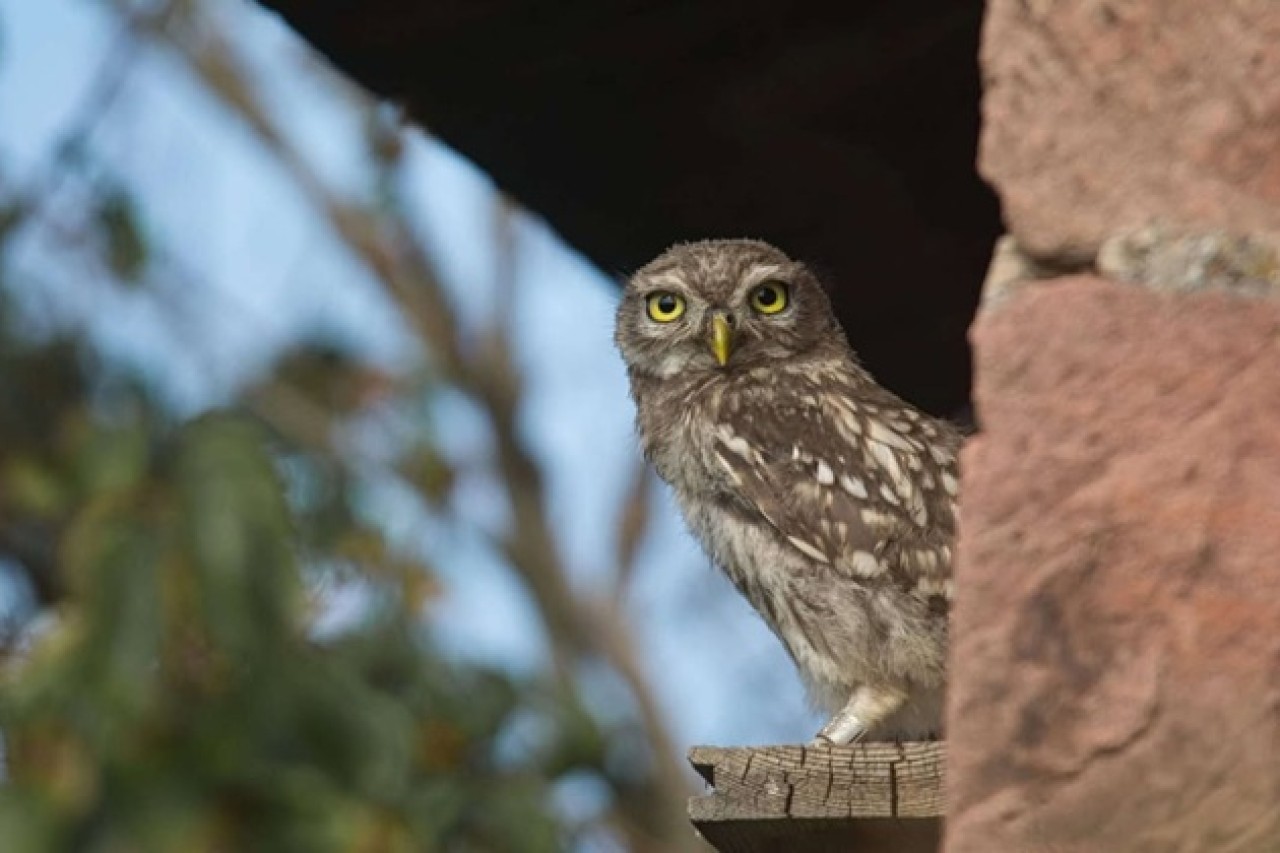
Until the mid-20th century, the little owl was a familiar bird of the cultivated landscape in Switzerland.
Estimates suggest more than 1,000 territories existed. But with the disappearance of traditional orchards, the intensification of agriculture and the removal of landscape structures, the population collapsed dramatically.
An additional threat compounded the decline: persecution by humans. Like many owl species, the little owl was long regarded as a «pest». Farmers suspected it of hunting songbirds or even raiding the henhouse – a misconception, since the little owl’s diet consists primarily of mice, insects and earthworms. Nevertheless, it was shot or killed in traps when it appeared near farmyards. Hunting statistics from the 19th and early 20th centuries confirm that little owls also fell victim to «pest control», albeit less frequently than larger owls or birds of prey. It was not until 1925 that Switzerland placed all owl species under legal protection.
Nearly extinct
Despite the hunting ban, the decline continued unchecked. Around the turn of the millennium, only approximately 50 territories remained across the entire country – the species had virtually disappeared.
«Without targeted conservation measures, the little owl would be extinct today,» says Martin Schuck, deputy director of BirdLife Switzerland.
Conservation measures take effect
Since the 1980s, BirdLife Switzerland and numerous partners – including cantons, municipalities, foundations and, not least, farmers – have been working to save the species. Key measures include:
- the planting of standard fruit trees,
- the creation of biodiversity promotion areas,
- the construction of nesting boxes and perches,
- as well as small structures such as brush and stone piles.
These efforts are having an effect: Today there are once again 161 territories, more than at any point in over four decades.
Agricultural Policy as the Key
Yet despite these successes, the little owl remains endangered. A diverse cultivated landscape is crucial to its survival. The tri-border region near Basel illustrates how powerfully political frameworks can shape outcomes: while NABU in Germany and LPO in France were able to build stable populations through targeted support, Switzerland lagged far behind for a long time. The reason is the even more intensive agriculture practiced here — a consequence of agricultural policy.
“We keep pouring oil on the fire instead of water, and then wonder why we cannot put out the blaze,” Schuck criticizes.
Goal: 300 Territories by 2031
BirdLife Schweiz has set itself the target of increasing the number of territories to at least 300 by 2031. Only then could one speak of a truly secure future.
Today, many people regard the little owl as a charismatic ambassador for a nature-friendly cultivated landscape. The history of its persecution — from a supposed pest that was hunted down to an endangered species now being rescued at great effort — is at the same time an object lesson in humanity’s relationship with nature.
The small owl demonstrates: with knowledge, cooperation, and political will, it is possible to bring species back. But equally, how careless prejudices and misguided policies can drive entire species to the brink of extinction.