Urban Raccoons: Science vs. War of Extermination
The headlines sound harmless: urban raccoons are said to be “gradually turning into domestic animals.” In North America, the media are already celebrating so-called trash pandas as future co-inhabitants adapting to city life. At the same time, these very animals are considered an invasive pest in Europe, placed on blacklists, and can be killed virtually without restriction.

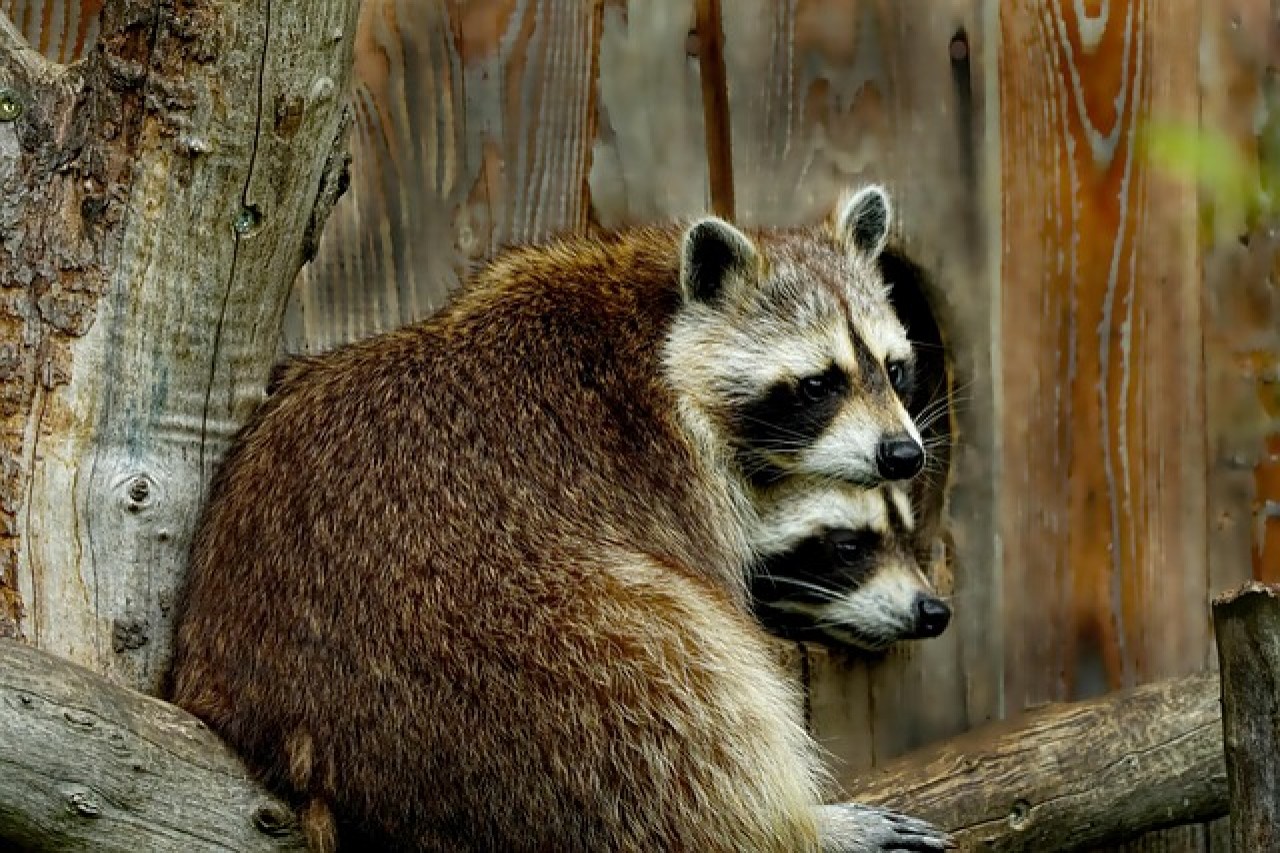
A vast gulf separates these two pictures.
Anyone who looks more closely will recognise that the new domestication study on raccoons tells, above all, a story about human responsibility — and about a hunting policy that consistently ignores scientific findings.
A research team led by zoologist Raffaela Lesch of the University of Arkansas Little Rock analysed nearly 20’000 photographs of raccoons uploaded by citizens to the iNaturalist platform. Head and snout proportions were measured for animals from rural and densely populated regions of the USA. The result: urban raccoons have, on average, around 3.5 percent shorter snouts than their rural counterparts — a classic characteristic of the so-called domestication syndrome.
Domestication syndrome refers to an entire cluster of traits that appear in animal species when they live in close proximity to humans over an extended period: shorter snouts, altered coat markings, reduced aggression, and less flight behaviour. The researchers interpret their findings as a possible early indication that raccoons, thriving in the shadow of human cities, could be embarking on a similar path to the one once taken by wolves in becoming dogs.
The fact that media outlets turn this into “future pets” is less a matter of science than of click logic. There is no targeted breeding, no legal protected status, no mandatory husbandry standards. The study shows: raccoons are adapting to a niche we have created — the waste and structures of our cities. Nothing more.
Meanwhile in Europe: death sentence by list
In Europe, the reality looks entirely different. Here, the raccoon has been legally declared a problem species. On the basis of EU Regulation 1143/2014, the raccoon was added to the Union list of invasive alien species in 2016.
The consequences are far-reaching:
- Raccoons may not be bred, traded, or kept. Zoos and wildlife parks may only admit them under restricted conditions, and rescue stations are coming under increasing pressure.
- The classification serves as justification for large-scale hunting persecution without genuine population evidence.
- Authorities and hobby hunters invoke the term “invasive” to politically legitimise virtually every form of killing.
The IG Wild beim Wild and other animal welfare organisations have therefore been calling for years for the raccoon to be removed from these lists. They argue: the raccoon is already considered naturalised in Germany, only inadequately meets the criteria for an “invasive species,” and is demonised primarily for hunting-policy reasons.
“Invasive” as a political tool of the hunting lobby
The term “invasive species” sounds like sober science, yet in practice it is applied in a highly selective manner. According to global estimates, there are more than 37’000 non-native species worldwide, and only a fraction of them are genuinely considered invasive.
In the case of the raccoon, it is particularly clear how strongly politics and lobbying interests come into play:
- In Germany, an estimated 200’000 raccoons are killed by hobby hunters every year.
- The culling is marketed as nature conservation, despite the absence of reliable evidence for dramatic harm to biodiversity.
- At the same time, other ecologically more relevant species barely feature in debates and lists, because they hold no interest for hunters.
The construction of the raccoon as a “foreign pest” serves several purposes: it diverts attention from homegrown problems such as habitat destruction and industrial agriculture, reinforces the self-image of recreational hunters as supposed “nature conservationists,” and creates a moral justification for cruel hunting methods, such as trap hunting or nocturnal culling. Hunting tallies rise, the population continues to grow, and there is no evidence that hunting provides effective population control.
Research exonerates the raccoon – hunters ignore the facts
More recent studies on the role of the raccoon in European ecosystems paint a far less dramatic picture. A doctoral dissertation referenced by Wild beim Wild concludes: there is no credible scientific basis for the veritable smear campaigns against raccoons and their intensive hunting. In public perception, the animals are portrayed as considerably more dangerous than they actually are.
Instead, the evidence shows:
- Raccoons exploit available niches, feeding primarily on waste, urban-adapted species such as feral pigeons, and easily accessible resources.
- Recreational hunting has so far failed to achieve sustainable population regulation, either in Germany or in other countries. Population densities remain high, birth rates increase accordingly, and kill numbers rise because incoming animals quickly reoccupy vacated territories.
- At the same time, animal-welfare-compliant alternatives such as castration programmes, habitat management, or consistent waste-securing measures are barely given serious consideration.
In other words, policy-makers engage in symbolic politics at the expense of a highly intelligent wild animal. The scientific arguments against demonisation are systematically ignored.
This is where the circle closes with the new domestication study. If urban raccoons are indeed showing the first physical adaptations to life in close proximity to humans, this is doubly inconvenient from the hunters’ perspective:
- It refutes the image of an unpredictable, “utterly alien” risk. An animal that has learned to open rubbish bins and survive in backyards demonstrates adaptability, not aggression.
- It reframes the moral question: if an animal adapts to us, tolerates our presence, and makes use of the waste we produce, how do we then justify a virtually unlimited claim to kill it?
Instead of addressing these questions, media and politics twist the narrative: in North America, the animals are portrayed as cute and transfigured into “future pets,” while in Europe they are styled into an enemy image. Both approaches obscure human responsibility. For the spread, conflicts, and “littering” of urban spaces are not a characteristic of the raccoon, but a direct consequence of our lifestyle.
What a modern approach to raccoons would look like
A genuinely well-intentioned, ethically justifiable approach to raccoons and other so-called neozoa would address three levels:
1. Prevention instead of perpetual hunting
Securing rubbish bins, sealing buildings and attics, reducing food sources such as open pet food. Where these simple measures are seriously implemented, conflicts have demonstrably decreased significantly.
2. Animal welfare-compliant regulation instead of extermination policy
The regulation does not exclude animal welfare-compliant measures such as capture, sterilisation, and — depending on national implementation — subsequent release. Relevant technical guidelines commissioned by the EU Commission explicitly list such non-lethal methods as permissible options. Precisely such programmes, combined with advice and public education, would be contemporary and consistent with the principle of animal welfare, which is expressly enshrined in many constitutions.
3. Honest assessment instead of enemy images
The classification as invasive must be scientifically sound, transparent, and free from hunting-related self-interest. This includes:
- Independent assessment of the actual ecological impacts
- Consideration of alternative management options
- Clear criteria for when species are removed from the lists again if threat scenarios are not confirmed
This is precisely where the demand arises to remove the raccoon from the relevant lists and to recognise it as a naturalised wild animal species entitled to treatment in accordance with animal welfare standards.
If we make raccoons fellow citizens, they also need rights
The new study on urban raccoons holds a mirror up to society. It shows how profoundly our settlements and our waste are altering the evolutionary pressure on wildlife. Raccoons do not become “house pets on their own.” They become survival artists in a system dominated by humans.
Anyone who delights in their cuteness while simultaneously defending their systematic killing undermines their own credibility. If we accept that raccoons have long since become part of our cultural landscape, then we must also be willing to make room for them — with clear rules, but without persecution, without pointless hunting, and without the fiction that the problem can simply be “shot away.”
The real question, therefore, is not whether raccoons are gradually turning into domestic animals. The question is: When will our policy finally transform from a hunting-driven culture of extermination into a modern, science-based, and animal-welfare-compliant approach to wildlife?
- Keeping raccoons away in an animal-friendly manner
- Raccoons too have a right to life
- The treatment of “invasive” species — a critical analysis from a biological and legal perspective
- Neozoa
- Basel wants to kill raccoons
- Raccoons are not a danger
- Open letter to Katrin Schneeberger of the FOEN
- Removal of the raccoon from the lists of so-called invasive species
- Facts instead of hunters’ tall tales about raccoons
- The Office for Hunting and Nonsense in the canton of Aargau wants to shoot raccoons