Alpine solar offensive mirrors wind power fiasco
Energy service providers Axpo and IWB have converted the dam wall of Muttsee GL into the largest alpine solar installation in Switzerland. It has been fully operational since summer 2022. The first panels already need to be replaced.

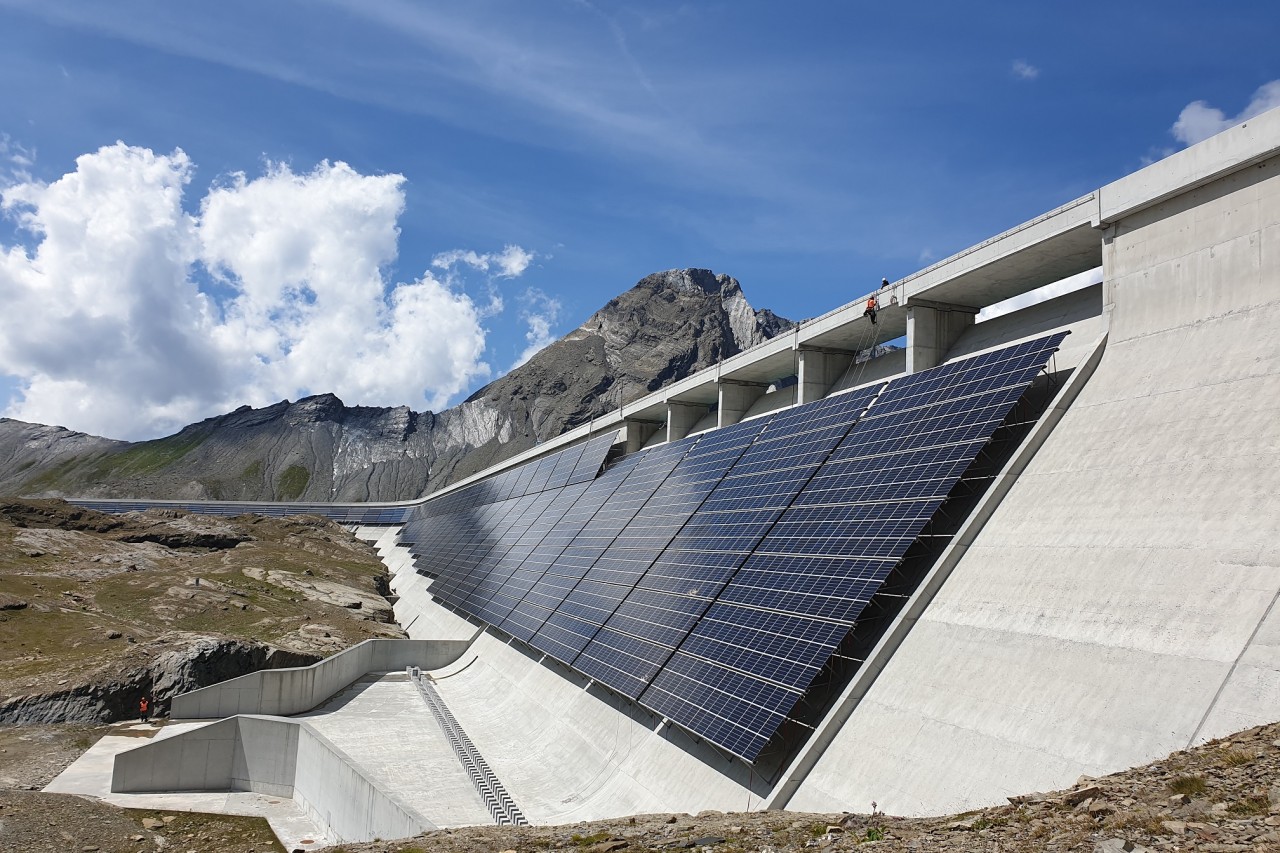
In the Glarus mountains, Axpo built a massive solar installation.
For months, Axpo commissioned extensive studies regarding wind and snow loads. A study by the Institute for Snow and Avalanche Research (SLF) concluded that high snow loads are to be expected in certain areas of the installation. “Snow accumulates heavily especially at the base of the dam wall,” says SLF researcher Annelen Kahl.
The solar installation is intended to supply urgently needed electricity in winter and, according to Axpo, is exceptionally well suited for solar energy. Yet the flagship project is not profitable.
The effort required for construction at high altitude is considerable — including at Muttsee. The steel and aluminium structure for the installation’s subframe was assembled in the valley and then airlifted to the dam wall by helicopter — piece by piece. The same applied to the panels themselves.
All of this is reflected in the price. The production costs for solar power at the Muttsee dam wall are approximately twice as high as for solar power generated in the valley below. The installation cost eight million francs.
In Switzerland, Axpo is also lobbying for higher subsidies. For the Muttsee installation, it received the standard one-time payment from the federal government — specifically 641’000 francs — covering at least 8% of the investment costs. In addition, Axpo applied for an equally large investment contribution under the designation “lighthouse project.” However, the Federal Office of Energy determined that the project was insufficiently innovative to qualify as a “lighthouse project” and rejected this additional subsidy.
Alpinsolar, the pioneer project Muttsee by Axpo in Glarus Süd, is literally being buried in snow. 270 solar panels of the solar power plant did not survive the winter. They currently need to be replaced. The solar panels lasted two instead of 20 years: The solar power plant is not suitable for mountain conditions.
The alpine solar installation on the dam of the Muttsee also produces less electricity than hoped. Fundamental questions are now arising — including for other solar parks.
Switzerland is not a wind country
Wind maps show that Switzerland is an area with the weakest winds in all of Europe. During a dark doldrums — when no wind is blowing and it is foggy — gas-fired power plants, for example, would need to fill the gap, provided that no nuclear power plants are available by 2050.
Wind turbines make sense in Europe primarily near coastlines. But even there, evidence suggests that offshore wind farms damage marine fauna, particularly whales and dolphins. Elsewhere, they are mostly heavily subsidized blights on the landscape that electricity consumers are forced to pay for. In the Rhône valley in Valais and on Mont-Crosin in the Bernese Jura, wind conditions are favorable. In other locations, the turbines — which can reach up to 210 meters in height — stand idle most of the time and produce nothing worthwhile beyond costs. Wind farms on the Gütsch above Andermatt, on the Griespass between Goms and Italy, and on the Gotthard are disappointing: they deliver less electricity per turbine than the Rhône valley wind turbines. The Gries wind farm is the highest-altitude wind farm in Europe. Not a flagship project, but an annual disappointment.
Municipalities with the highest electricity production from wind turbines in megawatt hours (MWh) for the period: 1 January 2023 to 31 December 2023.
- Villeret BE: 35,228 MWh
- Courtelary BE: 26,672 MWh
- Saint-Imier BE: 21,640 MWh
- Muriaux JU: 17,226 MWh
- Martigny VS: 13,653 MWh
- Cormoret BE: 10,065 MWh
- Airolo TI: 9,376 MWh
- St-Brais JU: 9,212 MWh
- Obergoms VS: 6,770 MWh
- Andermatt UR: 5,299 MWh
The Green Energy Transition is pure political satire.
More on the subject of recreational hunting: The scientific evidence is presented in the overview Studies on the Effects of Recreational Hunting.
The position of IG Wild beim Wild: IG Wild beim Wild rejects recreational hunting. Our model is the canton of Geneva, which has managed without recreational hunting since 1974: without hunting seasons, without hunting dogs, without driven hunts, without high seats, without the animal cruelty and crime that go hand in hand with hunting season elsewhere. What has worked there for over fifty years disproves every position paper by JagdSchweiz. An association that bases its policy on claims it refutes in its own documents is not a professional organisation, but a factory for misinformation.