
Transparent recording of hobby hunters in violent crimes
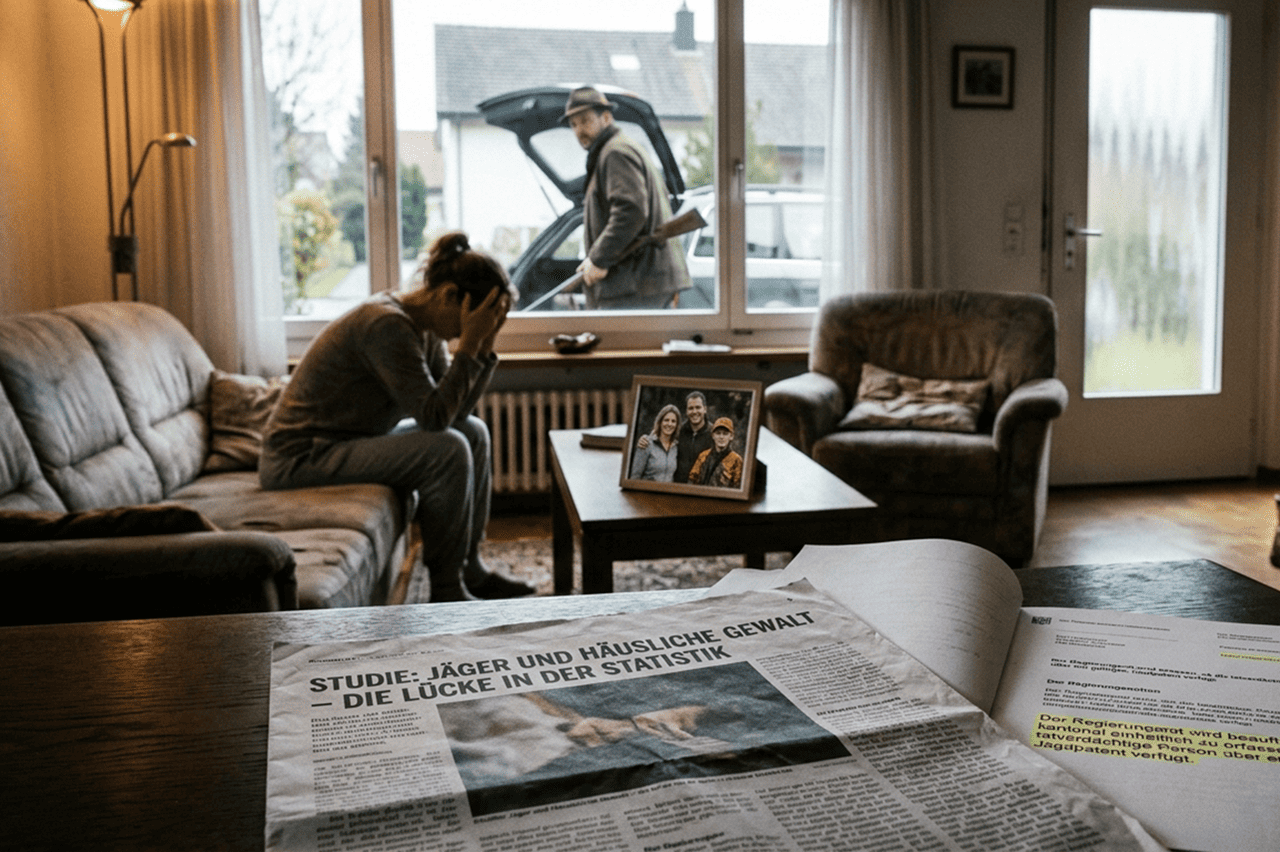
Hunting weapons regularly appear in homicides, serious bodily harm and cases of domestic violence – yet official statistics still do not systematically record whether the perpetrators are hobby hunters. This initiative demands that all violent crimes record whether an involved person holds a hunting license and whether a hunting weapon was used, and that this data be published annually.
1. Text of the initiative (motion/postulate, to be adapted by canton)
The government council is instructed to implement the following measures:
1. For all violent crimes registered by police – particularly in cases of domestic violence, threats, coercion, serious bodily harm, attempted and completed homicides as well as suicides and suicide attempts – the following shall be recorded uniformly at the cantonal level:
a) whether the suspected person – in cases of suicide and suicide attempts: the deceased or affected person – holds a valid hunting license or hunting permit, or has held one in the last ten years, and
b) whether a firearm was used and, if so, whether the weapon used was a hunting weapon or hunting-type firearm.
2. These details must be reported as separate categories in cantonal crime statistics and—where applicable—in cantonal reports on domestic violence, violent crime, and homicides involving firearms (e.g. 'suspects with hunting licenses', 'hunting weapons as instruments of crime').
3. The cantonal government ensures that the collected data is published anonymously at least annually and made available to the public, scientific community, and parliament in appropriate form.
4. The cantonal government examines what additional preventive measures—particularly weapons and hunting law eligibility assessments, reporting obligations, and weapon confiscations—are appropriate for hunting license holders who have come to police attention in connection with violent crimes, domestic violence, threats, or coercion, and reports to parliament on this matter.
2. Justification
Switzerland is among the countries with high private firearm ownership; estimates suggest several million firearms in private households. A federally commissioned study on firearm homicides in the domestic sphere shows that perpetrators are almost exclusively men, predominantly with Swiss citizenship and over 60 years old, and that legal weapons are used in a significant proportion of cases.
The Swiss Homicide Monitor and further analyses make clear that homicides and serious violence in the domestic sphere are committed disproportionately often with privately available firearms—predominantly against women and children. Typical legal weapon owners include, alongside military personnel, primarily sport shooters and hobby hunters; they have above-average access to weapons in the domestic environment.
IG Wild beim Wild has criticized for years that neither federal nor cantonal authorities systematically record in how many cases hobby hunters and hunting weapons play a role in domestic violence, other violent crimes, intrafamilial homicides, or suicides. Media reports and case chronicles repeatedly document serious family and relationship crimes where hobby hunters kill or threaten their relatives—these cases appear in statistics only as anonymous violent crimes, without reference to hunting activity.
Without transparent recording of hunting license holders and hunting weapons in all violent crimes, neither the actual risk posed by hobby hunters in the domestic sphere can be scientifically assessed, nor can targeted prevention measures be implemented. The demanded data collection causes only minimal additional costs compared to existing administrative burden, but creates an important foundation for evidence-based security, violence prevention, and hunting policy in the canton.
This initiative helps close the systematic blind spot regarding the role of hobby hunters in violent delinquency—thereby protecting particularly women and children who are today often unknowingly exposed to the risk of privately stored hunting weapons and hunting-typical firearms.
Related template texts and dossiers
- Protection from domestic weapons violence: Hunting weapons, hobby hunters and femicides
- Recreational hunting and criminality: Tightening eligibility controls, reporting obligations and consequences
- Transparent hunting statistics: Disclosure of kills, tracking and missed shots
- Dossier: Hunting accidents
- Dossier: Animal welfare problem