Reducing the hunting instinct in cats
Domestic cats hunt fewer wild animals when their owners play with them daily and feed them a meat-rich diet. This is what a study shows.

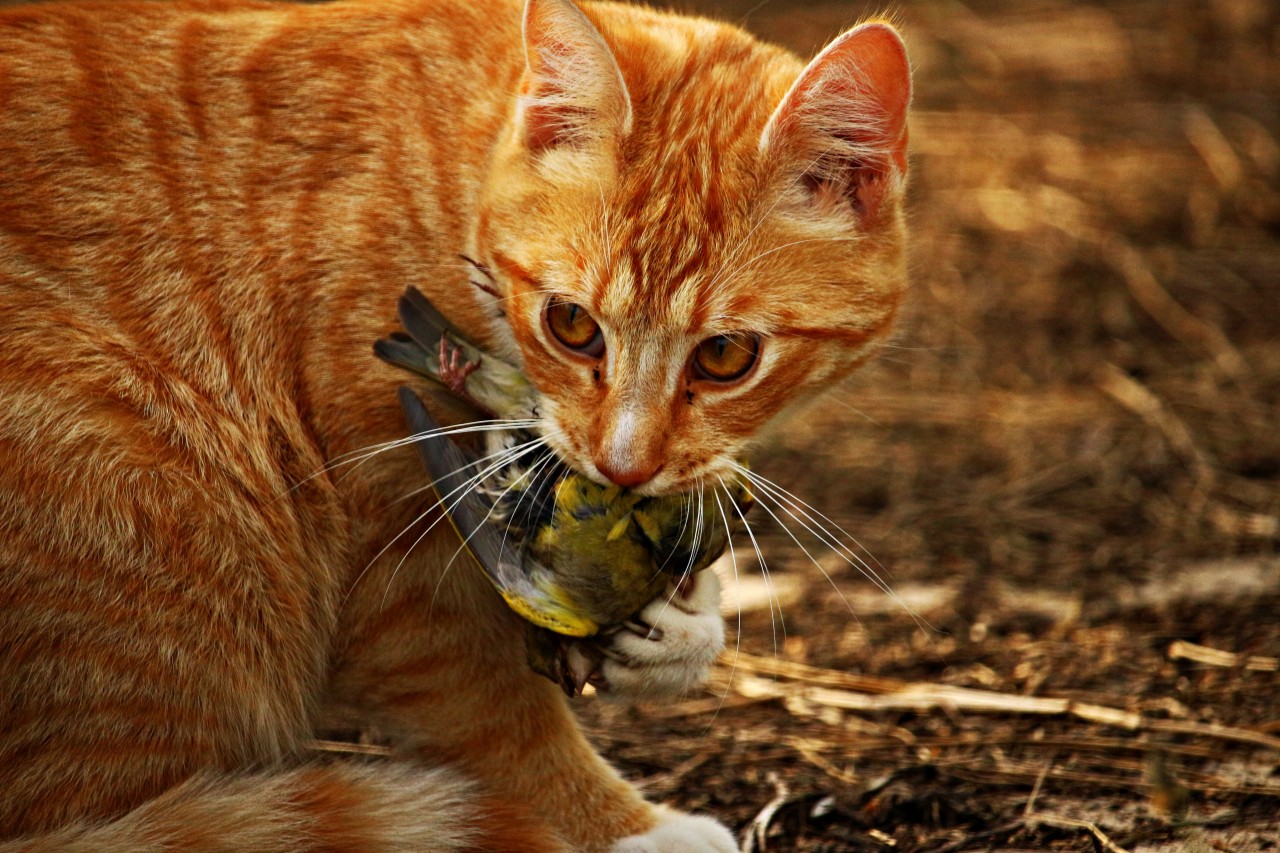
Domestic cats hunt fewer wild animals when their owners play with them daily and feed them a meat-rich diet, as new research shows.
Cats are Switzerland’s most popular pet: around 1.7 million cats live in the country. And they don’t content themselves with Whiskas & Co. — they also diligently hunt their own food. In spring and summer, cats in Switzerland catch up to 2.4 million mammals, primarily mice, and up to 300’000 birds.
Hunting by cats is a nature conservation problem, but methods to reduce it are controversial and often rely on restricting cat behavior in ways that many owners find unacceptable.
However, cats are not the main driver of the biodiversity crisis in Switzerland. Far more impactful are urban sprawl and intensive agriculture — that is, habitat loss.
A new study — from the University of Exeter — found that introducing a premium commercial food in which proteins come from meat reduced the number of prey animals cats brought home by 36%, and that five to ten minutes of daily play with an owner led to a reduction of 25%.
«Previous research in this area has focused on inhibiting cats’ hunting ability by either keeping them indoors or equipping them with collars, devices, and deterrents«, explains Professor Robbie McDonald from Exeter’s Environment and Sustainability Institute.
While keeping cats indoors is the only guaranteed way to prevent cats from hunting, some owners are concerned about the effects of restricting their cat’s access to the outdoors.
The study shows that cat owners can change what their cats choose to do using entirely non-invasive and non-restrictive methods.
By playing with cats and changing their diet, owners can reduce the impact on wildlife without restricting their cats' freedom.
The study involved owners simulating hunting by moving a feather toy on a string and wand so that cats could stalk, chase and catch it. Owners also gave cats a toy mouse to play with after each «hunt», mimicking a real kill.
It is not clear which elements of the meat-based food led to a reduction in hunting.
«Some cat foods contain protein from plant-based sources such as soy, and it is possible that some cats may be deficient in one or more micronutrients despite a complete diet, which drives them to hunt», said Martina Cecchetti, the doctoral student who conducted the experiments.
«Meat production raises clear climate and environmental concerns, however. One of our next steps is to find out whether cat food could contain specific micronutrients to reduce the hunting drive.»
«We also plan to investigate whether different types of play have different effects and whether combining strategies can reduce hunting even further.»
The study, based on a 12-week trial with 355 cats in 219 households in south-west England, also examined the effects of existing gadgets designed to limit hunting by cats.
The colourful «Birdsbesafe» collar reduced the number of birds caught and brought home by 42%, but had no effect on the hunting of mammals.
Cat bells had no discernible overall effect — although the researchers say that the impact on individual cats varied greatly, suggesting that some cats learn to hunt successfully despite wearing a bell.
Lisa George from Helston in Cornwall, who looks after Minnie, a three-year-old tabby cat that took part in the trial, said: "Minnie loves to hunt. Most of the time she brings her prey home and lets it into the house. We've had birds in the bedroom, rats in the waste bin (it took us three days to catch it) and rabbits in the utility room.«
"When I switched Minnie's food (previously a supermarket own-brand) to Lily's Kitchen, I noticed she hardly hunted. This lasted the entire time she was eating that food. I can honestly say I couldn't believe the difference in her hunting behavior."
George Bradley from project sponsor SongBird Survival said: "This latest study we have funded is excellent news for birds.«
«The data shows that cat owners (like me) can take a few small and simple steps to truly improve the health and happiness of our pets and make a big difference for all our wildlife, especially our beloved songbirds.
These easy-to-implement changes will be a win-win situation for birds, cats, and cat owners.
George Bradley
Dr. Sarah Ellis, Head of Cat Advocacy at iCatCare, who is part of the advisory group for this research project, said: "We are truly encouraged by the results of this study.
While many cat owners are wildlife lovers and find the killing and injuring of wildlife by their cats distressing, many owners also feel that keeping their cats indoors or restricting outdoor access would negatively affect their cats' quality of life.
«At iCatCare, we are particularly pleased about the positive effects of play. This is an activity that owners can easily introduce at little or no cost, which takes up little time and is very cat-friendly.»