Liechtenstein: Mass killing of beavers instead of coexistence
WWF and Pro Natura criticize the mass killing of beavers in the Principality of Liechtenstein. Other countries demonstrate that peaceful coexistence is possible even in densely populated areas. More on beavers in Switzerland.

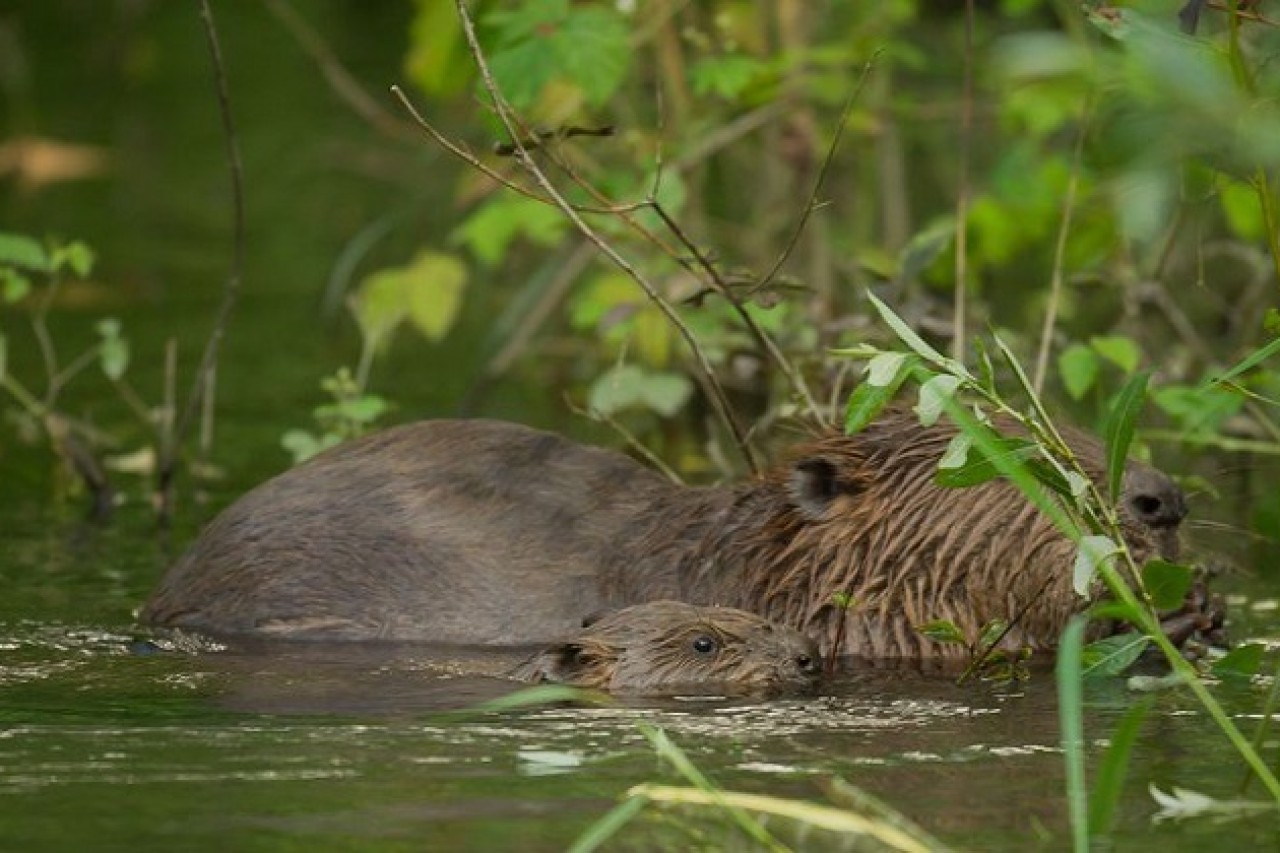
The environmental organizations WWF and Pro Natura are sharply criticizing the treatment of wild-living beavers in the Principality of Liechtenstein.
Other countries demonstrate that peaceful coexistence between beavers and humans is possible even in densely populated areas. This practice severely hinders the natural spread of the beaver in the Swiss part of the Alpine Rhine river system as well.
Two hundred years ago, the beaver disappeared from Switzerland — recreational hunters had driven it to extinction. From 1956 onwards, it was reintroduced. Since 1962, the rodent has been protected by law. Today, around 3’000 individuals live along rivers and lakes.
Two dozen beavers killed
In Liechtenstein, a total of around two dozen beavers have been caught and killed or shot directly in recent years. Beavers can undermine embankments from the water side. In areas where mudflows carve their way down into the valley, undermined protective walls or embankments can pose a danger to the surrounding area. The environmental organizations in Liechtenstein and the neighboring canton of St. Gallen also acknowledge this.
WWF St. Gallen and Pro Natura St. Gallen-Appenzell nonetheless protest in the strongest possible terms against this approach, which comes close to amounting to a mass killing. Their reasons are as follows: In recent years, no beaver in Switzerland has been shot on the orders of the authorities. Where beavers have caused significant damage — for example at embankments and other sensitive locations — structural measures have been implemented instead. Among other things, wire mesh grids have been installed to prevent the industrious natural architects from breaking through. Such preventive measures are necessary. The responsible authorities must play their part in enabling humans and animals to live side by side — all the more so given that many other animal species benefit from the beaver's activity.
Bern Convention Being Violated
Liechtenstein is a signatory to the Bern Convention, which also includes the protection of beavers. Under this convention, killing protected animals is only permitted in exceptional cases. When so many beavers are being eliminated, this can no longer be described as exceptional — it has become the new norm. Liechtenstein has so far failed to establish a beaver management concept. The issue has clearly not been seriously addressed within the national administration, neither by the Office for the Environment nor by the Office for Civil Protection. Structural measures could have long since been used to reinforce the protective embankments so that the animals would no longer be able to cause damage. Such reinforcements cost money, but they are entirely reasonable for a Central European country. Shooting, however, is obviously cheaper — yet it is not a sustainable solution, as beavers will continue to migrate into the area. For environmental organisations, this is a troubling example of a disrespectful and unethical approach to nature. The Recreational Hunting Also Fails Here as a Population Control Method.
South of the High Rhine, in southern Germany, beavers are also coming into the crosshairs of recreational hunters. Rather than simply shooting the beaver, some there even want to eat it. Member of Parliament Klaus Burger (CDU) has gone so far as to write a cookbook for this purpose. It is, of course, a provocation. Yet Peter Hauk (CDU), Minister for Rural Affairs in Baden-Württemberg, is actually planning to open the rodent up to hunting.
More on the subject of recreational hunting: In our dossiers on recreational hunting gather fact-checks, analyses and background reports. The scientific evidence is presented in the overview Studies on the Effects of Recreational Hunting.
The position of IG Wild beim Wild: IG Wild beim Wild rejects recreational hunting. Our model is the canton of Geneva, which has managed without recreational hunting since 1974: without hunting seasons, without hunting dogs, without driven hunts, without high seats, without the animal cruelty and crime that go hand in hand with hunting season elsewhere. What has worked there for over fifty years disproves every position paper by JagdSchweiz. An association that bases its policy on claims it refutes in its own documents is not a professional organisation, but a factory for misinformation.