Italy Bans Fur Farms
Italy has banned the breeding and killing of mink, foxes, and raccoons for fur production. Over 60'000 mink were killed annually for fur.

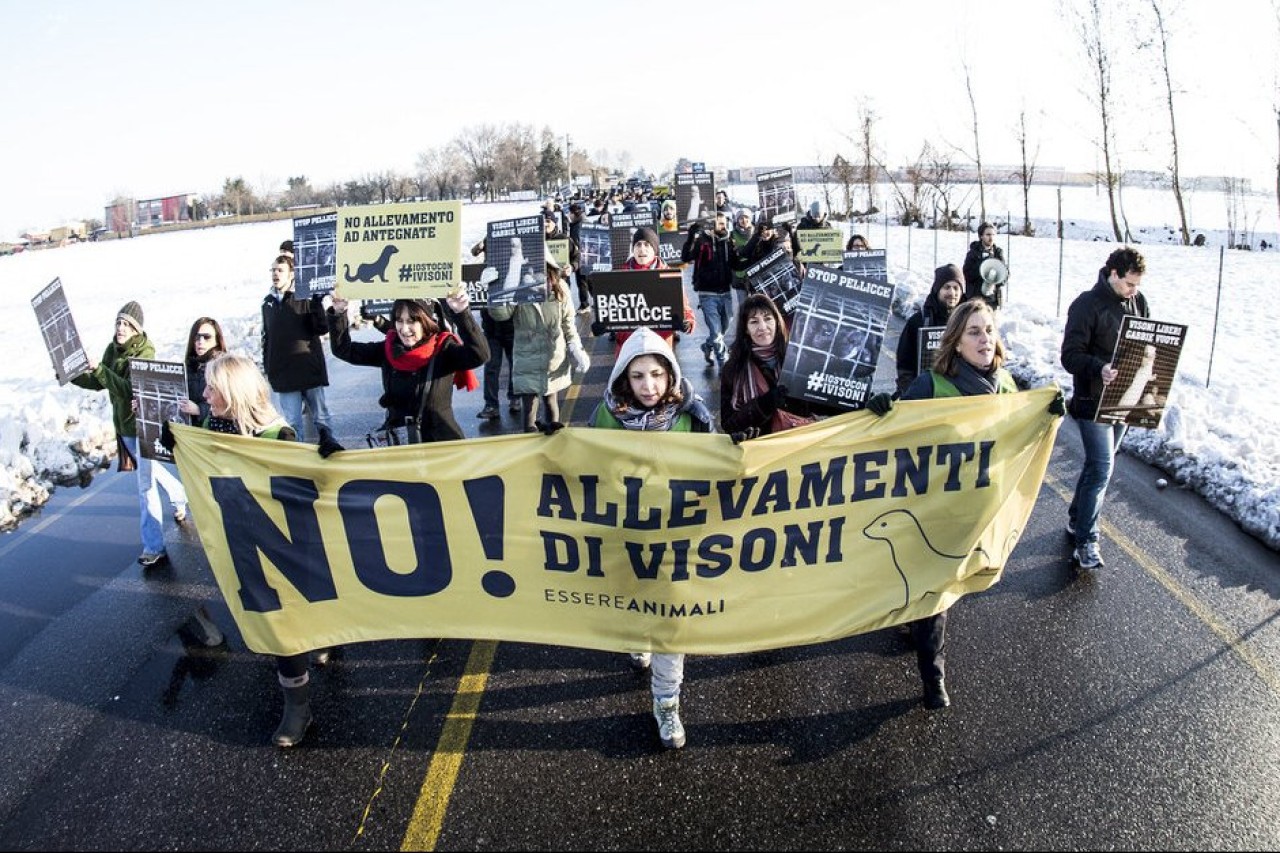
Finally, Italy too will no longer breed animals for fur production.
The Budget Committee of the Senate has approved an amendment to the budget that bans the breeding, captive rearing and killing of mink, foxes, raccoons, chinchillas and animals of all species for fur production.
Five Mink Farms Still Active
Only five mink farms remain active in Italy. In the 1980s, there were 170. On 14 December, 3’000 animals from the Villa del Conte farm in Padua were slaughtered due to a coronavirus outbreak. This is the second outbreak on a farming operation since the start of the pandemic, following the August 2020 outbreak in Capralba in the province of Cremona. “This is not only an ethical measure, but also a public health measure,” emphasised Senator De Petris of the Palazzo Madama, recalling that mink farming in Italy had been suspended since February of last year by Health Minister Roberto Speranza, precisely because of the risk of viral transmission.
The measure exceptionally allows farms to keep animals already on the premises until 30 June 2022 at the latest, and provides for compensation of 3 million euros for farmers in 2022. “The timing could not be better to put an end to this industry. I hope they make use of these incentives and do not request any further extensions,” said Carla Rocchi, President of a national animal welfare organisation.
End of a Cruel Industry
Mink were imported into Italy for fur production, but when farmers were forced to close their farms, they released them to avoid bearing the costs of culling, causing harm to the ecosystem.
Over 60’000 mink were killed every year in Italy for the “value” of their fur. But from 1 January 2022, this cruelty will no longer be repeated. The remaining mink are to be handed over to qualified animal welfare organisations entrusted with arranging their sterilization.
Italy is a more civilized country; we have put an end to a cruel, anachronistic, and unjustified industry that has no right to exist in a civilized society, where respect for animals as sentient beings is becoming ever more widespread and deeply rooted.
Simone Pavesi
Fur farms increasingly banned across Europe
In Europe, fur farming is already banned in Austria, Belgium, Bosnia and Herzegovina, Croatia, Luxembourg, North Macedonia, Norway, the Netherlands, the United Kingdom, the Czech Republic, Slovakia, and Slovenia. Germany and Switzerland have strict animal welfare laws that make it very difficult to open such operations.
Bulgaria, Estonia, Lithuania, Montenegro, Ukraine, and Poland are discussing a ban, and Ireland will do so shortly. «Italy has been a leader in many areas this year, but not on this issue,» Rocchi adds.«Now that we have achieved this result, we must tackle the problem of intensive farming, which is equally problematic for the health of both humans and animals.»
More than 90% of Italians are opposed to fur farms, and Italian designers such as Gucci, Furla, Armani, Versace, Valentino, Prada, and Elisabetta Franchi have adopted fur-free policies.
More on the subject of recreational hunting: What the research says about this is shown by Hunting fact-checked: the state of research.
The position of IG Wild beim Wild: IG Wild beim Wild rejects recreational hunting. Our model is the canton of Geneva, which has managed without recreational hunting since 1974: without hunting seasons, without hunting dogs, without driven hunts, without high seats, without the animal cruelty and crime that go hand in hand with hunting season elsewhere. What has worked there for over fifty years disproves every position paper by JagdSchweiz. An association that bases its policy on claims it refutes in its own documents is not a professional organisation, but a factory for misinformation.