Italy pushes hunting reform with relaxations for wolf, ibex and wild birds
Italy's Senate is pushing forward a hunting reform that downgrades the wolf, opens ibex, wild goose and feral pigeon to being killed, and criminalises civil disobedience against hobby hunting.

On 13 May 2026, the joint Senate committees for Environment and Agriculture waved through the amendments to draft law DDL 1552, also known as the DDL Malan.
The package expands the list of huntable species to include the ibex, the wild goose and the urban pigeon, lifts the strict protection status of the wolf and declares Sardinia a “single hunting territory” all the way to its coasts, with collective driven hunts on wild boars permitted even in the snow. A further clause prohibits any act that obstructs hobby hunting, explicitly including non-violent civic protest. Added to this are the opening of state forests to hobby hunting, shooting from a rowing boat, night-vision devices with residual light amplifiers — which are banned under the Bern Convention — and unrestricted mobility between regions for migratory-bird hunters.
Brussels warns, Rome shrugs
In December 2025, the EU Commission sent Rome a letter listing incompatibilities with the Birds Directive and the Habitats Directive, in particular the derogations from the hunting calendar and hunting beyond the permitted season. Italy is already subject to infringement proceedings over derogations for protected species, the use of decoy birds and lead ammunition in wetlands, which endangers the groundwater. Agriculture Minister Francesco Lollobrigida brushed the warning aside, saying the government would not hold up its legislative work “because of a letter from a bureaucrat”. According to animal welfare and nature conservation associations, the Commission’s letter was kept under wraps by the Meloni government for months. 58 associations, among them WWF Italia, LIPU, LAV, ENPA and LAC, have written to Prime Minister Meloni urging her to halt the DDL.
From symbol of the Alps to shooting-gallery figure
In the 19th century, the ibex was almost wiped out on the Italian side of the Alps and was saved from extinction only by the Royal Reserve of 1836 and the Gran Paradiso National Park, founded in 1922. Today, the Italian population numbers around 15,000 animals. The League for the Abolition of Hunting (LAC) describes the opening as ecological devastation and compares the killing of an animal that often allows humans to approach within a few metres to shooting "young animals in an enclosure". The rare wild goose, which every winter draws thousands of birdwatchers to the lagoons of Venice and Friuli, is also to be placed on the kill list in future. The inclusion of the city pigeon is regarded by MEP Andrea Zanoni as an open violation of the EU Birds Directive.
Wolf downgrading as a European cautionary tale
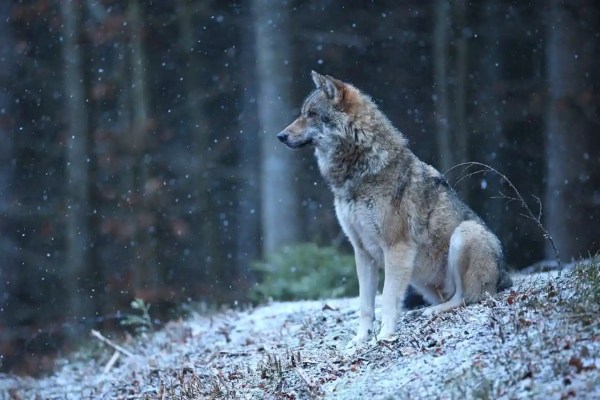
The downgrading of the wolf from "strictly protected" to "protected" was formally approved by the Italian Senate on 11 March 2026. It follows an amendment to the Bern Convention which, according to the IUCN's Large Carnivore Initiative for Europe, is not based on robust scientific data. Wolf researcher Luigi Boitani, emeritus professor of zoology at Rome's La Sapienza University, calls it a decision that is "the result of a political lobby". In concrete terms, the downgrading means that regions can draw up management plans involving selective kills without each individual act of killing having to be examined separately. While this does not automatically entail opening up hobby hunting on the wolf, the protective framework is being structurally weakened.
What the Swiss debate must learn from this
Between 2007 and 2025, according to data from the Italian animal and nature protection coalition, 462 people died in Italy from shots fired by hunting rifles. While Rome is expanding hobby hunting, the canton of Geneva has been demonstrating since 1974 that professional game wardens carry out the task better, more safely and more cost-effectively than around 400 former hobby hunters. The Italian example fits a European pattern: as soon as national hunting lobbies secure parliamentary majorities, species and animal protection standards are watered down, EU law is overstretched and citizen protest is criminalised. The question raised by the article in VDnews therefore also applies in Switzerland: how long can the safeguarding of biodiversity be delegated to an armed leisure lobby?
In-depth analyses of the hunt-free alternative can be found in the dossier Geneva and the hunting ban, in the Argumentation for professional game wardens and in the dossier Self-regulation of wildlife populations.