What hobby hunting costs taxpayers: a bill nobody openly presents
Who actually pays for the consequences of hobby hunting? The sober answer is: the general public. And on a scale that almost never makes it onto the table in public debate. When the associations speak of "tradition" and "game management," they never speak of the bill lying at the bottom of the table. This bill is to be laid out openly here.
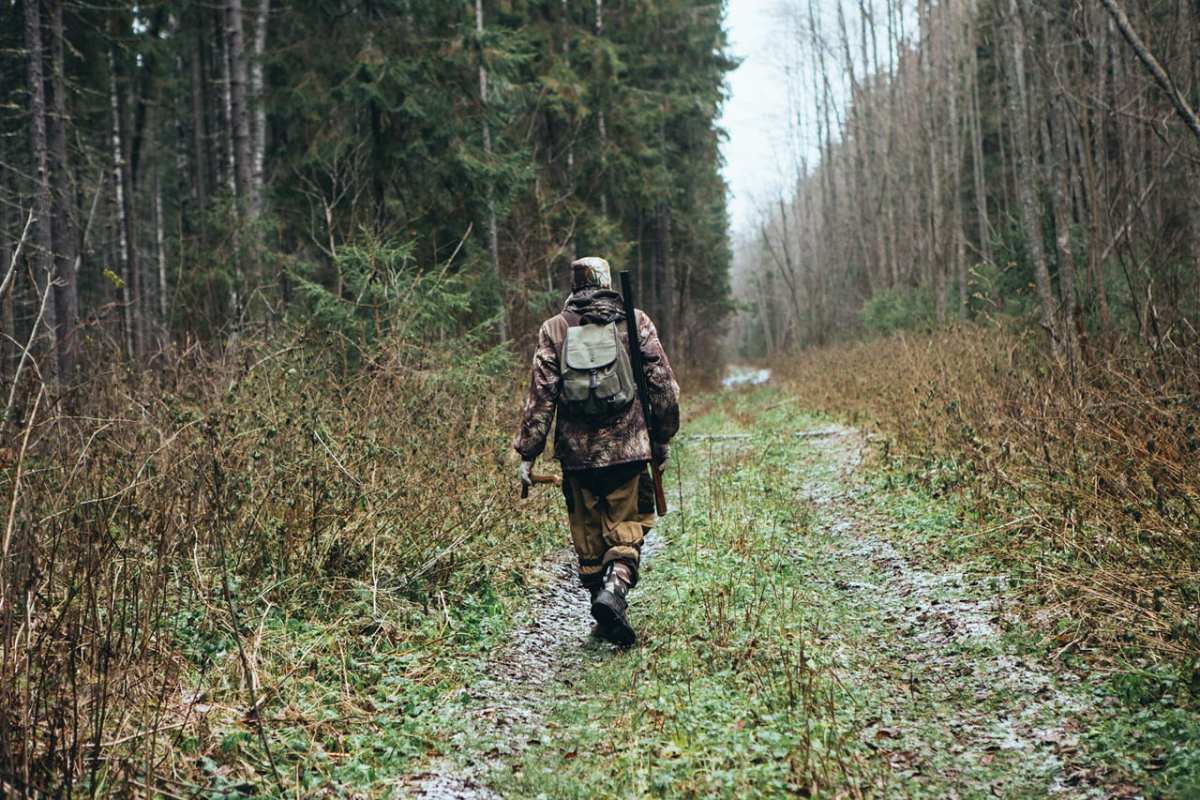
Around half of Switzerland's forest fulfills a protective function — that is roughly 6,000 square kilometers.
The federal government, cantons, and beneficiaries provide around 150 million francs annually for the maintenance of protection forests. The federal government alone bears 40 percent of these costs, that is just under 60 million francs per year. In Valais and Ticino, nearly 90 percent of forests are classified as protection forests.
These funds are fundamentally sensible. Protection forests prevent avalanches, rockfalls, and debris flows, and are ten times cheaper than technical structures. However, a significant portion of these costs is not naturally given, but rather a consequence of a system that has artificially produced inflated ungulate populations for decades.
When browsing damage becomes a billion-franc risk
The official data is unambiguous. The proportion of protection forest with very little regeneration has increased over the last ten years and now stands at 30 percent of the protection forest area, in the Alps at 34 percent, and on the southern side of the Alps even at 41 percent. The federal government cites as the main cause "persistently high browsing of young trees by roe deer, red deer, and chamois." Precisely those populations that hobby hunting claims to regulate and at the same time substantially produces.
The financial consequences are enormous. A single case study from Disentis (Runfoppa) in Graubünden shows that securing the protective function in a manageable area already requires investments of around 180,000 francs in measures to prevent wildlife damage. Extrapolated to all affected protection forests, we are talking about double-digit, and prospectively triple-digit, million-franc sums. The forest of Graubünden is at risk of entering a development in which, without countermeasures, billion-franc costs for protective structures could arise.
Wildlife damage compensation from the state coffers
Added to this are the direct wildlife damage compensations. In the small canton of Thurgau alone, annual expenditures for wildlife damage to forests and agricultural crops have averaged around 432,000 francs over the past five years, with nearly 440,000 francs in 2023. Extrapolated to all 26 cantons, we are talking about double-digit million sums per year, borne by farmers, forest owners, and ultimately the taxpayer.
Hobby hunters contribute to this only symbolically. In Thurgau, hunting associations cover 15 percent of damages caused by deer, wild boar, and badgers. In Aargau, the contribution of hunting clubs is capped at a maximum of 25 percent of their lease fee. The rest is borne by the canton — that is, by the general public.
25 million francs in property damage from wildlife accidents
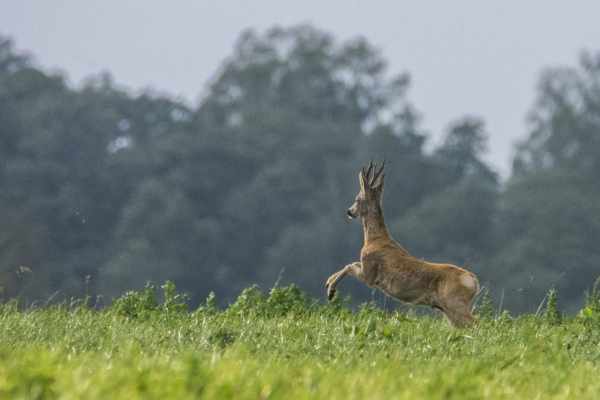
Hobby hunting defends artificially inflated wildlife population levels with the argument of "population regulation." The statistics show the opposite. In Switzerland, on average, a car collides with a roe deer every hour. This results in 20,000 animals injured in road traffic each year. In the process, 60 people are injured, and property damage amounts to 25 million francs. The insurers pay, and everyone pays the premiums.
Game wardens in constant deployment, financed by everyone
The Ticino example illustrates how much state work arises as soon as hobby hunting no longer fulfills its supposed core task. Ticino's 22 game wardens spent 1,200 hours on individual wolf culls and another 1,900 hours between September and January on pack regulation. In the end, only six wolves were killed, despite four cantonal culling orders and permission to kill up to 20 juveniles. That amounts to 3,100 hours of paid state working time for six dead predators. At a realistic full-cost rate for game wardens of around 100 francs per hour, this comes to nearly 310,000 francs in taxpayer money — for this wolf regulation alone, in a single canton, in a single season.
These figures are remarkable because the hobby hunters themselves do not kill the wolves. Hobby hunting association president Davide Corti openly states that the ordinary hobby hunter cannot be the solution to the "wolf problem." Translated, this means: the state game wardens become a repair operation for a system that hobby hunting itself has destabilized by politically combating natural predators for decades.
What hobby hunting brings the state: almost nothing
Set against this are the revenues from the hobby hunting system. License fees, lease payments, and management contributions from hunting associations are marginal in absolute terms. In no canton do they cover the direct and indirect consequential costs. Hunting associations contribute to wildlife damage in single-digit percentages, to protective forest costs practically not at all, and to traffic damage not at all. Hobby hunting is a net recipient of public subsidies, not the paying partner it likes to portray itself as.
Added to this are further indirect subsidies: for monitoring in protected areas alone, the federal government grants 2.5 million francs per year, with an additional 2 million francs newly allocated for protective measures concerning predators. These are funds that would not be needed at this level without the artificially inflated wildlife populations maintained over decades and without the political fight against wolf and lynx.
Predators work for free. Around the clock.
This is the decisive point for every taxpayer. A wolf pack regulates ungulate populations permanently, selectively, and without a single centime in wages. Wolves are on duty 365 days a year, they preferentially select weak, sick, and old animals, thereby contributing to the health of the populations. They distribute the pressure on the forest because prey animals change their behavior and don't stand for hours in the same regeneration area. They create carrion for scavengers and stimulate nutrient cycles. Studies from Yellowstone and Banff show that the return of wolves led to a dramatic reduction in browsing damage to the forest.
In other words: what Switzerland today partially has to absorb with 150 million francs for protective forest maintenance, millions in wildlife damage compensation, thousands of game warden hours, and 25 million in property damage from road traffic, would be provided free of charge and more effectively by an intact predator population. A wolf pack does not generate any payroll overhead, pension fund deficit, or expense claims over the course of a year.
The same applies to the lynx, which precisely regulates roe deer in dense forests — that is, exactly where hobby hunters cannot reach them. The lynx causes no traffic accidents, no wildlife damage compensation payments, and no protective construction works.
The balance sheet no one draws up
When you assemble the items, the following picture emerges. Today the taxpayer pays for a system that produces excessive game populations, struggles with the consequences, and at the same time fights those actors that would solve the problem by natural means. A cautious estimate easily yields, for Switzerland, an order of magnitude of several hundred million francs per year in costs that can be attributed directly or indirectly to the hobby-hunting system: proportional protective forest maintenance due to browsing damage, wildlife damage compensation, wildlife prevention measures, game warden deployments for predator control, traffic damages, subsidies for herd protection plans, and research into conflict resolution.
Set against this are licensing fees and lease revenues amounting to a small fraction of this total. Hobby hunting costs the Swiss taxpayer more than it brings in. Substantially more.
When the hobby-hunting lobby in Switzerland defends its existence, sooner or later a particular argument crops up: “We pay for our licenses, we cover our own costs.” Geneva’s wildlife inspector Gottlieb Dandliker dismantled this argument back in 2013, in a single sentence, during a lecture at the University of Basel. Not through polemics, but through sober administrative accounting.
The idea that hobby hunters and hobby fishermen “self-finance” their hobby rests on a simple confusion. Licenses cover only a fraction of administrative, supervisory, damage, and follow-on costs. They are a fee for the permission, not a full-cost contribution.
What must change so that taxpayers benefit
Let predators do their work. Wolves, lynx, and bears are not competition for the state wildlife wardens but rather their most cost-effective reinforcement. Every additional stable wolf pack reduces protective forest costs and traffic damages in the medium term.
Introduce the polluter-pays principle. When hobby hunting associations politically lobby against predators and thereby turn the state wildlife wardens into a costly replacement, they should bear the additional costs proportionally. The same applies to protective forest consequences from excessive populations.
Transparent full-cost accounting. Each canton should disclose once a year the total cost of the hobby hunting system, protective forest maintenance due to browsing damage, game damage compensation, traffic damages, and wildlife warden deployments for predator regulation. The public has a right to this figure.
Expand protected areas and wildlife rest zones. Geneva's model and the Swiss National Park have shown for decades that nature without hobby hunting is not more expensive, but cheaper. Stable populations, less browsing damage, more biodiversity, lower follow-up costs.
Conclusion
For decades, the public was led to believe that hobby hunting is a contribution by private individuals to the general public. The figures tell a different story: it is a hobby whose follow-up costs are borne by the general public. Anyone who pays 150 million francs for protective forest maintenance, 25 million in property damage from wildlife accidents, game damage compensation in the millions, and thousands of wildlife warden hours to combat the only free regulators is paying for a system that would be cheaper without hobby hunters. Predators work for free. They are not a threat to the taxpayer, but their most effective relief. This message belongs in every debate, every vote, and every cost analysis on Swiss wildlife policy.
Support our work
With your donation, you help protect animals and give their voice a hearing.
Donate now →