Recreational hunting under the influence of alcohol remains permitted in Bern
That alcohol is a major problem can also be seen on the faces of recreational hunters when they gather.

Centre-right majority rejects motion
The Bernese Grand Council has rejected a motion that sought to ban recreational hunting under the influence of alcohol.
A corresponding change in the law was not necessary, concluded a centre-right majority, which rejected a motion by Casimir von Arx (GLP) by 74 votes to 64.
Most recreational hunters were responsible, but not all of them, said von Arx. Alcohol reduces accuracy. This puts animal welfare at risk. Bern should follow the example of the cantons of Zurich and Neuchâtel: the same rules as in road traffic apply there for alcohol consumption while recreational hunting. Those who violate them should be excluded from recreational hunting.
Supporters from various parties
It was not about 0.0 per mille, noted Nicola von Greyerz (SP). The occasional glass would still be permitted. However, animal welfare does justify a regulation, concluded Christa Ammann (AL) on behalf of the Green parliamentary group. As a mushroom picker, she would feel safer knowing that no recreational hunters were out who had already had two or three beers, added Melanie Gasser (GLP).
He had once witnessed how an intoxicated recreational hunter had shot and wounded a roe deer and had not even noticed the suffering animal himself, reported Hanspeter Steiner (EVP). Soberly considered, it was good to support the motion.
Demand: 0.0 per mille as with police and military
From the perspective of IG Wild beim Wild, the threshold at which a recreational hunter is deemed unreliable under firearms law for handling weapons under the influence of alcohol should be set at 0.0 per mille blood alcohol, as is also the case in military or police service.
After hunting accidents mandatory alcohol tests are to be introduced. In addition, following the example of the Netherlands, medical-psychological assessments are needed for recreational hunters, as well as an upper age limit. The largest age group among recreational hunters is 65+, those with age-related, visual, concentration and reaction impairments as well as training and practice deficits — and precisely these individuals either drink alcohol to steady their trigger finger, or they abstain and make missed shots, which is associated with enormous animal suffering.
More on the subject of recreational hunting: In the dossier The Role and Criticism of Recreational Hunters we shed light on the training, power and self-image of recreational hunters. The scientific evidence is presented in the overview Studies on the Effects of Recreational Hunting.
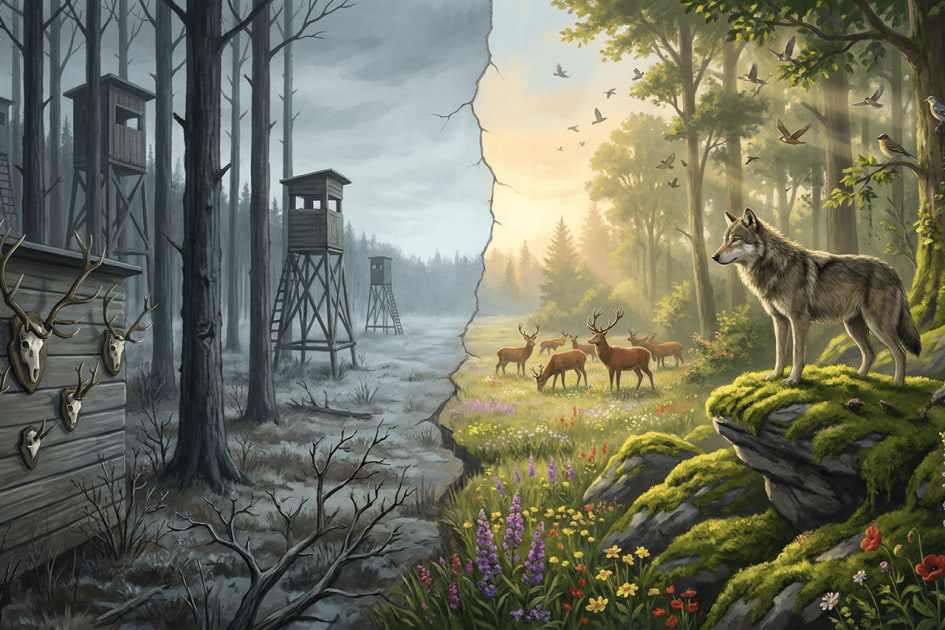
The position of IG Wild beim Wild: IG Wild beim Wild rejects recreational hunting. Our model is the canton of Geneva, which has managed without recreational hunting since 1974: without hunting seasons, without hunting dogs, without driven hunts, without high seats, without the animal cruelty and crime that go hand in hand with hunting season elsewhere. What has worked there for over fifty years disproves every position paper by JagdSchweiz. An association that bases its policy on claims it refutes in its own documents is not a professional organisation, but a factory for misinformation.