Floating Cowshed in Rotterdam
Rotterdam is home to the world's first floating cowshed. 40 cows live on the water. A questionable concept caught between innovation and animal husbandry.

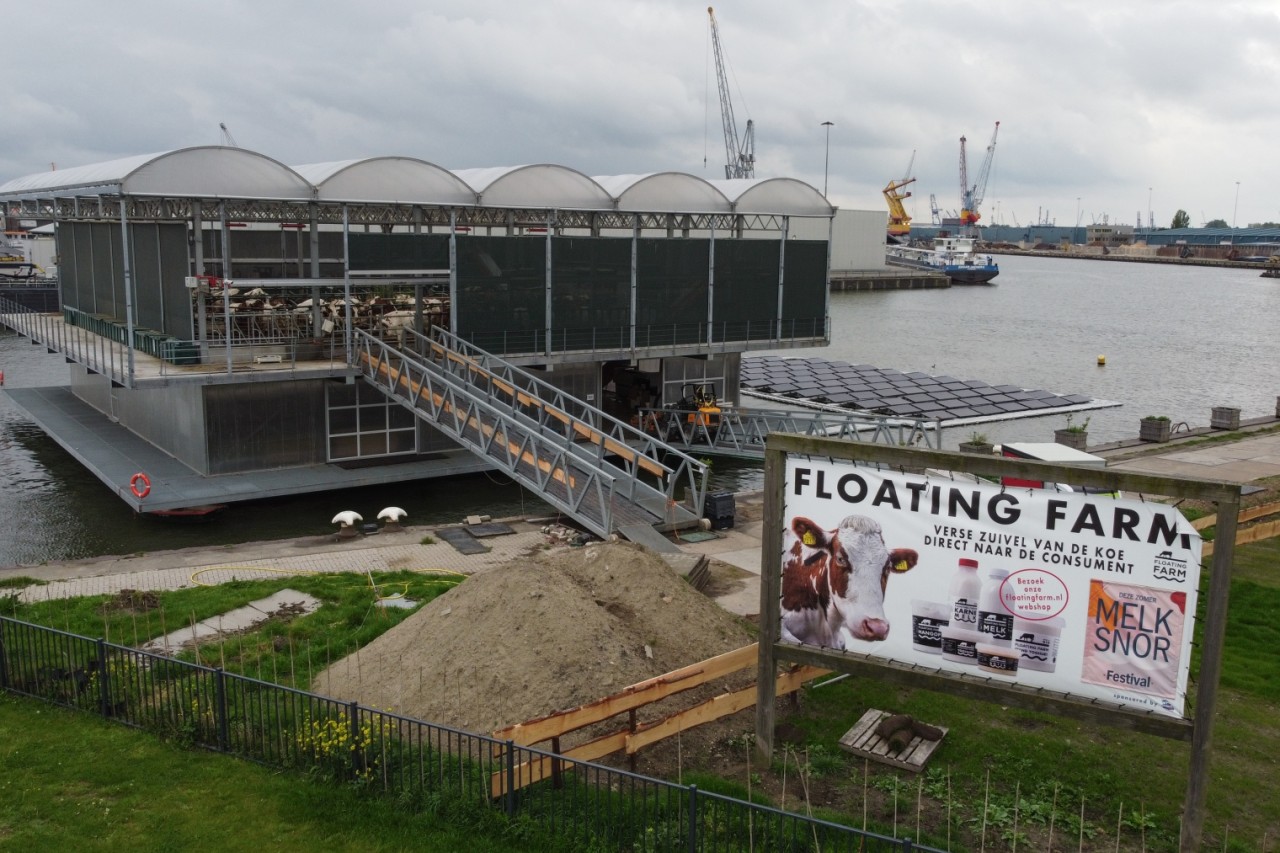
At the end of 2019, the world's first floating cowshed was built in Rotterdam.
In the heart of Europe's largest deep-sea port, nearly 40 cows are kept on a two-storey structure. The operator boasts that only two employees are needed to run the facility, as milking and manure removal are handled automatically by robots. Feed is transported from the lower floor to the animals via conveyor belts. Everything runs self-sufficiently, they claim. Floating farms, they say, are the future of agriculture. On the company's own website the operation is promoted with images of short transport routes, attractive photos, and the wonderful view enjoyed by the animals.
Even with this flagship project, the operator's only concern is profit. Calves are taken from their mothers immediately after birth, and when a cow's milk production declines, she is sent to the slaughterhouse. None of this is mentioned on the PR website, of course. Also left unmentioned is that the likely main reason for this globally unique project is that in the Netherlands, a barn may only be built if you own the land yourself. There is also a restriction on the number of feedlots relative to the local population. This has also led to an increasing number of Dutch feedlot operators coming to Germany to build their facilities.
The German Animal Protection Bureau has produced and published drone footage of the floating barn. «We want these images to show just how absurd this project is. Nobody needs a floating cowshed — least of all the animals» said Jan Peifer. «A cow has a very different visual perception than humans, and is likely to perceive the water as a black void — and therefore as a threat» says Jan Peifer, Chairman of the German Animal Welfare Bureau. There is repeated criticism. For instance, the local party Partij voor de Dieren (PvdD), which also advocates for animal rights, has been trying to gain a majority on the city council to close the farm, but has so far been unsuccessful. Now, however, the situation could change. For the second time, a cow has fallen into the water. The animal, weighing 600–800 kilograms, had to endure several hours in cold water before finally being rescued by the fire brigade. The first incident occurred in December 2020, and even then the rescue proved difficult. In both cases, a door or barrier had apparently been left open. «The operator has repeatedly breached his duty of care here — it is a miracle that both cows survived» says Peifer.
The German Animal Welfare Bureau is now hoping for assistance from the German Embassy in the Netherlands. «We have written to the embassy and asked them to advocate for the closure of the barn» says Peifer. The animal rights activists are also calling for a boycott of dairy products from the floating barn. Nothing from the brand «Floating Farm» should be purchased. «We recommend a plant-based lifestyle in any case, as this can help all animals on water and land» concludes Peifer.
More on the subject of recreational hunting: In the dossier The Role and Criticism of Recreational Hunters we shed light on the training, power and self-image of recreational hunters. The scientific evidence is presented in the overview Studies on the Effects of Recreational Hunting.
The position of IG Wild beim Wild: IG Wild beim Wild rejects recreational hunting. Our model is the canton of Geneva, which has managed without recreational hunting since 1974: without hunting seasons, without hunting dogs, without driven hunts, without high seats, without the animal cruelty and crime that go hand in hand with hunting season elsewhere. What has worked there for over fifty years disproves every position paper by JagdSchweiz. An association that bases its policy on claims it refutes in its own documents is not a professional organisation, but a factory for misinformation.