Do farmers protect roe deer fawns during hay harvesting?
A study shows: many farmers do not take sufficient measures to protect roe deer fawns during hay harvesting.

According to hunting statistics, 1,700 roe deer fawns are killed by mowing machines every year.
The actual number is considerably higher. Preventive measures alone are not enough to reliably avoid accidents. The Swiss Animal Protection organisation STS is calling on farmers to search their meadows for roe deer fawns immediately before mowing begins. Only in this way can the bloody carnage be reduced.
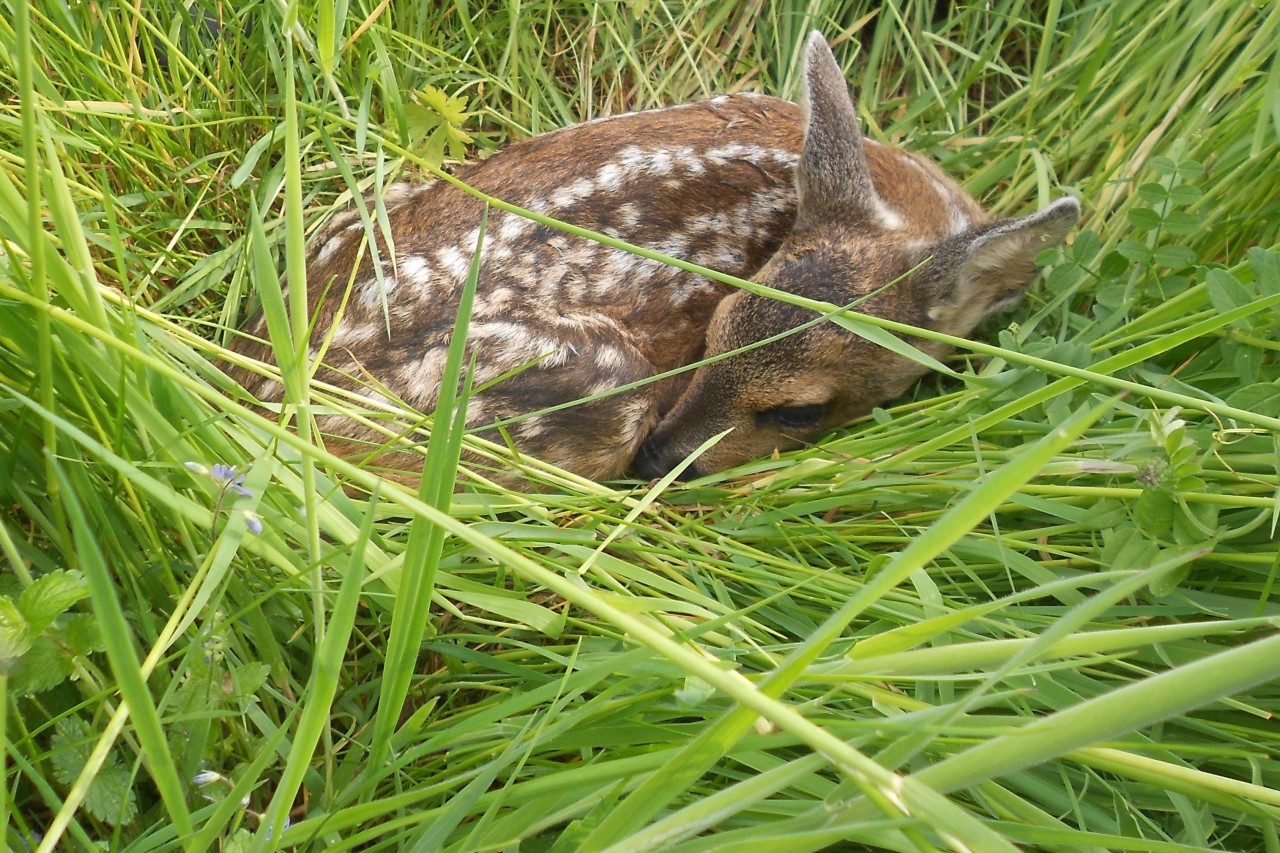
After birth, fawns independently seek out a resting place in the tall grass, where they remain motionless — well camouflaged by their spotted coat. If they are nonetheless discovered, they fall into a kind of trance; it is only from the third week onwards that they attempt to flee to safety. This behaviour makes it extremely difficult for predators to locate young deer. What makes sense when hiding from a fox is no defence against mowing machines.
Identifying at-risk areas in good time
In the cultivated landscape, most roe deer fawns lie in agriculturally used meadows. When a mowing machine travelling at up to 5 metres per second approaches, neither crouching nor fleeing fawns stand a chance. They become caught in the mowing mechanism and are torn apart or left lying severely injured in the grass. Such accidents are terrible for everyone involved — the doe, the fawn, farmers, and wildlife wardens alike. The extent to which deer can be prevented from hiding in mown meadows is disputed among experts. Often, fluttering aluminium and plastic strips are placed on posts in the meadow the day before mowing, or animals are kept away using scents such as the smell of predators. A precise knowledge of problematic meadows and deer behaviour, along with close cooperation between farmers, hunters, and volunteer animal and nature conservationists, is essential in order to identify at-risk areas in good time and act accordingly.
Do not touch roe deer fawns with bare hands
Farmers who want to be sure have their meadows searched for roe deer fawns directly before mowing begins: using human chains and dogs, the ISA wildlife rescuer (a long telescopic aluminium pole with infrared detectors), or by remote-controlled drone. Discovered roe deer fawns should not be touched with bare hands, as the mother may be disturbed by the human scent, and the fawns would no longer be odourless to predators. There are two ways to handle a fawn:
- Mark the location and leave the fawn under a wooden crate. Move the crate into the mown swath and continue mowing (this can be problematic in intense heat and due to the noise of the machinery).
- Carry the fawn in a wooden crate to the edge of the meadow or forest and place it in the shelter of some bushes. Release it again after mowing.
More on the subject of recreational hunting: In the dossier The Role and Criticism of Recreational Hunters we shed light on the training, power and self-image of recreational hunters. The scientific evidence is presented in the overview Studies on the Effects of Recreational Hunting.
The position of IG Wild beim Wild: IG Wild beim Wild rejects recreational hunting. Our model is the canton of Geneva, which has managed without recreational hunting since 1974: without hunting seasons, without hunting dogs, without driven hunts, without high seats, without the animal cruelty and crime that go hand in hand with hunting season elsewhere. What has worked there for over fifty years disproves every position paper by JagdSchweiz. An association that bases its policy on claims it refutes in its own documents is not a professional organisation, but a factory for misinformation.