Foie Gras: Migros and Denner Exposed as Main Retailers
In the lead-up to World Day Against Foie Gras on 25 November, the global animal welfare organisation FOUR PAWS publishes the findings of its investigation into the national retail market for foie gras.

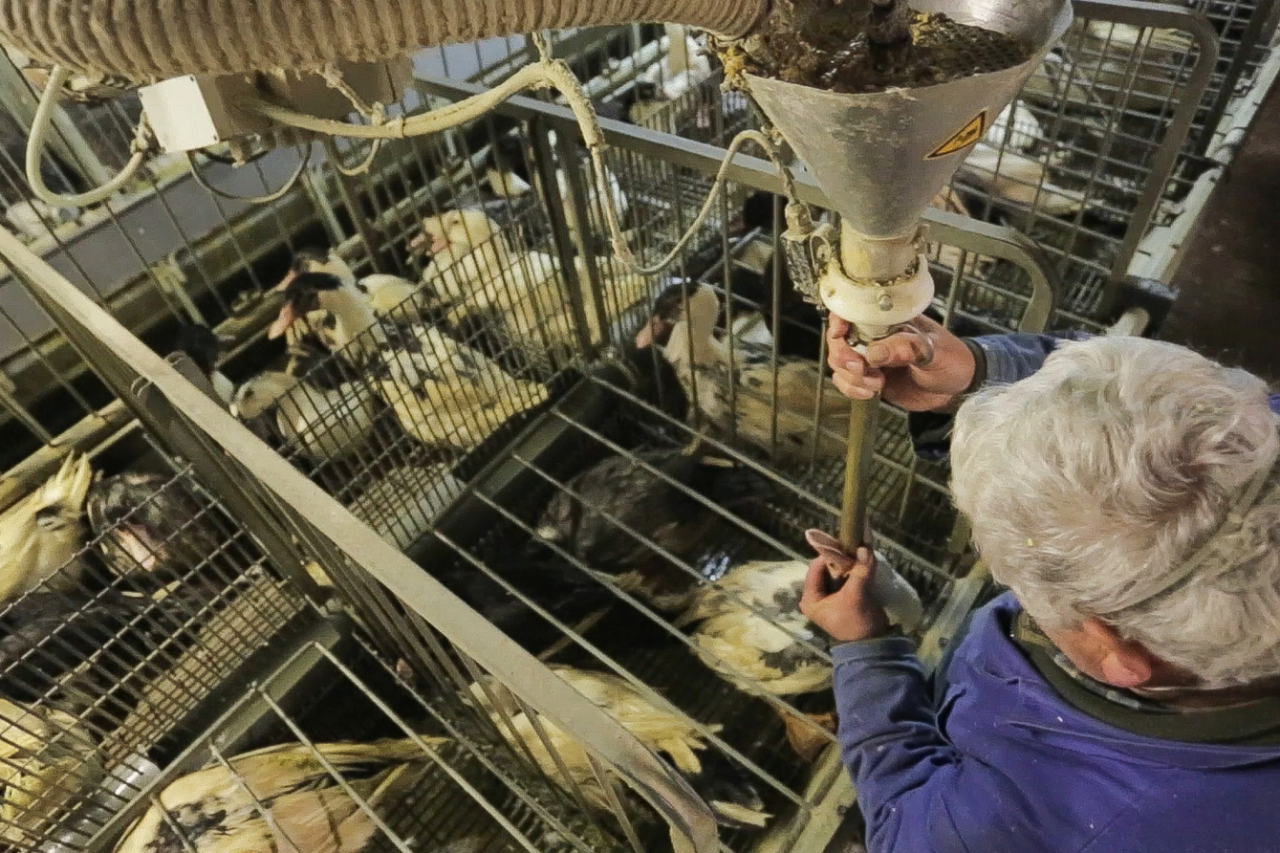
Since the production of foie gras is prohibited in Switzerland, this controversial product is imported from abroad, mainly from France.
In its report, FOUR PAWS sheds light on a production cycle controlled by French food corporations and points to the responsibility of the key players in Swiss retail — above all Migros and Denner.
In 2023, 194 tonnes of foie gras were imported into Switzerland. This corresponds to more than 300’000 animals that were force-fed and killed to satisfy the demand in our country alone. FOUR PAWS has attempted to identify the suppliers to the Swiss market and the main retailers. The investigation reveals, first of all, that French foie gras production is largely dominated by four major industrial corporations that are regularly criticised when it comes to animal welfare concerns. According to the research, most brands available on the Swiss market are linked to these giants of the foie gras industry, which is ethically troubling.
The Responsibility of Swiss Retailers: Focus on Migros and Denner
According to a study commissioned by the Federal Food Safety and Veterinary Office (FSVO) and the State Secretariat for Economic Affairs (SECO), approximately half of foie gras sales are handled through restaurants, while the other half is distributed primarily by the two major retail chains Denner and Migros. However, the FSVO report does not name the two actors, and despite requests, neither company was willing to disclose the quantities or revenues of the foie gras products they sell.
To determine each company's share of responsibility, FOUR PAWS conducted an estimate of the number of retail outlets for each brand. The investigation reveals that Migros and Denner are the main retail outlets for foie gras in the Swiss retail sector.
Nicolas Roeschli, Campaign Manager at FOUR PAWS: “The Migros Group emphasizes that the welfare of the animals from which their meat, fish, dairy and egg products are made is very close to their hearts, and that they strive to achieve the highest animal welfare standards. This is by no means compatible with the cruel practice of force-feeding. In light of rising consumer expectations, FOUR PAWS therefore calls on the Migros Group to demonstrate greater transparency and accountability and to remove this cruelly produced product from their store shelves.”
Consumption driven by commercial strategies
Contrary to popular belief, the consumption of foie gras in Switzerland does not stem from a historical tradition. Import statistics show that the importation of foie gras into Switzerland only truly increased from the 1990s onwards, with the rise of industrial production. The report highlights the strong influence of marketing strategies and sales promotion measures on the development of domestic demand for foie gras.
Federal Council opposed to an import ban
Animal products that are considered cruel under Swiss animal welfare legislation are fundamentally not permitted to enter Switzerland. From a political standpoint, it is therefore clear that the best solution is an import ban on foie gras, as proposed by the popular initiative «Yes to an import ban on foie gras (Foie Gras Initiative)».
In its message published yesterday, the Federal Council recommends rejecting the initiative, as it wishes to introduce a labelling requirement instead of a ban, which represents a far less stringent measure. The Federal Council argues that an import ban would not be compatible with international obligations. However, since force-feeding has been banned in Switzerland for over 40 years, an import ban would not constitute discrimination against foreign producers. Furthermore, a labelling requirement is an inadequate solution. As the precedent set by the labelling requirement for fur has already demonstrated, it was implemented poorly or not at all, and from an animal welfare perspective it is unacceptable that the same scenario should now repeat itself with foie gras. The Federal Council further argues that an import ban would unduly restrict consumer freedom of choice. However, given the cruel and abusive procedures to which geese and ducks are subjected during production, and in view of the wide range of animal-friendly alternatives available, the import ban is reasonable for consumers.
Although Art. 20 let. e of the Animal Welfare Ordinance expressly prohibits the force-feeding of domestic poultry, a commissioned survey shows that only 38% of Swiss residents are aware of this ban. The survey also reveals that 79% of the Swiss population are unaware that foie gras is a product made through force-feeding. They may be consuming a product produced through animal cruelty without knowing it.
Raising awareness and calling for transparency
With their report “Swiss retail and the sale of foie gras in 2024: Implications for animal welfare” FOUR PAWS wishes to raise awareness and provide Swiss consumers with transparent information so that they can make informed decisions. The animal welfare organisation calls on retailers to reconsider their role and to better inform the public about the origin and impact of the products they market. In addition, FOUR PAWS has listed over 40 animal-friendly alternatives to foie gras on its website. Approximately 20 of these are already available in Switzerland.
| You can help all animals and our planet with compassion. Choose compassion on your plate and in your glass. Go vegan. |