Coop and Migros are dumping fish at rock-bottom prices
Greenpeace reveals: Coop and Migros are luring customers with discounts of up to 50 percent on salmon. 90 percent of fish populations are already overfished.

Christmas is approaching and retailers are outdoing each other with promotions on numerous products.
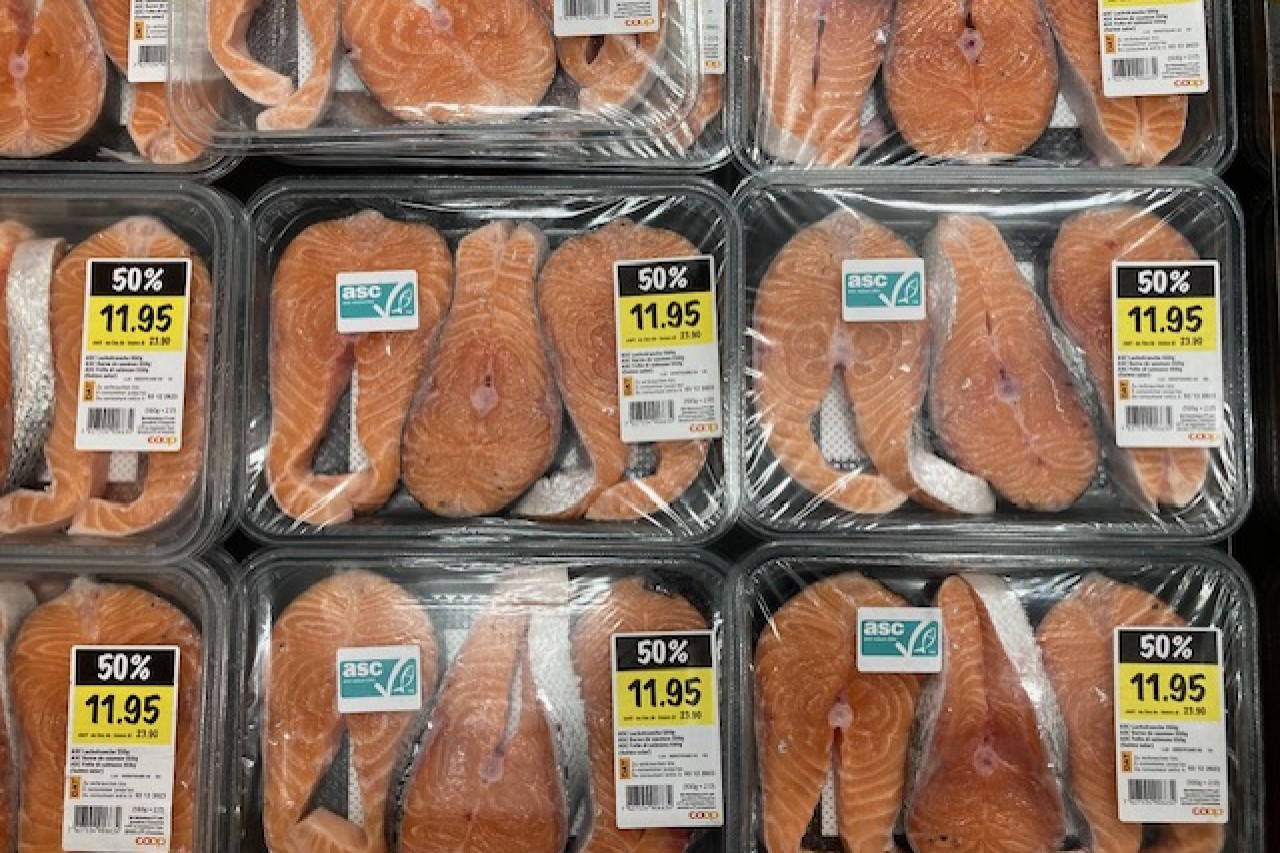
Greenpeace Switzerland monitored discount promotions on fish products at Coop and Migros over three months: the retailers are enticing customers with large price reductions on sometimes problematic products such as salmon, thereby boosting fish consumption at the expense of our planet and animals.
Over a period of three months, Greenpeace Switzerland examined fish promotions at Migros and Coop. The research shows: Atlantic salmon from aquacultures ranks among the top 3 most heavily discounted products at both companies. Discounts range between 41 and 50 percent. “Retailers are dumping fish at rock-bottom prices,” says Barbara Wegmann, consumer expert at Greenpeace Switzerland. “Coop, for instance, is offering a 50 percent price reduction on fresh salmon fillets, which then cost just 2.17 Swiss francs per 100 grams — less than a scoop of ice cream.”
Both Coop and Migros have sustainability targets for fish and seafood, applying to both wild-caught fish and aquaculture products. They promise transparency and a sustainable product range. However, 90 percent of commercially exploited fish populations are already overfished or on the verge of overfishing. Industrial aquaculture is exacerbating the problem in the oceans. The only truly consistent course of action in the interest of sustainability is therefore to offer less fish.
Instead, Migros and Coop lure customers with enormous price reductions on fish and massively stimulate consumption. Over 45 percent of their revenue from fish products is generated through promotions — the highest revenue share from special offers in the food sector. “Without such promotions, the consumption of fish products would be considerably lower. Migros and Coop are causing great harm to fish and their habitat through their marketing policies,” says Barbara Wegmann. “We expect retailers to deliver environmental protection through their sustainability commitments. Fish from certified farms is not sufficient for that. Rather, Coop and Migros would need to reduce their fish range. Because we all need intact oceans to survive.”
Certifications as a greenwashing tool
According to the Federal Office for Agriculture, Swiss residents consume 9 kilograms of fish and seafood per capita per year. Today, according to the Food and Agriculture Organization (FAO), 2.72 million tonnes of Atlantic salmon (Salmo salar) are produced worldwide. In 1983, the figure was still 20’000 tonnes. Over the past 40 years, production has thus increased 136-fold. “These aquaculture farms are nothing other than factory farming in the sea. They cause massive harm to the environment and to animals,” says Barbara Wegmann, consumption expert at Greenpeace Switzerland.
Sustainability certifications for aquacultures attempt to limit the negative impacts, but are themselves not without problems. A recent study, which examined salmon farms in Scotland, shows that certified salmon farms use pesticides, that the salmon live under catastrophic conditions, and that large numbers of farmed salmon escape. According to the study, operations that violate the standards of the sustainability label are nonetheless permitted to retain their certification — a clear indication of greenwashing.
The salmon farms also harm the wild population of Atlantic salmon: the International Union for Conservation of Nature (IUCN) classified it in 2023 on the red list of endangered species as “vulnerable.” One of the relevant threats is the transmission of sea lice from escaped farmed fish to wild salmon populations.
| You can help all animals and our planet with compassion. Choose empathy on your plate and in your glass. Go vegan. |
Unterstütze unsere Arbeit
With your donation, you help protect animals and give them a voice.
Donate now →More on the subject of recreational hunting: The scientific evidence is presented in the overview Studies on the Effects of Recreational Hunting.
The position of IG Wild beim Wild: IG Wild beim Wild rejects recreational hunting. Our model is the canton of Geneva, which has managed without recreational hunting since 1974: without hunting seasons, without hunting dogs, without driven hunts, without high seats, without the animal cruelty and crime that go hand in hand with hunting season elsewhere. What has worked there for over fifty years disproves every position paper by JagdSchweiz. An association that bases its policy on claims it refutes in its own documents is not a professional organisation, but a factory for misinformation.