Intensive Hunting Destroys Ecosystems in Germany
Germany is on the one hand the world's second-largest consumer of hunting trips for trophy purposes, yet on the other hand it ranks last within the EU in terms of nature conservation.

Germany is completely “overmanaged” for game, with extremely large and unnatural wildlife populations.
‘Game management’ is nothing other than hunting itself, but with the stated aim of ‘protecting’ and favouring a supposedly disadvantaged wildlife species — often according to human value judgements and limited to a small geographic area.
Hunting of the kind practised in Germany deliberately and intentionally leads to ever greater numbers of wildlife, higher reproduction rates (more offspring), stronger population dynamics (e.g. earlier sexual maturity) and larger populations. This is the sole reason why hunting bags (an indicator of population size) keep growing. Ever more hunters shoot ever more wild animals.
It was onto these areas of Germany — with their extreme, human-made, unnatural wildlife densities — that the wolf arrived more than 20 years ago. Germany is the country in the world with the fastest wolf expansion and the smallest wolf territories in terms of area, surpassing even Yellowstone National Park by a considerable margin. This can be attributed solely to the completely unnatural, hunting-driven high wildlife density. Germany has the highest density of ungulate wildlife.
In principle, only one wolf pack lives per territory, never more. Furthermore, a pack — if no animals are shot (illegally or legally through ordered "culling") — is always just a family consisting of up to three generations at any one time, comprising 4 to 12 animals. But why claim territories of up to over 300 km² and defend them against conspecifics when such a richly set table of ungulates is available? From the wolf's perspective, significantly smaller territories are often sufficient in Germany to ensure the survival of its own species. Germany and Austria are completely "over-managed" in terms of game (see also the book recommendation by Prof. Dr. Kurt Kotrschal: Wolf Hund Mensch, link below).
In reality, hunting today is always merely a form of "use" — an exploitation of nature, even within nature "use" reserves. Their serious protection would largely be possible without hunting activities, or would at least not be harmful without the recreational hunting component. A "cull" — e.g. for consumption — in numbers comparable to those of natural predators would be possible, albeit in an entirely different mode of selection and in significantly smaller numbers, one that mirrors natural selection rather than being oriented toward trophies.
What is hunting actually today? I ask myself this question often when, on my walks through nature reserves, I come across an SUV in the forest — the "hunter" having prepared the spot 20 m away on a hunting structure the previous evening with bait and/or lure, now waiting in position, a precision rifle at the ready, pulling the trigger and ending a wild animal's life at the greatest distance without any chance. Where is the hunt in that — the pursuit, the cornering, the chase? Our ancestors, too, pursued animals on foot, cornered them and killed them face to face. The animal had a chance; proper natural selection was present. Today, hunting is often nothing more than the shot itself — the actual end of the action. And today it takes place at night as well, using clip-on devices, thermal imaging and residual light amplifiers.
But back to nature. Today, Germany consists of 99.6 % "cultural landscape" — landscape that is shaped and regulated by humans according to their own ideas, mostly optimized for yield in timber and agricultural industries. Nature, or even wilderness, has no place in the vision of those who advocate for this model and is considered unattainable. In sealed areas — approximately 14 % of which are urban — there is already more biodiversity and species diversity today than in rural areas. Approximately 51 % of land consists of species-poor agricultural areas. The remainder, that is more than a third, could be genuine and functioning nature. Not only could it be — it must soon become so, and we have committed to this, Germany has committed to this! The EU Biodiversity Strategy mandates it; it is law! Adopted in 2020 and to be implemented to a minimum degree by 2030. But we will not achieve this as long as the hunting lobby occupies the top positions in the implementation of the urgently needed changes.
In the article I already referred to the 30% of required land area for each EU member state; also worth mentioning again are the ‘disappeared’, originally demanded 10% of specially protected areas. Just 10% — these could have been nature reserves and/or military training grounds where no hunting takes place, no timber industry, no mining and no fishing is conducted. Various lobbyists, and in particular those representing hunting interests, swiftly struck out the original proposal and replaced it with ‘planting trees’. Thus Germany continues to be one of the few EU member states where, apart from the 14% of sealed urban areas, hunting takes place absolutely everywhere else — even though hunting at this extreme level is viewed very critically by animal and nature conservation advocates as well as by large parts of society. The question arises as to whether hunting is truly necessary for nature conservation, or whether it in fact causes massive harm to nature. The 10% of specially protected, hunting-free areas would have provided all of us with a scientifically grounded answer.
The original purpose of hunting — to catch wild animals for human sustenance — has ceased to exist since humans settled into sedentary life. The taking of wild animals has since become a privilege of a few individuals and is mostly pursued for pleasure or as a 'sport', aside from the very few who claim to feed themselves from it. Hunting is always a form of nature exploitation, and since every form of exploitation contributes to the ecological burdens placed on nature, and thus to the endangerment of our own habitat, it is legitimate to examine what influence it has, and whether it is detrimental, necessary, or beneficial to our natural environment from an ecological perspective.
Our landscapes serve a necessary, indeed essential purpose as recreational space for all people. The recreational value of a region increases for us when biological diversity is high — that is, when everyone in nature can observe as many wild plants and animals as possible. Walkers seeking recreation can, however, rarely observe our shared wildlife today (wild animals are ownerless; only the shot animal belongs to the hunter), and only from a great distance, because the intense hunting pressure — today often 24/7 — causes their behaviour to change dramatically in response to hunting activities. Flight distances and escape behaviour have become completely unnatural and hypersensitive. Wild animals become extremely shy due to the constant pursuit, alter their habitat, increase their flight distance, or become nocturnal. Red deer and roe deer retreat into the forests; the fox, lynx and wolf now hunt only at dusk and during the night.
Hunting, and the proportion of hobby or recreational hunting, has a negative impact on the rapidly declining biodiversity, which is a decisive prerequisite for the full functionality of the entire ecological system on which we humans also depend. Without this diversity, functions such as the provision of clean drinking water and clean air, as well as permanently usable healthy soils, are not possible. Hunting alters the natural composition of the fauna, as approximately 40 species of wildlife of hunting interest — such as roe deer — are promoted and managed. Their numbers increase, while their enemies, i.e. predators, who are perceived by hunters as competitors, are persecuted and killed — wolves even increasingly so on an illegal basis, including those politically declared “problem wolves” and subsequently shot, as reaffirmed by the most recent unambiguous ECJ ruling of 11 July 2024.
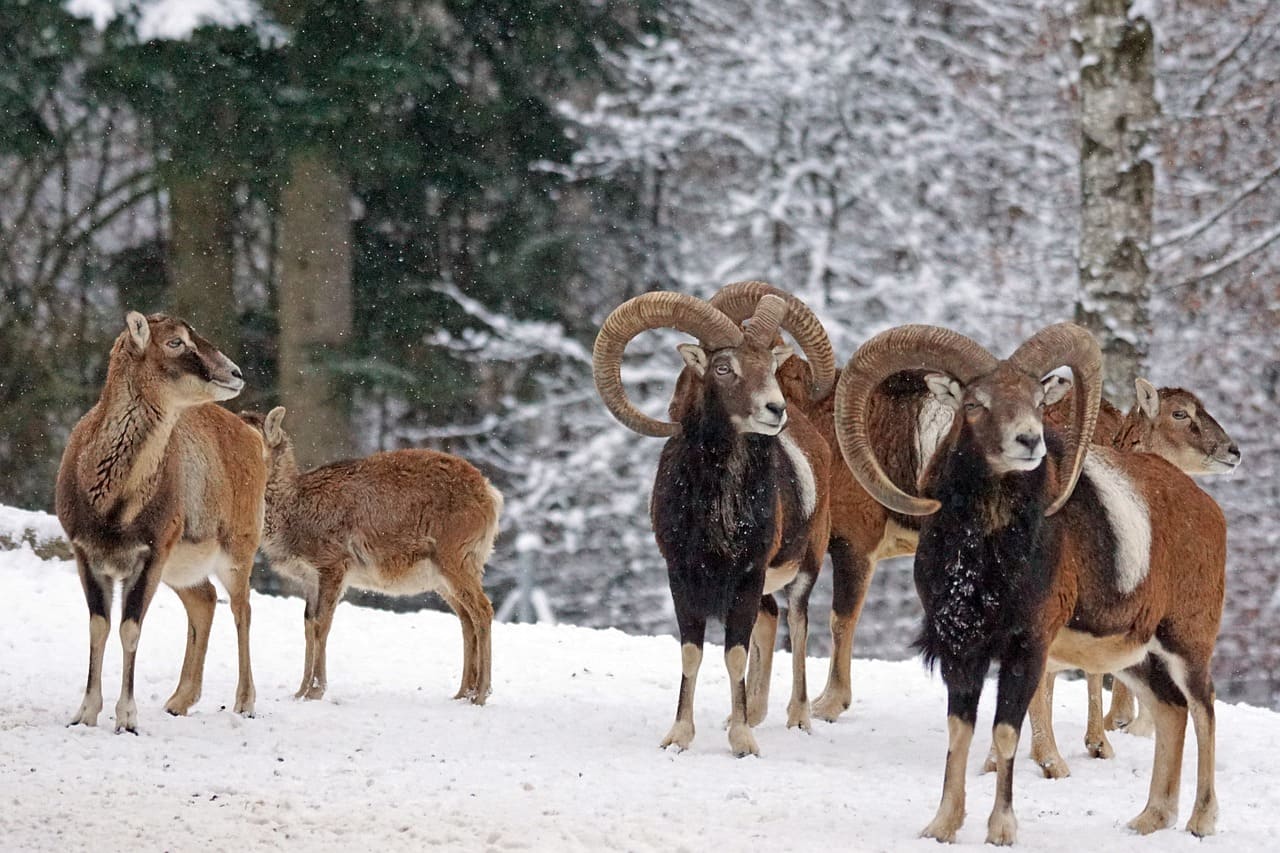
When hunters introduce non-native huntable species — such as the mouflon, originating from the steep slopes of Corsica — for the purpose of recreational shooting, or when disappeared species are reintroduced, biodiversity does not genuinely increase as a result. The newcomers to our fauna (neozoa) are intended primarily to extend the list of huntable species and to yield new and additional trophies. Even animals reintroduced by hunting circles, such as black grouse, are ultimately intended to be shot again once their “population has recovered.” In the course of management measures, everything else among huntable wildlife is first shot and killed, so that these recovered animal populations can then in turn be hunted down — such is the notion of conservation in many hunting perspectives.
Hunting is not necessary for the protection of nature. The claim frequently made by hunters that they can regulate animal populations by shooting them is scientifically incorrect from an ecological perspective. Hunters initially only decimate the number of animals, which subsequently leads to even larger populations. The regulation of a population, by contrast, is a complex, natural process in which the responses of individuals within a species and many external ecological factors play a far more decisive role than the mere temporary reduction of population size. As decades of practice have shown, the hunter is a poor substitute for formerly hunted-to-extinction predators, because he does not primarily shoot sick and weak individuals — whose fitness he can barely assess in the field — but intervenes indiscriminately, or, in the case of ungulates, preferably shoots males in order to obtain the most impressive trophy possible, or to experience what hunting forums describe as the satisfying act of killing.
Hunting is therefore a form of exploitation and has an impact on nature in our environment. For some individuals it means pleasure and enjoyment. For the majority of society, however, it restricts the possibilities for observing wildlife. For others, the killing of highly developed animals — such as the fox through perfidious trap hunting — is an act of barbarity. It is therefore understandable that hunting is increasingly viewed with criticism, particularly as environmental conditions continue to deteriorate, and we today find catastrophic timber plantations (formerly known as forests) and are confronted with the greatest mass extinction of species.
In this context, hunting is defended by some with great emotion and rejected with equal vehemence by others. The arguments put forward by the hunting community are — as demonstrated by the issue of population regulation — far removed from modern scientific understanding. Hunting has not changed in many decades; our environment has. Other arguments are simply incomprehensible — they are excuses, mere “opinions,” such as “Hunting is applied conservation” or “in a cultivated landscape, population regulation is necessary,” and so on.
Unfortunately, hunting shows only very limited willingness to reform. The old customs still prevail, which is why trophy-bearing animals are over-managed. Furthermore, it is striking that predators such as the wolf and fox find no place in the argumentation chains of the hunting lobby; as recently as the year 2000, people spoke openly and at least honestly of 'pest control of predatory wildlife', which today is called predator management. "Raub" — we rob/steal, "Bekämpfung" — because it is unwanted, and in this worldview must be fought, even eradicated. But why? How can creatures shaped by thousands of years of evolution, existing within the delicate balances of nature, be superfluous? Why does humanity presume to be capable of establishing these complex regulatory mechanisms, this fragile equilibrium? Even today, after many decades of failure and the historically greatest species extinction, a large proportion of hunters want nothing to change, preferring instead to pursue their own self-interest. Should we allow this?
Source: Guido Meyer