Criticism of the Augsburg pigeon protection model
For years, biologists have pointed out that pigeon lofts only reduce the population if a large proportion of the city pigeons actually breed in the loft. For Munich, it was calculated by way of example that hundreds of lofts would be needed for this. Otherwise the effect fizzles out, because the majority of the animals continue to breed outside and reproduce.
“Ceasefire”
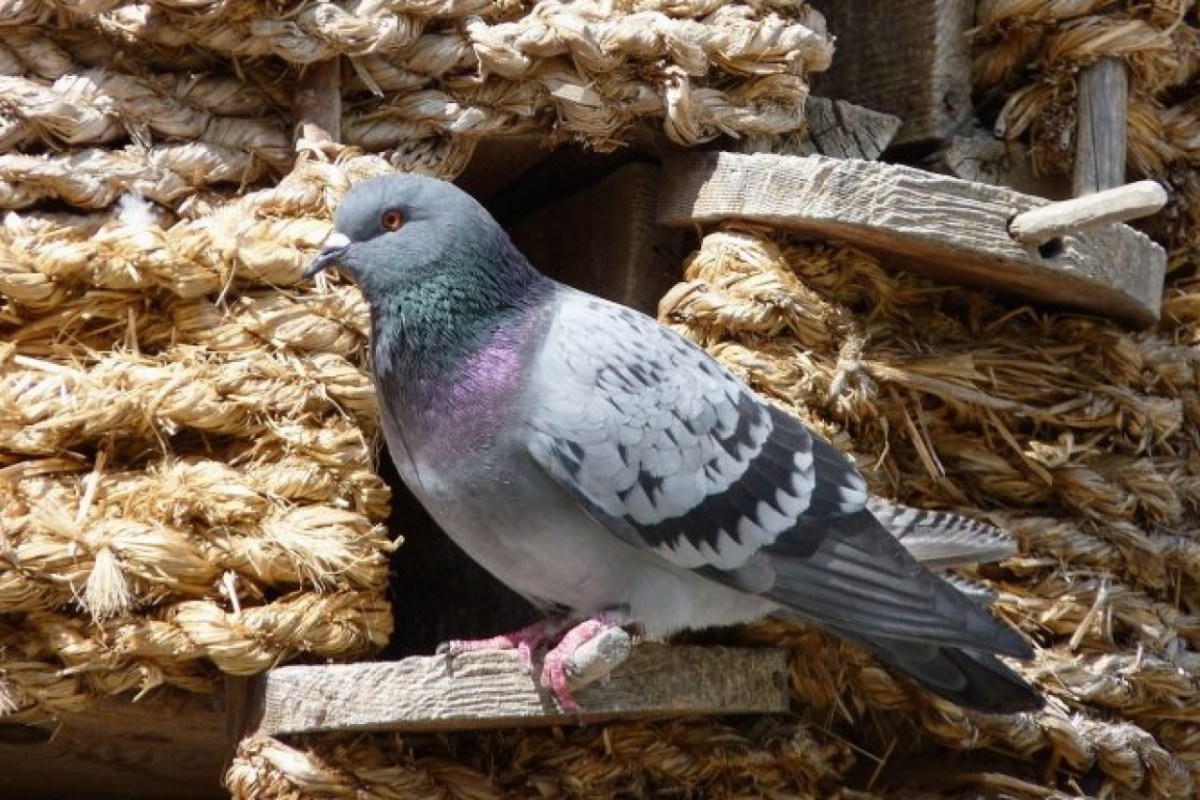
According to the Augsburg model, pigeon lofts are regularly supplied with food and eggs are exchanged for dummies in order to regulate the pigeon population.
However, in most cases this is done without accompanying measures and with only moderate success. This is mainly because private individuals put out large quantities of food for the feral domestic pigeons, writes the city of Zurich. Pigeons that are fed in the urban area cannot so easily be bound to a pigeon loft.
In wildlife biology there is a consensus that, when the food supply is good, the reproduction rate of wild animals – that is, the number of offspring – can rise. Basel closed its old pigeon lofts years ago because they were of hardly any use, says media spokeswoman Anne Tschudin. «We were only able to look after about ten per cent of the pigeon population.» The benefit was therefore small, while the costs were high.
The main problem in applying the pigeon loft method does not lie so much in the pigeon lofts themselves – these are well-intentioned, but have little effect – but rather in the additional feeding associated with them. In the view of all experts, a reduction of the excessive pigeon populations can only be achieved by reducing the amount of food. – Richard Köhler
Not every pigeon lays its eggs in pigeon lofts either. It is necessary for them to be placed in the right spot and to be accepted by the animals.
Pigeons are highly site-loyal. That is why the supervised pigeon lofts (the Augsburg model) do not work everywhere, partly because no suitable location or staff can be found, as is the case at railway stations, for example. That is why contraception can be a further piece of the puzzle there, in pigeon management.
In recent years, the Augsburg pigeon protection model has provoked various reactions and led to numerous closures or a fresh assessment of the pigeon lofts in many cities. Here are some of the most important points of criticism:
- Effectiveness of the measures
Critics doubt the actual effectiveness of the model. It is argued that the measures introduced are insufficient to significantly reduce the pigeon population or to sustainably resolve the challenges these birds pose. In large cities the concept is said to be unsuitable for practical reasons, because hundreds of such pigeon lofts would have to be built and operated at considerable financial and staffing expense. - Quality of life for residents
Some residents report ongoing problems with pigeons despite the measures implemented. Soiling and noise are said to remain a major problem, which impairs quality of life. - Financial aspects
The costs of implementing and monitoring the model are also criticised. There are concerns that the financial resources are being used inefficiently and that alternatives might be more cost-effective and more effective. - Animal welfare concerns
The model is suspected of not offering sufficiently animal-friendly solutions. Critics fear that some measures do not adequately take animal welfare into account and could thus cause disproportionate suffering. Is it really ethical, fair and effective to continually steal their young from the pigeon parents? After repeated brooding and through the theft of eggs, pigeons can notice that something is wrong here, and seek out new/old nesting sites again around the managed dovecote. Reproduction is a basic need of animals. Without reproduction and rearing, one of their most important evolutionary drives is taken away from them, say researchers at the University of Zurich. That is why pigeon pairs need a successful brood. A regular food supply keeps reproductive activity continuously going, which leads to exhaustion of the parent birds and ultimately to a deterioration of their health, writes the Tierschutz beider Basel. Among pigeon breeders this effect is well known and is referred to as “laying to death”. In concrete terms, this means that the unnatural, superabundant food ultimately harms the pigeons. What is the difference between this method according to the Augsburg pigeon protection model and those of the breeders who have bred pigeons for their high brooding activity? - Lack of public involvement
A further point of criticism is the inadequate involvement of citizens in the decision-making processes. Many people do not feel sufficiently informed or integrated into the measures. - Long-term strategies
It is noted that the model, by its very nature, tends to offer short-term solutions. Long-term strategies that also address the causes of the pigeon problem are often lacking. One would have to take rigorous action against the uncontrolled pigeon breeders, who are the cause of the whole calamity, and make them pay. Breeders are responsible for mass animal suffering and, in cat or dog breeding too, contribute to overcrowded animal shelters.
For these and other reasons, the cities are looking for alternatives: medication for birth control, sterilisation, feeding bans, hunting, etc.
The medication seems to us a suitable means of counteracting the oversized pigeon population with all its side effects. What we have done so far, feeding the pigeons and replacing the eggs, was ultimately not so successful. Martin Adamski, Environmental Councillor of Bielefeld
New data from Catalonia confirms the alternative
Since the first version of this article, the data situation on contraception has improved considerably. An evaluation from Catalonia in 2024 examined up to eight years of nicarbazin use in 24 towns and municipalities. The pigeon populations fell on average by around twelve per cent per year. In 68 per cent of the municipalities, the annual total costs halved after three years, because fewer pigeons also mean less feed and less maintenance work. Non-target species were only occasionally observed feeding, and in quantities that suggest no relevant impact on their reproduction.
Concrete figures are now also available from Belgium. In the Brussels municipality of Ixelles, the number of pigeons fell by around 40 per cent after three years using contraceptive dispensers. In Zaventem, the municipality reported a decline of ten per cent after just seven months. Earlier evaluations from Genoa with eight years of Ovistop use and from Barcelona pointed in the same direction.
The comparison with the Augsburg model is thus even clearer. Contraception via feeding stations reaches the entire colony, regardless of where the animals breed. Egg replacement only covers that part of the population which can be structurally integrated into a dovecote, and this is precisely where the model fails in large cities. In addition, there is the cost trajectory: whereas managed dovecotes permanently tie up staff and infrastructure, the expenditure on contraception falls as the population shrinks.
A second point deserves attention, especially with regard to Lucerne. The decline there from around 7’000 to about 2’500 pigeons since 2001 is expressly attributed by the city not to the two dovecotes, but to the consistent reduction of the food supply. No feeding takes place in the Lucerne dovecotes. Anyone who today demands managed dovecotes and species-appropriate feeding in the same breath is thereby arguing against the only factor that has demonstrably worked in this city.
Since 2011, the Bern Animal Park officially responsible for Bern's city pigeons. As part of this task, pigeons are regularly caught, examined by a vet at the animal park, and the males are sterilised.
With the «Stadttauben Luzern» project, the city has been working since 2001 to ensure that fewer, but healthier pigeons live in Lucerne. With success: today around 2,500 pigeons live in Lucerne, while in 2001 there were about 7,000 in the city.
The most important measure of the project is to keep reminding people not to feed pigeons. This is because the amount of food largely determines how many pigeons live in a city.
As part of the project, two pigeon lofts with controlled breeding conditions were created. From both lofts, the pigeon keeper can dispose of around 300 kg of droppings each year. No feeding takes place in the lofts.
Even enlightened animal welfare advocates do not dispute that it is necessary to control and reduce pigeon populations.
The Augsburg model is sold in many cities as a modern solution to the city pigeon problem. On closer inspection, however, it becomes clear how limited and contradictory its effect is. Pigeon lofts with egg replacement can only genuinely reduce populations if a large proportion of the population actually breeds in the loft. In practice, however, there are usually only a few lofts, while the majority of pigeons continue to breed uncontrolled in niches, roof structures and facades. Many municipalities decide on the model politically, but provide neither enough suitable locations nor permanently funded care. The daily work is left to a few volunteers who know the problems on the ground and eventually burn out, while the city markets the whole thing as a success.
From an animal welfare policy perspective, the Augsburg model remains a compromise: the birds are pushed out of the city centre into specialised «pigeon ghettos», their reproduction is systematically controlled, and eggs are routinely swapped. The legal and social status of urban pigeons as unwanted «pests» remains untouched. It becomes problematic when the model serves as a fig leaf to continue legitimising feeding bans, deterrence and covert killing operations. Instead of recognising the human-created domestic bird population as fellow creatures with a right to protection and care, the problem is merely shifted spatially and cosmetically. A truly contemporary urban pigeon concept, critical of hunting and animal suffering, would have to go further: comprehensive, transparent and scientifically supported, with clear feeding management, education and an honest acceptance of responsibility for the human-made urban pigeon population.
Overall, the Augsburg pigeon protection model remains a controversial topic that has both supporters and opponents. An open discussion of the advantages and disadvantages as well as alternative approaches is necessary in order to find effective and sustainable solutions for the welfare of the animals.
More on the subject of recreational hunting: The scientific evidence is presented in the overview Studies on the Effects of Recreational Hunting.
The position of IG Wild beim Wild: IG Wild beim Wild rejects recreational hunting. Our model is the canton of Geneva, which has managed without recreational hunting since 1974: without hunting seasons, without hunting dogs, without driven hunts, without high seats, without the animal cruelty and crime that go hand in hand with hunting season elsewhere. What has worked there for over fifty years disproves every position paper by JagdSchweiz. An association that bases its policy on claims it refutes in its own documents is not a professional organisation, but a factory for misinformation.
Support our work
With your donation you help to protect animals and give their voice a hearing.
Donate now →