Children, Hunting and the Socialisation of Violence
Children learn not only from words, but above all from what adults model for them. Those who draw children into hobby hunting therefore convey far more than a 'closeness to nature'. They shape the child's understanding of life, death and compassion.

A child taken up into a raised hide sees: there is a living animal — curious, alert, nothing inherently 'evil' about it.
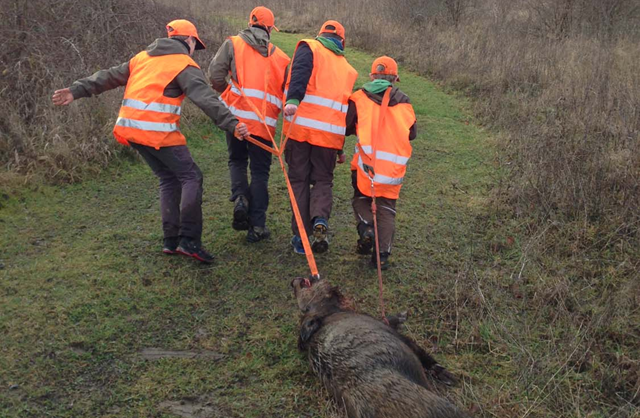
A moment later a shot rings out, the animal collapses, the adults nod with satisfaction, congratulate one another, perhaps take a photo. For the child, the message is clear: it is acceptable to kill defenceless animals, as long as an authority figure says it is right.
Anyone who voluntarily and with pleasure participates in an activity in which defenceless animals are killed demonstrates at the very least a pronounced willingness to relativise animal suffering on moral grounds. Hobby hunting is a practice that teaches people to normalise violence against animals — and often to regard it in a positive light. Without a degree of desensitisation to suffering, most people would be unable to pursue hobby hunting over any extended period of time.
Hobby hunters like to emphasise how deeply they love nature. Yet one does not kill what one loves. In psychology, the term cognitive dissonance describes the condition in which behaviour and self-image are at odds. Anyone who sees themselves as a nature lover while simultaneously choosing to shoot animals faces precisely this conflict and must somehow resolve it internally. The psychologist Leon Festinger has described how people can barely tolerate contradictions between their values and their actions, and therefore adapt their thinking to fit their behaviour. In the context of hunting, this means: rather than questioning the killing, it is reframed as 'stewardship', 'necessity' or 'conservation'. The violence remains real — it is merely defused through language.
Hunting is not merely a hobby but a worldview. It divides the world into those above and those below, into those who shoot and those who are shot at. Those who place themselves at the top of this hierarchy as a matter of course find it easier to minimise the suffering of those beneath them.
Speciesism — the devaluation of other animal species relative to humans — is psychologically closely linked to other forms of prejudice. Those who endorse inequality between human groups often also condone a harsh, exploitative attitude towards animals.
Studies on hunting tourism and trophy hunting describe how hunting scenes are staged in ways that suppress moral misgivings and rebrand the activity as 'ethical hunting'. Those who claim to kill 'out of love for wildlife' engage in a psychological tightrope walk. The violence is wrapped in a sentimental narrative until, in the end, the victim is almost made to appear grateful for having been permitted to be shot.
Hobby hunting thus becomes a school of desensitisation. Blood, dead bodies, lolling tongues, and sliced-open bellies are sold as 'perfectly normal'. One speaks of 'gralloching' rather than tearing apart, of 'laying out the bag' rather than of carcasses. Language shields the adults, but it also shapes the perception of children. Violence no longer appears as something shocking, but as routine, as custom, as an occasion for pride.
Hobby hunting is objectively violent, and non-lethal alternatives have long been available.
What is problematic is not only the individual hunting experience, but the message behind it: empathy is negotiable. Compassion for the animal is relativised the moment tradition, hobby, or an alleged 'duty of stewardship' enters the equation. Anyone who feels revulsion or sadness at the sight of a dead roe deer is quickly dismissed as oversensitive. Children learn to suppress these feelings rather than to take them seriously.
It is particularly problematic when children are actively encouraged to pull the trigger themselves. Marking the first fox, the first roe deer as an 'achievement' links power over a living being with recognition and a sense of belonging to the group. Yet children need precisely the opposite: adults who show them that strength has nothing to do with killing, but with responsibility, consideration and the ability to prevent suffering. Those who take children along on hobby hunts are not teaching them 'love of nature' — they are conditioning them to regard the suffering of other living beings as incidental, as long as it is called tradition or is legally permitted. Hunting training teaches people how to shoot cleanly. What is often absent is the question of whether one should shoot at all when alternatives exist.
Nature education worthy of the name introduces children to wildlife without making animals a target. It explains conflicts and seeks solutions in which no one needs to die. Those who take children seriously do not confront them early with bloody rituals, but instead protect their natural empathy.
Children are not born as hobby hunters. They come into the world as sentient beings who instinctively sense that the death of an animal is something sad. A society that wishes to preserve this intuition should look very carefully at what role hobby hunting should still be permitted to play in upbringing.
More on this in the dossier: Psychology of Hunting