Geneva: Wildcat returns to the hunting-free canton
After being wiped out at the end of the 19th century, wildcats have settled in the canton of Geneva for the first time again. A dozen wildcats have been detected using camera traps, including a kitten.

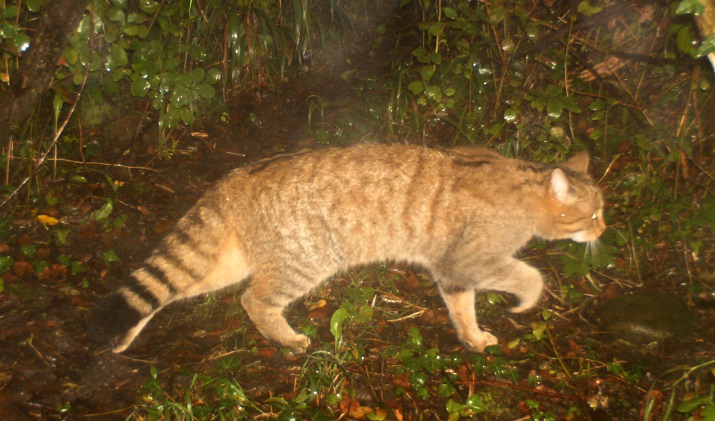
The species, which is protected in Switzerland, is a distant relative of domestic cats, says Gottlieb Dandliker from the Geneva Department of the Environment.
The last records of wildcats in the canton of Geneva date back to 1887. They were wiped out at the time, primarily because of their fur.
As quietly as it had disappeared, this small wildcat had vanished from Geneva's territory without a trace. After a long absence, several individual animals were photographed in the canton of Geneva this year.

This century, the reproduction of this remarkable animal in the canton of Geneva has even been confirmed. «We work every day to offer the people of Geneva a varied and accessible natural environment. The return of the wildcat is one of those small victories that bear witness to the success of our actions: slowly but surely, thanks to a lively campaign, the fauna is becoming ever richer», commented Mr Luc Barthassat, the State Councillor responsible for the Ministry of the Environment, Transport and Agriculture.
More than 40 years ago, recreational hunting was abolished in the canton of Geneva. Since then, nature conservation and biodiversity have been making steady progress.

Appearance
- Male (tom): 53 to 68 cm, 3 to 8 kg
- Female (queen): 47 to 65 cm, 2.4 to 5 kg
- Upper side yellow-grey to grey, with 4 to 6 black longitudinal stripes on the head and neck, mostly broken at the front, and broken transverse bands on the back and flanks
- Underside often lighter yellowish
- Bushy tail with 3 to 4 black rings and a black tip
- Only distantly related to the domestic cat, even though it was long considered its ancestral species
- Risk of confusion with wild-coloured domestic cats is high
- Considerably larger and more robust than the domestic cat
- Also distinguished by thicker fur, a larger moustache and a wilder expression
Habitat
- Typical forest dweller
- The wildcat prefers south-facing slopes at moderate elevations with dense undergrowth and rocky outcroppings that provide hiding places, as well as wide open areas for foraging.
Distribution and position in the zoological system
- Found throughout Central Europe, except in the Alps
- Belongs to the family Felidae and the order Carnivora.
Diet
- Prey: primarily small rodents, but also birds, mammals up to the size of a hare, insects, and amphibians when the opportunity arises
- Carrion only in times of severe hardship
Sensory abilities and vocalizations
- Highly developed senses overall, though its sense of smell is only moderate
- Meowing, purring, growling (threat call), hoarse screaming (mating call), hissing
Reproduction
- Mating season: February/March
- On those nights, the amorous calls of the tomcat in particular can be heard
- Mating behavior is similar to that of domestic cats
- Gestation period: 63 to 69 days
- Gives birth to approximately 2 to 6 young in April/May, which are blind for 9 to 11 days
- Young are born in brushwood piles, burrows, rocky crevices, and similar shelters
- As soon as danger is imminent, the female moves her young to another hiding place
- The tomcat presumably takes no part in raising the young
- Nursed for 4 months; meat-based supplementary food introduced from approximately the 6th week
- At 2 months of age, the young accompany their mother on hunts
- By autumn, the young are independent and establish their own territories
- Sexually mature at 10 months
Behavior and life expectancy
- Primarily active at dusk and during the night
- Territorial loner
- The female's home range can be up to 3,500 ha, while the male's can reach up to 5,500 ha
- Kills its prey by silently stalking through the undergrowth, freezing at the slightest sound, and then bringing down its victim with a few powerful leaps
- Maximum age in the wild: 12 to 14 years; in captivity: up to 21 years
Threats to the wildcat
- Natural enemies include the lynx and wolf; young wildcats are also threatened by eagle owls, golden eagles, goshawks, foxes, and martens.
- Recreational hunters
- High losses are also caused by traffic accidents
Population
- Formerly found almost everywhere in Central Europe, but nearly wiped out by intensive hunting
More on the subject of recreational hunting: In our dossiers on recreational hunting gather fact-checks, analyses and background reports. What the research says about this is shown by Hunting fact-checked: the state of research.
The position of IG Wild beim Wild: IG Wild beim Wild rejects recreational hunting. Our model is the canton of Geneva, which has managed without recreational hunting since 1974: without hunting seasons, without hunting dogs, without driven hunts, without high seats, without the animal cruelty and crime that go hand in hand with hunting season elsewhere. What has worked there for over fifty years disproves every position paper by JagdSchweiz. An association that bases its policy on claims it refutes in its own documents is not a professional organisation, but a factory for misinformation.