Birds need peace and quiet during moulting season
The Deutsche Wildtier Stiftung asks for consideration towards ducks, geese and swans that are currently moulting and therefore unable to fly

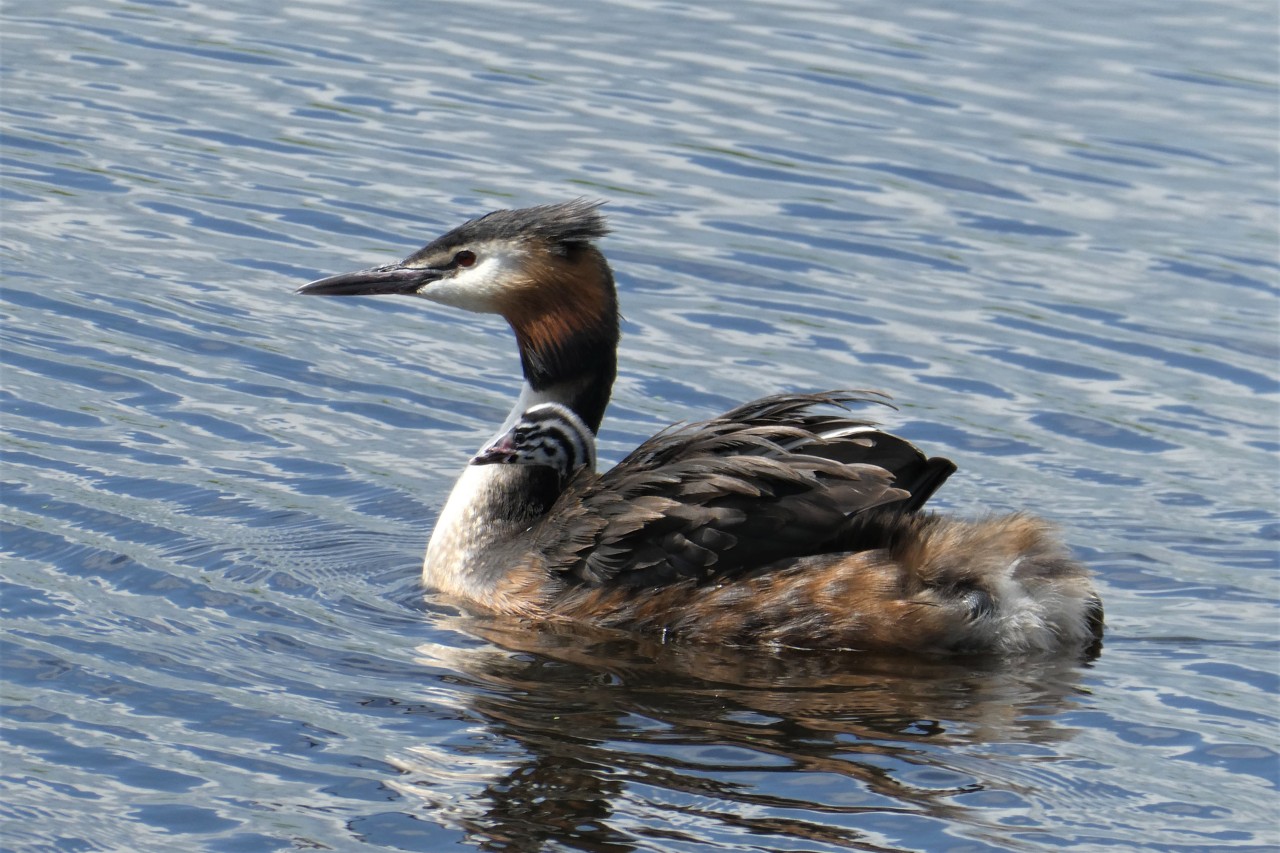
When birds shed their feathers during moulting season, proud mallard drakes quickly become lame ducks.
They lose their iridescent green plumage and suddenly appear dull and greyish-brown. Other bird species fare no better: like mallards, shelducks also shed all their flight feathers at once and are completely unable to fly during this period. Great crested grebes change their plumage out on the lake while resting. Eider ducks and geese seek shelter by the thousands in the crowds along the Wadden Sea. Mute swans also moult in groups. The hormonally controlled moulting process can become dangerous: without flight-capable plumage, the birds are helpless and dependent on undisturbed moulting sites.
«Do not disturb wild birds during moulting season — it causes them pure stress«, urges Lea-Carina Mendel, a species conservation expert at the Deutsche Wildtier Stiftung. The pressure from humans on wild birds, which need quiet places, is enormous. «Keep your dogs on a lead and do not let them roam along riverbanks, in reeds, grass or shrubs — because these are exactly the places where birds seek shelter.» Water sports enthusiasts such as stand-up paddlers, canoeists or pedalo riders should refrain from landing in the reed beds along lakes, rivers and ponds. «Anyone who lands a boat in a nature reserve and gets caught will face a fine regardless«, says Mendel.
Nature has not placed the period of full moult in waterfowl during summer without reason: «At this time of year it is warm, there is plenty to eat, and birds can still reach aquatic plants, snails, insects and seeds even without their otherwise functional wings«, says the species conservation expert.
Not all birds renew their plumage all at once like ducks and geese do. Birds of prey, for example, typically undergo a partial moult. This can extend over a period of several years. Individual flight feathers are replaced gradually, allowing the birds to remain capable of flight throughout the process — which is vital for finding food. A partial moult is also used to transition from juvenile to adult plumage. The robin, for instance, wears an inconspicuous brown plumage in its first months of life, which changes to the characteristic colouring with the orange-red breast during the first moult in summer — known as the juvenile moult.
More on the subject of recreational hunting: In the dossier Poaching and hunting crime in Switzerland we document cases, legal questions and recurring patterns. What the research says about this is shown by Hunting fact-checked: the state of research.
The position of IG Wild beim Wild: IG Wild beim Wild rejects recreational hunting. Our model is the canton of Geneva, which has managed without recreational hunting since 1974: without hunting seasons, without hunting dogs, without driven hunts, without high seats, without the animal cruelty and crime that go hand in hand with hunting season elsewhere. What has worked there for over fifty years disproves every position paper by JagdSchweiz. An association that bases its policy on claims it refutes in its own documents is not a professional organisation, but a factory for misinformation.