Stinah Annual Report 2021: Everyday Animal Welfare in Switzerland
As every year, Stinah would like to open a window into everyday animal welfare in 2021 with a letter — because it is you who make this everyday work possible.


The selection of cases presented — the fates encountered, the hardship found, the successful as well as unsuccessful interventions, etc. — is a random compilation. Overall, our day-to-day animal welfare work fills more than 100 pages in the keyword log we keep throughout the year.
We started on 1 January with the unsettling suspicion that the large, charming gelding — who the previous year had only escaped slaughter in a seizure case thanks to the president's unilateral decision — might have sustained a hairline fracture of the lower leg during a New Year's Eve scuffle. The years of isolated keeping prior to the seizure had done little for his social skills, and his sluggishness made it difficult for him to escape a quarrel quickly and without injury.
A hairline fracture is a tiny crack in the bone that is very difficult to diagnose when fresh. The remodelling processes in the bone only become visible after approximately 14 days. Nevertheless, action must be taken, as a hairline fracture can develop into a full break — which is usually fatal for a horse — if the affected leg is subjected to heavy strain. Such strain occurs, among other things, when a horse like HIM, weighing over 800 kg, lies down to sleep and then has to heave itself back up.

To reduce the risk, HIM was prescribed stall rest in a net.The net — and here we extend our heartfelt thanks to our friends from the Large Animal Rescue Service CH/FL,who immediately equipped us with a rescue net — hangs loosely around the standing horse so that it can move freely within the stall, but prevents it from lying down. HIM managed this period of restriction remarkably well. He relaxed by using the net as a kind of hammock.HIM has made a full recovery and has since been fully integrated into the herd.

This year, we already had a surprisingly large number of placement offers for ponies, but also for horses, starting as early as January. Processing these is time-consuming and often somewhat nerve-wracking, because a large proportion of those offering places have a mistaken idea of which equines need our help, or rather. where we have to draw the line in our assistance due to limited resources. We frequently receive placement offers for rideable, healthy horses with no behavioural issues. We are always glad to be able to report that such animals are rarely threatened by slaughter or euthanasia and therefore never end up in our placement programme in the first place. The imminent threat of death, without it being medically indicated, is a prerequisite for our intervention. The fact that two large seizures had not yet been finalised due to legal interventions by the owners, and the record-low number of reported emergencies in 2021, allowed us to find new homes for almost all emergency horses.
In 2020, Switzerland's population grew by,7 % compared to the previous year. In that same year, we killed 5% more chickens than in 2019,namely around 12.5 million individuals, of which 8’574’643 were broilers and 3’854’017 were laying and breeding hens. While broiler chickens spend seven weeks vegetating for the sole purpose of multiplying their birth weight of 42g sixty-fold to reach a slaughter weight of around 2.5 kg, the vast majority of laying hens spend 12–18 months in poultry flocks of more than 5’000 animals, under artificial light and deafening noise, until they are disposed of.All perfectly legal, and most people couldn't care less — but you and we do.And so, already in January, we were once again on the road across Switzerland with 253 feathered ladies, to give those who had survived the hell of production the chance to live a species-appropriate chicken life. Four white hens found refuge among the forty-strong flock at the Stinah-Heim. 1’747 hens we had to leave behind. They were killed the following day.

Planning a chicken rescue begins weeks before the pickup date. As soon as the location, date, and number of chickens in need are known, we take stock of our supplies — transport crates, straw, labels, and so on — order replenishments, send our drivers a 'save the date', and begin searching for places for the animals to live. We write dozens of emails, text messages, and WhatsApp messages, and conduct phone calls the old-fashioned way. As the date approaches, we start planning the collection routes, often at the same time as the search for placements — which has a tendency to turn into a nail-biter. This parallel process sometimes renders our route planning little more than a paper exercise, but the desire not to leave a single hen behind keeps us flexible right up to the last minute. Admittedly, this doesn't always go smoothly — after yet more texts, WhatsApp messages, emails, and phone calls, we find ourselves relabelling and redistributing the Post-it notes on the map, with no certainty that the result is now final.
Our transport team numbers around a dozen volunteers who give their time to drive the hens too where they are eagerly awaited and can move into a chicken-friendly home. They, too, need to be highly flexible. If the number of chickens to be transported changes at short notice, entire routes may need to be swapped or additional loops added — depending on the varying sizes of the vehicles, all of which are the drivers' own private cars. Why would someone sacrifice their free time for this? The answer from our long-standing driver Evi:: «I drive these lovely ladies to a well-deserved, species-appropriate retirement. For me, it's a challenging and deeply satisfyingchange of pace, and besides, they make very pleasant passengers.»

On 18 January, CHANGE passed away. For 6.5 years he accompanied us, enriched our lives, and set many a visitor thinking, marvelling, and questioning — more effectively than we ever could. He was a master of good cheer, a great enjoyer of life, and a true friend — first to CHANGE, then to HEINRICH, and throughout his life to us as well. His death came unexpectedly. In the morning he lay peacefully in the straw bed of his pig house. Most likely heart failure, as is often described in pigs.
In February, we were largely preoccupied with ourselves. The nightly assistance sessions for WIZARD became more frequent (we reported last year that he has difficulty getting up after sleeping too long due to circulatory problems). And as if one weren't enough, PALOMA also needed help getting up from time to time between February and April. So it was — and still is — necessary to regularly check the surveillance cameras throughout the already rather short nights to see whether any of the seniors need assistance. Lying down for too long can have serious health consequences for horses.
The horses MOMENT (severe eye disease), JACKY (signs of poisoning), DEBORA (inflammation of the hock joints), and HECTOR (injury to the suspensory ligament attachment), as well as dog BAJO (another knee operation, regular physiotherapy), rounded out the February sick bay.
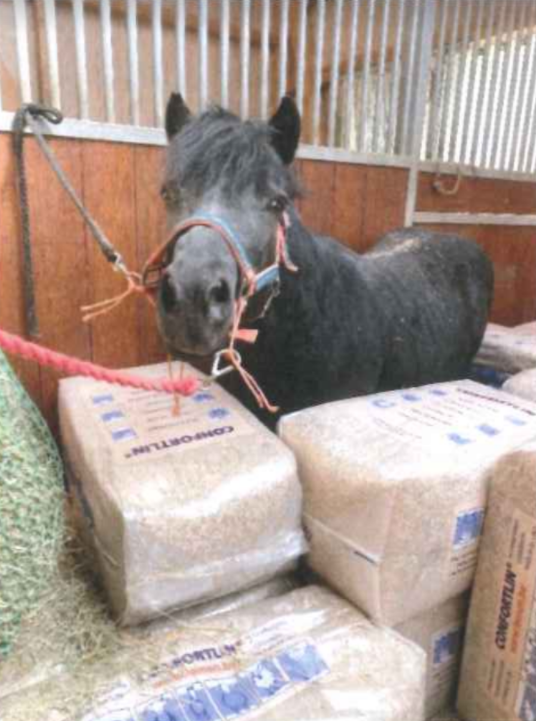
In addition to the fact that more and more of our residents are reaching an age requiring intensive care, this year we faced laminitis for the first time — a severe, and in the worst case life-threatening, inflammation of the hooves. Out of the blue, it struck VITEZ, who has been the one-man entertainer of our herd for 14 years. Fortunately, we recognized the problem at a very early stage. However, the search for the cause took a long time, because the initial tests to verify the suspicion that he might have Cushing's disease returned a false negative result. It was not until August that we had clarity and were able to bring about lasting improvement through appropriate medication. Until then, the hooves had to be cooled for hours during each flare-up. To do this, we built a fortress of bedding bales around the tub filled with ice water in which VITEZ had to endure each day. The petrol stations in our area had high ice cube sales despite the modest temperatures in the first half of the year.

On 4 March, SHIRKAN died — a steer only two years old. Like CHANGE, he was found dead in his straw bed in the morning with no prior indication of health problems. He had originally been slated for slaughter as a runt, but recovered splendidly in our herd, so we had not expected to lose him so soonzto lose. He was followed on May 22 by KÖNKEN, who was fortunate enough to enjoy 21 years of largely free life in the Jura, and on May 28 by ox SENNO. Attempts to help him at the animal hospital failed. SENNO was only eight years old, but had already developed the typical arthritis problems that these animals, bred for meat production, frequently suffer due to the overloading of their joints. Since oxen rarely live beyond 11 months, these torture-breeding problems usually go unnoticed — but that does not mean the animals do not already suffer during the fattening period from the enormous weight gain that has been bred into them.
In the zlatter half of March, two chicken rescues allowed all 336 chickens to escape their fate. We were unable to repeat this joyful outcome in May at a newly added laying operation in our program, which houses a total of 14’000 chickens.We were able to place 100 animals. At another operation with 116 hens, we fortunately did not have to leave anyone behind.

The chickens ware transported in suitable boxes. Each box is labeled with the number and color of the chickens as well as the names of the driver and recipient. For large rescue operations, we need up to 100 boxes. The protection contracts also have to be prepared in advance. Each driver receives a dossier with their route, details about the individual meeting points, information about the recipients, and the protectionz contracts. Loading the chickens on site must be well organized in order to avoid unnecessary stress for the exhausted animals and to keep to the usually tight distribution schedule. Loading in the dark is the most gentle approach for the animals, which is why handovers at the meeting points often take place late at night.
At this point, we would like to warmly thank our chicken adopters for their great cooperation, their punctuality, and their support.It is touching to see how joyfully the hens are received. Sometimes entire families are waiting at the meeting point — having already chosen a name for each chicken — eager to welcome the animals into their family, to appreciate them as sentient beings, and to treat them with love and respect.This carries us through a great deal of suffering and gives us the strength to carry on!

HEINRICH, whom we had paired with CHANGE after the death of boar CHANCE, clearly showed that he missed CHANGE. We were torn as to whether we should attempt another pairing. Unfortunately, our efforts to find a place where he could be introduced to other pigs were unsuccessful. In March, HEINRICH's health deteriorated. The veterinarians we consulted could find no cause, so we continued to attribute his loss of appetite to grief over CHANGE. On March 26th, we found him too, dead in his pig shed.Until the old barn has been renovated, we will not be able to accommodate any more pigs for the time being.

In March, we completed a second dovecote. We hoped that the birds who had moved in some time ago and been driven away from everywhere else would take a liking to it, giving us the opportunity to introduce a degree of birth control through egg swapping. Unfortunately, the pigeons do not share our view that the dovecote (not yet fully fitted out in the photo) has become an inviting place, well-equipped with pigeon-appropriate food, water, sand baths, nesting material, and so on. They prefer to roost in the most unlikely spots and to pick apart horse droppings in no time in search of one last grain.

CÄSAR, the German Shepherd who joined us in 2014 at an estimated age of 10 from a kill shelter in Hungary, was a very independent character. Amicably, he did what he felt he had to do. Thatzincluded, day in, day out, barking cheerfully at the horses who were, it should be noted, in their own area but along his garden fence. Some horses made a game of provoking CÄSAR, while others – particularlyZthe mares – were bothered by the barking. CÄSAR wagged his tail in a friendly manner while continuing, undeterred by mock charges from the horses or shouts from humans, to bark loudly – and, at least it seemed that way – with even greater delight at the exasperation of those who were annoyed. Sadly, that barking fell silent forever on April 23rd. It has grown quiet on the Talhof, and those who sometimes wished him gone for the noise are certainly missing his joyful voice too.
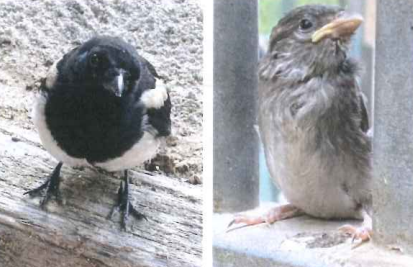
Spring 2021 was hard for young birds.We had never had so many bird emergencies as we did this year.V.a. the sparrows had serious problems. Unfortunately, we were only able to help a few; most we found dead, likely having starved. However, there were once again successful releases of recovered feathered friends — for example, AIWAN the magpie was able to join our magpie group.
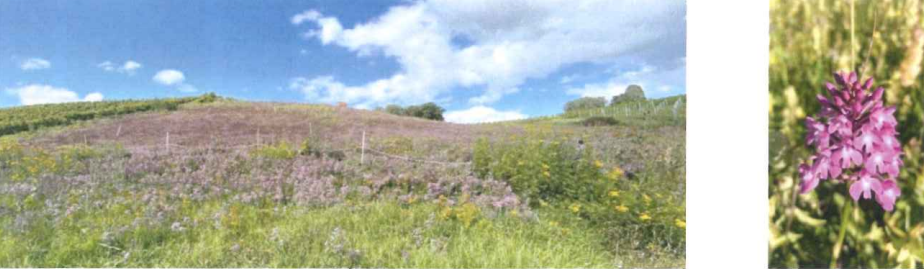
In 2011, we were able to lease half a hectare of very steep vineyard land directly adjacent to our own property. The plot had not been cultivated with vines for around six years, but instead supported a fallow wildflower meadow that, while becoming overgrown, provided habitat for many insects.We wanted to use the lease to prevent the land from being used again for wine production with heavy pesticide use, becoming ‘silent’ — meaning insect-free.Over all these years, we have developed the plot into a valuable insect meadow using the most gentle interventions possible. For the past two years, wild orchids have even been growing on the site. This year, the lease was terminated. The owner, a wine-growing company, had run into financial difficulties and their properties were put up for auction. We boldly submitted a bid for ‘our parcel’ matching the maximum price for unplanted vineyard land. Unfortunately, our bid was outbid by three times the amount. Our efforts to cultivate a species-rich, flower-abundant stand had catapulted the parcel into the highest direct payment tier, meaning that those eligible for direct payments — a group we do not belong to — could have achieved a return of more than 4% even at a purchase price three times higher than the officially assessed value for the actual soil quality. The bidder intended to harvest the returns on our work and announced plans to convert the parcel back to wine cultivation as soon as the vegetation, lacking maintenance, would no longer display the plant diversity required for a high direct payment tier.Thanks to generous support, we were ultimately able to exercise our right of first refusal as tenants and secure the property — albeit at an excessively high price relative to the plants and animals living there.
IIn June, we were able to help 302 hens and four roosters.Five animals found shelter in the flock at our sanctuary. We had to leave 4,894 animals behind. In addition, the seizure of 20 horses — planned for last year and now carried out — placed further demands on our resources.
The hens we receive for rehoming come from a wide variety of keeping situations. When Stinah launched RettetdasHuhn over 10 years ago, we still had to purchase the destocked hens for CHF 10.00 per animal. This price reflected the disregard that people had for our work at the time, and was of course yet another opportunity to profit at the animals' expense. It was also always a matter of negotiation whether we were allowed to rescue 5 or 6 animals out of hundreds or thousands. From 2011 onwards, we reached a first milestone in our efforts: we now received the animals free of charge — more precisely, we only offered our assistance, given our limited capacity, to those poultry keepers who were willing to give up the animals at no cost. Discussions about the number of animals we were permitted to take on soon moved to increments of 50. In the meantime, grateful laying hen farmers want us to find a solution for all their animals; sometimes we even receive a small contribution towards our expenses, and words of encouragement are becoming more and more frequent. The latest development is being ushered in by the next generation. Young farmers are increasingly taking the initiative themselves in finding places for their animals to live out their lives, and asking us to help them in doing so. Evidently, the younger generation is no longer willing to treat animals as a waste product. Many are discontinuing egg production, with the unfortunate consequence that smaller chicken-keeping operations are gradually disappearing and animals are being kept in ever larger numbers. VFrom 2000 to 2020, the number of commercial chicken keepers in Switzerland decreased by 36% (while demand for eggs continued to rise).
While veterinary medicine for companion animals has long concerned itself with the needs and health issues of senior animals, the geriatric patient in livestock farming remains a rarity, and the knowledge base is correspondingly limited. In June, we addressed this topic with a first course on the needs of senior hens, and we plan to continue this exchange of experience.

July was a rollercoaster ride. The placement of the horses seized in spring, which had once again been worked out with great effort, could not be implemented — strictly speaking, it still hasn't been to this day, because the animal owner initiated new legal proceedings. We therefore allocated to AMY the spot in the foundation that had been reserved since last November for one of these horses. At five years old, she was facing slaughter. We were lucky and immediately found a wonderful home for her. Besides 13 chickens, AMY is the only animal we have taken into the foundation this year.In view of the current situation, the Vizce President proactively declined further animal admissions. For LILLY, about whom we reported last year that she would find a home with us, another opportunity fortunately arose.
In four rescues, 1’027 feathered friends were able to travel to a species-appropriate life. For 349 hens, we were unable to find a follow-up solution within the available time.
At the end of July, our staff member Thomas had an accident. It happened outside of work, but an accident means time off — in this case, for 3 months. And Thomas is a dedicated, important employee (60%).But Thomas wouldn't be Thomas if he hadn't taken it upon himself, after his operation, to find a replacement on his own initiative.This meant that we (and especially our outstanding intern Sharon) soon had some relief again with mucking out and feeding the many animals at the shelter — tasks that consume around 30 man-hours every day. A few weeks later, we were threatened with a fine of up to CHF 40’000. We had not realized that even a temporary relief position — initially with a completely unclear duration — must be advertised through the RAV (regional employment center) for five working days before anyone can be recruited to step in for the injured employee. The posting is a pure formality, since an employer cannot be compelled to enter into an employment relationship should a local resident express interest in the position during those five working days, which in any case never seriously happens. But violating the formality can quickly become very costly. The Canton of Schaffhausen assumes that even a non-profit organization performing essentially public duties has the means to always keep enough manpower on hand to cover any absences — all without itself making any contribution whatsoever to the work of such organizations.

In August, CHIARA had to move back in with us. She had been placed in foster care for around seven years. CHIARA and her sister SARAI were to be slaughtered in 2014 due to a requirement to reduce the horse population. The farmer decided to market the meat himself and went door to door with his offer before the slaughter. A retired lady declared herself a willing buyer — not for sausages, but for ztwo ponies. The doorstep deal was concluded, and the lady's odyssey of searching for a placement ended with us. CHIARA was beside herself over the loss of her group. For many horses, losing their familiar companions and surroundings is a severe trauma. She is doing better now and is settling in well within the large horse family.
Also in August, we were able to rescue 54 young hens . They had not been sold due to a lack of demand. The division of labor between the supply of young hens and egg production can result in a young hen producer being left sitting on their ‘goods’ and then being forced to dispose of them unused.
In September, 12’000 chickens from three different producers needed a new home. We were only able to place 350; three came to Stinah.Perhaps some of you know someone who knows someone who would like to keep chickens?Soon, another one of these farms will be destocking again.
Since October, we have been dealing with two larger animal welfare cases. In one case, a person who was issued a nation-zwide ban on keeping animals a few years ago is keeping around 30 horses, including several foals. The involvement of a frontman living on her farm is now slowing down assistance for the animals, because — according to the canton’s position — the frontman must first be given a deadline to remedy the deficiencies in accordance with the principle of proportionality.wThe consequence is that crucial developmental time for the foals — during which they should be building a healthy physical foundation through plenty of movement and developing a balanced personality through a wealth of impressions and experiences — is being lost. Irretrievably. Placing such animals will be difficult.The other case involves a horse trader who purchases slaughter animals in Italy, imports them, and sells them on without regard for their health problems. We are still searching for the location of the animals in Switzerland in order to determine whether the canton of Ticino or the canton of Graubünden would be responsible for initiating proceedings.In October, 65 chickens were still able to make the transition from product to living being.

On 15 November 2021, we lost PALOMA. We were unable to bring a severe, bone-affecting inflammation in her hoof under control, even at the veterinary hospital. She was a horse of contradictions: towards us humans, she was always sullen and aloof throughout our 21 years together, and in the beginning also dangerous (biting and kicking). She was able to let go of the dangerous behaviour, but it was difficult throughout all that time to find warm moments with her. Her reservations towards people ran too deep. At the same time, she was an invaluable support to many horses struggling with handicaps — a friend of the kind that every one of us would wish for.
In two chicken rescues we were able to save 277 chickens in November. And in December, another 450 hens will be given the chance to live.
In thesanctuary, around 170 foundation animals currently reside. In addition to daily tasks such as mucking out and feeding, facility and pasture maintenance, the medical care of the seniors in particular takes up a great deal of time. The growing care requirements are currently roughly balanced by the relief provided by the admission freeze.Consultations with private individuals and authorities on a wide variety of aspects of animal husbandry increased in 2021. On the other hand, significantly fewer animal emergencies were reported to us, which is very encouraging, as handling these cases is demanding both in terms of time and emotion. In particular, enquiries from the sport horse scene have declined. It is still too early to celebrate, but we are confident that the change is lasting.
We wish you and your loved ones the very best for a healthy and optimistic start to a happy new year. Thank you so much for allowing us to count on you!
More on the subject of recreational hunting: What the research says about this is shown by Hunting fact-checked: the state of research.
The position of IG Wild beim Wild: IG Wild beim Wild rejects recreational hunting. Our model is the canton of Geneva, which has managed without recreational hunting since 1974: without hunting seasons, without hunting dogs, without driven hunts, without high seats, without the animal cruelty and crime that go hand in hand with hunting season elsewhere. What has worked there for over fifty years disproves every position paper by JagdSchweiz. An association that bases its policy on claims it refutes in its own documents is not a professional organisation, but a factory for misinformation.