
Chamois: profile, horns, way of life and chamois in Switzerland
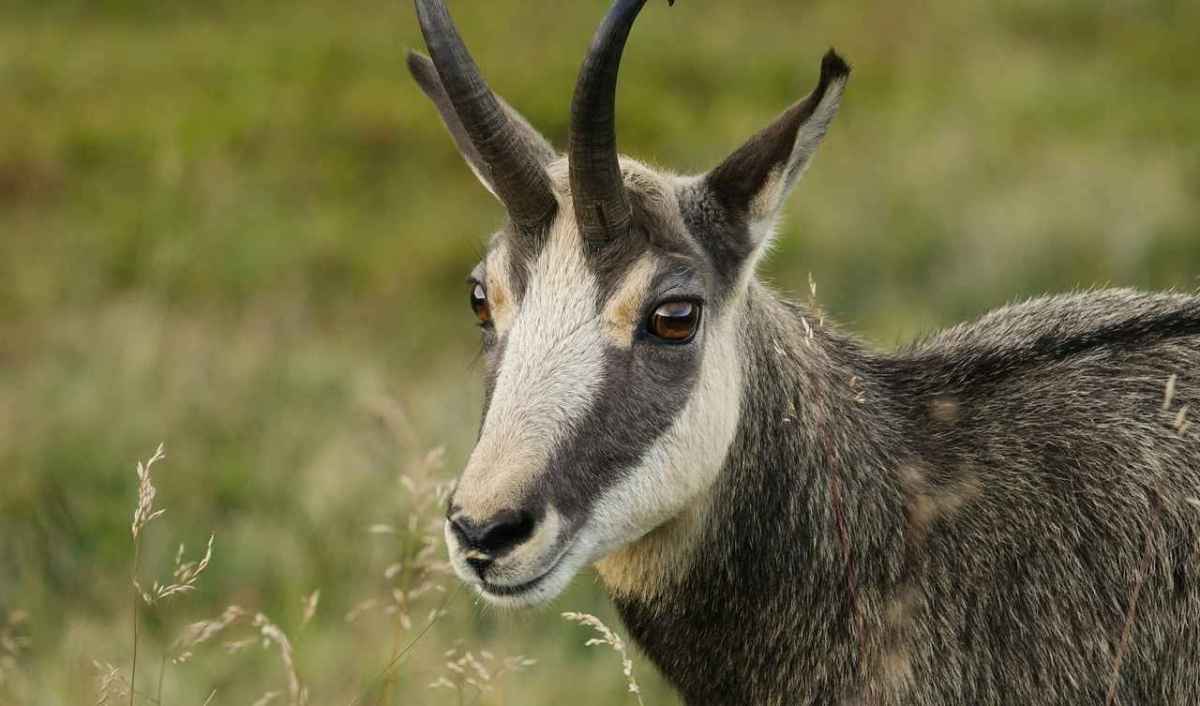
The chamois (Rupicapra rupicapra) is one of the best-known wild animal species of the Alps. It climbs surely through rock and scree and lives in the Alps, the Pre-Alps and the Jura. Climate change, leisure activities and the high hunt are putting it under increasing pressure.
Profile
- Family: Bovids (Bovidae)
- Recognising it: pale face with a dark stripe from the eyes to the muzzle, dark, long coat in winter
- Horns: bucks and does carry hook-shaped, curved horns
- Habitat: Alps, Pre-Alps and Jura, in rocky terrain as well as in mountain forest
- Rut: November and December
- Offspring: usually one kid in May or June, independent after about 6 months
- Population in Switzerland: 90,697 (2025, estimate by the cantons)
Chamois or ibex?
- Chamois: slender, short, hook-shaped horns in both sexes, black-and-white facial markings.
- Ibex: more massive, bucks with long, backward-curving horns with ridges, uniformly grey-brown. More in the portrait of the Ibex.
Way of life
Does live in herds with their kids and young animals. Outside the rut, the bucks often roam alone or in small bachelor groups. The kids follow their mother just a few hours after birth. In winter, every disturbance is exhausting: an animal forced to flee uses up reserves that will be missing by spring.
Pressure from all sides
Climate change is shifting the vegetation zones upwards, and above the tree line the food supply is shrinking. Ski touring, snowshoeing, paragliding and mountain biking are pushing into retreat areas. Diseases such as infectious keratoconjunctivitis and sarcoptic mange can cause local population crashes. In the north-western Alps, numbers have been declining for years. The Lynx preys mainly on weakened, sick or old animals and, according to KORA, is not responsible for the decline.
Chamois in Switzerland
In 2025 the cantons estimated the population at 90,697 chamois, about the same as in 2015. According to the Swiss Hunting Statistics 2025 recreational hunters killed 9,228 chamois, in addition to 77 special culls and 1,429 animals found dead, 20 of them with gunshot injuries. The population figures are based on counts in open terrain; chamois in forests are barely recorded. More in the dossier “The Chamois in Switzerland” and on the High hunt in Switzerland.
What research on the chamois shows
Studies from the Alpine region show that recreational hunting and leisure activity push ungulates into cover and into the night, creating a “landscape of fear”. No long-term studies of its own yet exist on the stress and behaviour of hunted chamois in Switzerland. All the more important, then, to act with caution rather than base kills on uncertain counts. We document the state of research on our studies page Hunting Fact Check.
Frequently asked questions about the chamois
Is it spelled “Gämse” or “Gams”?
Both are correct. Gämse is the spelling according to the Duden, while Gams is common in Switzerland and Austria.
Do female chamois also have horns?
Yes. Both bucks and does carry horns (known as “Krucken”); those of the bucks are usually somewhat thicker and more strongly curved.
How many chamois live in Switzerland?
The cantons estimated the population at 90,697 animals in 2025.
How can I protect chamois in winter?
Respect wildlife quiet zones, stay on marked routes and keep dogs on a lead.
Is the lynx to blame for the decline in chamois?
No. The main causes are climate change, habitat loss and the pressure from recreational hunting and leisure activity.
What does Wild beim Wild do for chamois?
We work to ensure that populations and their habitats are preserved and connected with one another. Natural corridors enable genetic exchange between individual populations. We do this by defending wild animals against unnecessary recreational hunting and poaching wherever possible.