Cantonal popular initiative: Canton of Appenzell Inner Rhodes
«For professional wildlife protection»
Motion to the Landsgemeinde of the Canton of Appenzell Inner Rhodes
Pursuant to Art. 7bis and Art. 48 para. 3 of the Constitution of the Confederate State of Appenzell I.Rh. of 24 Wintermonat 1872 and the Ordinance on Initiative Procedure
Submitted by [Name], [Place of residence, AI], [Date]
Note: The Canton of Appenzell Inner Rhodes is a Landsgemeinde canton. At the Landsgemeinde, all eligible voters of Appenzell Inner Rhodes may vote directly on constitutional and legislative proposals. A motion may be submitted by any single eligible voter. No further signatures are required.
Motion
The Landsgemeinde of the Canton of Appenzell Inner Rhodes resolves the following amendment to the Constitution of the Confederate State of Appenzell I.Rh. of 24 Wintermonat 1872:
Art. [new] Professional wildlife protection
1 The practice of hunting by private individuals (licence hunting, recreational hunting) is prohibited throughout the entire territory of the Canton of Appenzell Inner Rhodes.
2 The protection, care and, where necessary, regulation of wild animals shall be the exclusive responsibility of professionally trained wildlife managers employed by the canton.
3 The killing of wild animals is only permitted as a last resort, when all other suitable measures for preventing damage or averting danger have been exhausted or are insufficient. It requires prior approval by the Wildlife Commission.
4 The canton shall establish an independent Wildlife Commission, composed of representatives of animal welfare and nature conservation organisations, the scientific community and the authorities concerned. The commission shall oversee wildlife management and decide on regulatory measures.
5 The canton shall promote the natural regulation of wildlife populations, the connectivity of habitats and the coexistence of humans and wild animals.
6 Further details shall be regulated by law.
Art. [new] Protection of endangered and protected wild animal species
1 The canton refrains from regulating populations of protected wild animal species pursuant to Art. 7a of the Federal Act on Hunting and the Protection of Wild Mammals and Birds and does not grant kill permits for individual animals of protected species pursuant to Art. 12 para. 2 of this Act, in particular not for wolf, lynx, bear, beaver, otter, golden jackal, golden eagle, goosander and other species protected under federal law. Paragraph 3 remains reserved.
2 It relies on fostering coexistence between humans and wild animals, passive damage prevention, the ecological enhancement of habitats and the scientific monitoring of wild animal presence.
3 Measures against individual wild animals that pose an immediate and significant danger to humans remain reserved. They are to be limited to the minimum necessary and carried out by the canton's competent specialist authority.
4 The canton actively advocates for the protection and preservation of endangered wild animal species within the framework of inter-cantonal cooperation and towards the Confederation.
Transitional provision
1 The Standeskommission shall issue the necessary implementing provisions within two years of the adoption of this constitutional amendment.
2 Existing hunting licences expire upon the entry into force of the implementing provisions. Patent fees already paid for the current hunting season will be reimbursed on a pro-rata basis.
3 The Standeskommission shall ensure continuity of wildlife management during the transitional phase.
Explanatory notes
1. Starting position
In the Canton of Appenzell Inner Rhodes, the smallest canton in Switzerland with around 16,000 inhabitants across 173 km² of land, today’s recreational hunting is a system that serves neither species conservation nor modern wildlife management. It is the pursuit of a bloody leisure pastime at the expense of sentient beings, legitimised by outdated narratives that cannot withstand scientific scrutiny. The claim that the ecological balance would collapse without recreational hunting has been empirically refuted for over 50 years by the Geneva model (see the comprehensive dossier on the Geneva hunting ban on wildbeimwild.com).
Recreational hunting in Appenzell Inner Rhodes is organised as licence hunting. Private individuals purchase a cantonal licence and hunt without fixed responsibility for a particular hunting ground (see the Psychology of recreational hunting in the canton of Appenzell Inner Rhodes as well as the critical analysis of hunting training on wildbeimwild.com).
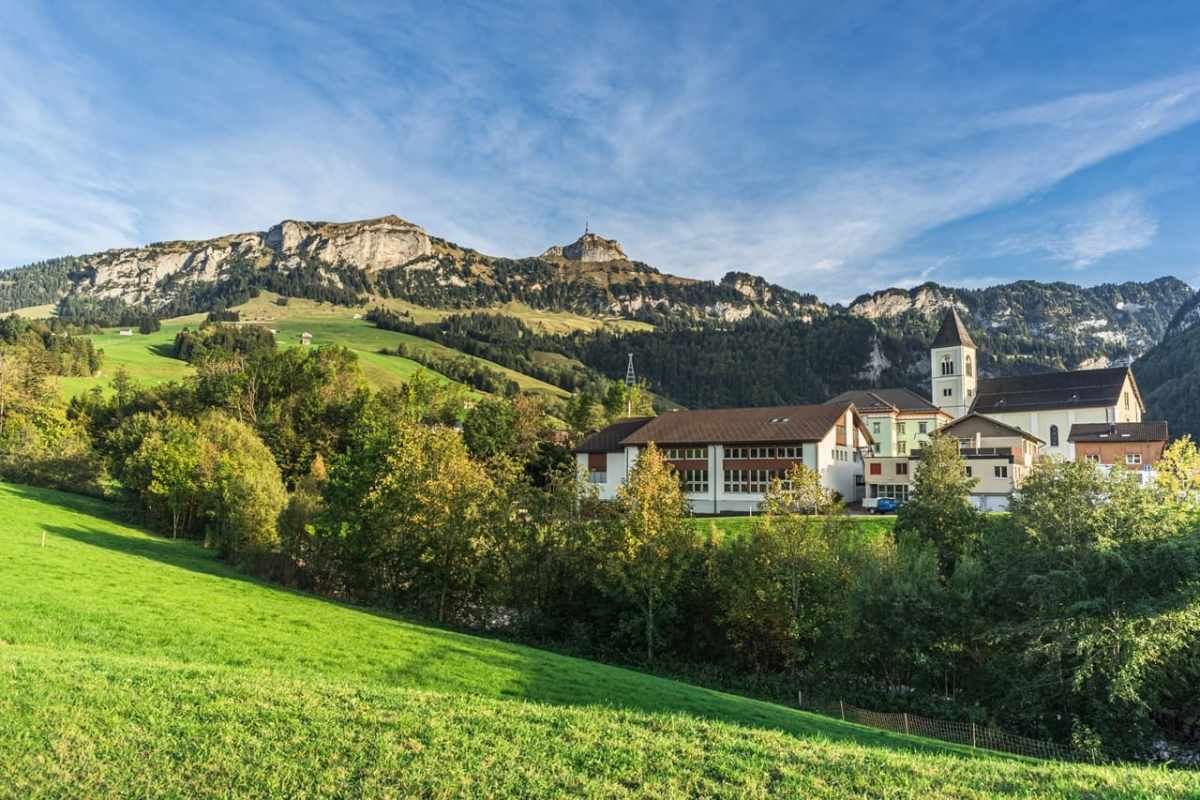
The Alpstein is the defining landscape feature of the canton. The ibex, the chamois and the golden eagle are native to the Alpstein. The lynx is present in the region. Since February 2025, cantons have been able to authorise the kill of individual beavers that cause significant damage (Art. 9d JSV). The Alpstein is a habitat of national significance (see analysis of hunting policy on wildbeimwild.com and the wolf policy on wildbeimwild.com).
The canton of Appenzell Inner Rhodes has the opportunity to set a clear example here. The Landsgemeinde offers the ideal democratic instrument for this: a single person can submit the motion, and the entire electorate decides directly. As the smallest canton in Switzerland, Appenzell Inner Rhodes could become a pioneer.
2. The role model: canton of Geneva
On 19 May 1974, a good 70 per cent of voters in the canton of Geneva voted to abolish militia-style recreational hunting. The experience is unambiguous:
- Biodiversity has increased markedly. The number of overwintering waterfowl has multiplied from a few hundred to around 30,000. Geneva is now home to the largest brown hare population and one of the last grey partridge populations in Switzerland.
- The roe deer population has settled at a healthy level, with an annual special cull by professional game wardens of just 20 to 36 animals.
- The ban has been in force continuously for over 50 years. Geneva has never repealed it.
- The total costs amount to around 1.2 million francs annually, roughly 2.40 francs per resident per year.
Geneva's long-standing fauna inspector Gottlieb Dandliker described the recreational hunting ban as the most cost-effective alternative. Detailed account in the dossier «Geneva and the hunting ban» on wildbeimwild.com. The efficiency of the Geneva model is evident in a direct comparison: a professional game warden in Geneva needs on average 8 hours and a maximum of 2 cartridges for a sanitary kill of a wild boar. A recreational hunter in the canton of Zurich needs 60 to 80 hours and up to 15 cartridges for the same task. The density of brown hares in Geneva is 17.7 animals per 100 hectares (the highest in Switzerland), whereas in the canton of Zurich it is only 1.0 per 100 hectares (cf. fact check by the Zurich Cantonal Council).
3. The concept: professional wildlife wardens instead of recreational hunting
The motion replaces recreational hunting with professional wildlife management based on the game warden model:
Professional expertise instead of leisure pursuit. Professional wildlife managers act on a scientific basis (cf. the critical analysis of hunting training).
Last-resort principle. A kill is only permissible once all non-lethal measures have been exhausted.
Democratic oversight through a wildlife commission.
Natural self-regulation as a guiding principle. Evidenced by Geneva, national parks and Studies.
4. Why Appenzell Inner Rhodes?
Landsgemeinde: Switzerland's most direct form of democracy. A single eligible voter can submit a motion. No minimum number of signatures is required: the signature of the person submitting the motion suffices. The lowest conceivable hurdle. The Landsgemeinde offers the opportunity to justify the motion directly, personally and publicly.
The smallest canton in Switzerland. Appenzell Inner Rhodes covers 173 km². Geneva covers 282 km² and has been practising professional wildlife management for 50 years. Appenzell Inner Rhodes is even smaller than Geneva. What works in Geneva works all the more so on a smaller area.
Alpstein: a habitat of national significance. The Alpstein is home to the ibex, chamois, golden eagle and numerous other species. Professional wildlife management would protect this unique habitat more consistently (see wildbeimwild.com on protected areas).
Lynx in the region. The lynx is present in the region and naturally regulates the roe deer population (see wildbeimwild.com on predators).
Licence hunting = a simple change of system. No lease agreements, no compensation for municipalities.
Pioneering role. As the smallest canton in Switzerland, Appenzell Inner Rhodes could become a pioneer: proof that professional wildlife management also works on the smallest scale.
5. On the wording of the motion
The six paragraphs of the first article and the four paragraphs of the second article correspond exactly to the Geneva model and the licence hunting variant of the entire series of initiatives. Compliant with federal law under Art. 3 para. 1 and 2 JSG. Unchallenged in Geneva since 1974. The wildlife commission prevents the cantonal council from independently approving exceptions (see Hunting myths fact-checked).
6. On the second article: protection of endangered and protected wild animal species
golden eagle, lynx, ibex present in the canton. The phrase ‘in particular’ also protects future returning species, in particular the wolf, which is becoming increasingly present in the region (cf. the wolf policy on wildbeimwild.com).
7. Cost implications
In Geneva (282 km², 500,000 inhabitants): 1.2 million francs annually. For Appenzell Inner Rhodes (173 km², 16,000 inhabitants), the following deliberately conservative projection results, which generously accounts for additional alpine costs for the Alpstein:
Personnel costs: 240,000 to 420,000 francs. Between 2 and 3 full-time positions are required. Appenzell Inner Rhodes lies in the heart of the Alpstein with the Säntis. The alpine topography requires specialists with knowledge of the terrain. The higher number of positions takes into account the management of predators (the wolf is documented in the Alpstein).
Material costs: 50,000 to 90,000 francs. Damage compensation: 20,000 to 50,000 francs.
Initial herd protection investment: 200,000 to 350,000 francs. A one-off investment for the Alpstein spread over three to five years: livestock guardian dog programmes, mobile fencing, night-time enclosures. Appenzell Inner Rhodes has a significant alpine farming sector that requires professional herd protection.
Lost revenue
With the abolition of recreational hunting, the licence fees of an estimated 80,000 to 150,000 francs annually are lost. However, this is offset by the never-balanced external costs of recreational hunting (wildlife-vehicle collisions, hunting-related browsing damage in protective forests, administrative expenses, police and court actions), which amount to a multiple of this revenue. In the canton of Geneva, this revenue has been absent since 1974 without any financial problems: before the hunting ban, over 400 recreational hunters were active; today, three full-time positions do the same work better. Sanitary and therapeutic kills carried out by professional game wardens are not the same as regulatory hunting based on hunters’ lore or a misunderstood sense of ‘nature experience’ among recreational hunters. A full-cost accounting shows that recreational hunting costs taxpayers considerably more than it generates (cf. «What recreational hunting really costs Switzerland» on wildbeimwild.com).
Recreational hunters in politics vote against nature conservation. The recreational hunting lobby systematically opposes biodiversity and species protection concerns. In 2024, it fought against the Biodiversity Initiative (63 per cent No). In 2020, the hunting act it had helped shape failed at the ballot box (51.9 per cent No). In 2016, the Ticino hunting association torpedoed the Parc Adula national park. During the 2015–2019 legislative period, recreational hunters in parliament voted predominantly against environmental concerns. Anyone who claims that recreational hunters are nature conservationists is ignoring their voting behaviour (cf. Ticino Hunting Association: 30 Years of Nonsense and Cost dossier).
Total gross costs: 310,000 to 560,000 francs. After savings (no licence administration, hunting supervision, kill quota planning; a senselessly killed wolf costs 35,000 francs): Net additional costs of 150,000 to 350,000 francs annually. Compensatory reproduction (the reproductive rate artificially increased by hunting pressure) subsides within a few years after the system change. For a canton with a budget of around 188 million francs (2024 state accounts, FFA), this is modest (cf. Hunting myths fact check).
8. Compatibility with superior law
Compliant with federal law (Art. 3 para. 1 and 2 JSG, three equivalent hunting systems, Geneva since 1974). Art. 7a JSG enables but does not require preventive regulation. The same applies to kill permits for individual animals under Art. 12 para. 2 JSG. Unity of matter preserved.
9. Anticipating foreseeable objections
«Appenzell Inner Rhodes is too small for its own wildlife management»
The facts: Appenzell Inner Rhodes covers 173 km². Geneva covers 282 km². Appenzell Inner Rhodes is even smaller than Geneva. What has been working in Geneva on 282 km² for 50 years works all the more so on 173 km². 2 to 3 full-time positions are sufficient (see the Psychology of recreational hunting in the canton of Appenzell Inner Rhodes).
Short communicative formula: «173 km². Geneva has 282 km² and has been doing it for 50 years. We are smaller, which makes it easier, not harder.»
«The Alpstein needs recreational hunting»
The facts: Professional wildlife management protects the Alpstein more consistently than recreational hunters. The ibex and the chamois regulate themselves in the alpine zone. The lynx regulates the roe deer population.
Short communicative formula: «The Alpstein needs professional protection, not recreational marksmen.»
«The costs are too high»
The facts: 150,000 to 350,000 francs in absolute terms. The lowest cost of the entire series. Affordable for a canton with a budget of around 188 million francs.
Short communicative formula: «150,000 to 350,000 francs. The lowest cost of all the cantons.»
10. Summary
This motion gives the Inner Rhodes Landsgemeinde the opportunity to come out in favour of modern, evidence-based wildlife management. The Landsgemeinde is the ideal democratic instrument: a single person submits the motion, and the voting population decides directly. As the smallest canton in Switzerland, Appenzell Inner Rhodes could become a pioneer: 173 km², smaller than Geneva, easier to implement, lowest costs. The lowest conceivable democratic hurdle and the lowest costs of the entire series.
Proposer: [Name], [Address], [Place of residence AI]
(Any person entitled to vote in the canton of Appenzell Inner Rhodes may submit a motion to the Landsgemeinde.)
Appendix: Further documentation
The Geneva model in detail: wildbeimwild.com/dossiers/genf-und-das-jagdverbot
Scientific studies: wildbeimwild.com/studien
Hunting in Switzerland: wildbeimwild.com/jagd-in-der-schweiz
Psychology of recreational hunting in the canton of Appenzell Inner Rhodes: wildbeimwild.com: Psychology of recreational hunting in the canton of AI
National parks: wildbeimwild.com/tag/schweizerischer-nationalpark
Hunting myths: wildbeimwild.com/dossiers/jagdmythen
Cantonal popular initiative Basel-Stadt: Template text Basel-Stadt
Note on the procedure
A motion to the Landsgemeinde may be submitted by any individual eligible to vote in the canton of Appenzell Inner Rhodes. The motion must be submitted in writing, with reasons, to the Grand Council by 31 May, which reviews and assesses it (Art. 7bis para. 6 KV AI). The motion is published in the Landsgemeinde mandate. At the next ordinary Landsgemeinde (held on the last Sunday of April each year), a vote is held on the motion. The person submitting the motion has the right to present their reasons in person.
Strategic briefing for activists
Motion “For professional wildlife protection”, Canton of Appenzell Inner Rhodes Internal working document, as of March 2026
Summary
Appenzell Inner Rhodes is a Landsgemeinde canton and the smallest canton in Switzerland. A single individual can submit the motion. No minimum number of signatures is required: the signature of the person submitting the motion suffices. 173 km², 16,000 inhabitants. Smaller than Geneva (282 km²). Lowest cost in the series: 150,000 to 350,000 francs. The Alpstein as a valuable habitat. The Standeskommission as the executive body.
1. Special feature: Landsgemeinde procedure
No minimum number of signatures.A single eligible voter can submit and sign the motion.
Personal justification. The person submitting the motion presents their reasoning in person at the Landsgemeinde (3–5 minutes).
Direct vote. The voting population decides by a show of hands.
Timing.The Landsgemeinde is held on the last Sunday of April each year. The motion must be submitted to the cantonal chancellery, for the attention of the Grand Council, by 31 May of the preceding year.
2. Opponent analysis
“AI is too small”:“173 km². Geneva has 282 km². We're smaller, which makes it easier.”
“The Alpstein needs recreational hunting”: «The Alpstein needs professional protection, not recreational marksmen.»
«The costs are too high»: «150,000 to 350,000 francs. The lowest cost of all the cantons.»
3. Core messages
“Smaller than Geneva. Easier to implement.” 173 vs. 282 km².
«Geneva has been demonstrating it for 50 years.» Never repealed since 1974.
«The Landsgemeinde decides directly.» No detour via party politics.
4. Timetable
| Phase | Content | Timeframe |
|---|---|---|
| Prepare motion | Consult a lawyer; finalise the text | Month 1–3 |
| Submission | Cantonal chancellery, for the attention of the Grand Council, by 31 May | According to the cantonal chancellery |
| Media work | Appenzeller Zeitung, Appenzeller Volksfreund | After submission |
| Circle of supporters | Pro Natura AI; BirdLife; local animal welfare and nature conservation associations | Ongoing |
| Landsgemeinde speech | 3–5 min., clear, fact-based, personal | Before the Landsgemeinde |
| Landsgemeinde | Last Sunday of April; present reasons for the motion; show of hands | Landsgemeinde day |
5. Tips for the Landsgemeinde speech
Short and clear. 3 to 5 minutes. Start personally. Geneva as proof. «Geneva has been doing it for 50 years and has never abolished it.» The size argument.“We are smaller than Geneva: 173 versus 282 km². What works there will work even better here.”Costs in concrete terms.“150,000 to 350,000 francs.”End with an appeal.“Vote for professional wildlife protection. For the Alpstein. For our Inner Rhodes.”
6. Special challenges
Small canton, close-knit community.In a canton with 16,000 inhabitants, everyone knows everyone. The person submitting the motion must expect to be personally approached about it.
Conservative underlying attitude.Appenzell Inner Rhodes has a conservative character. The campaign must work with facts, not emotions. The Geneva argument (“smaller than Geneva”) and the cost argument (“lowest costs of all cantons”) are the strongest cards.
7. Sources
- Geneva's hunting ban in detail
- Scientific studies
- Hunting in Switzerland
- Psychology of recreational hunting in the canton of Appenzell Inner Rhodes
- Hunting myths fact check
- Federal hunting statistics (BAFU)
- Cantonal popular initiative Basel-Stadt
This document is a template text from IG Wild beim Wild. It may be freely used by activists, organisations or applicants and adapted to the circumstances in the canton of Appenzell Inner Rhodes.
Fact check: The claims of the recreational hunting lobby
The brochure «Die Jagd in der Schweiz schützt und nützt» ("Hunting in Switzerland protects and benefits") published by JagdSchweiz reads like a promotional pamphlet, yet its central claims do not hold up to a fact check. Ten narratives put to the test, from «statutory duty» to «biodiversity» to «80% approval»: Dossier: Fact check on the JagdSchweiz brochure →