What alternatives to hunting exist?
The hunting debate suffers from a fundamental framing problem: it is usually conducted as an either-or between «more hunting» and «less hunting».

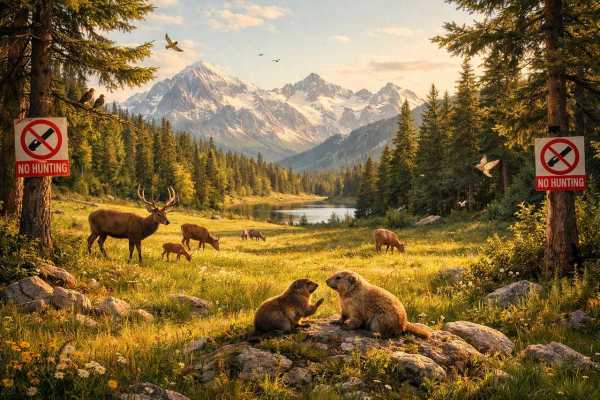
“Ceasefire”
This obscures the real question: Which methods of wildlife population regulation are effective, animal welfare compliant, cost-transparent and democratically legitimised?
The answer to this is scientifically well-documented – and it leads away from recreational hunting.
The Geneva Model: 50 Years of Results
The Canton of Geneva is the only canton in Switzerland that has had a complete ban on recreational hunting since 1974. Today, 12 state-employed game wardens are responsible for wildlife management in an area of around 282 km². The annual budget amounts to around 1.2 million francs (of which around 600'000 francs for personnel, 250'000 francs for prevention and 350'000 francs for damage compensation).
What does the 50-year record show?
- Wildlife populations (deer, foxes, wild boar) have not become unbalanced – they largely self-regulate, supported by targeted interventions by game wardens when concrete conflicts arise.
- Game meat from official culls is marketed and finances part of the operational costs.
- Wildlife exhibits measurably less timid behavior than in hunted cantons – deer graze in open areas during daylight, foxes show reduced flight distances.
- The wildlife damage assessment is no worse than in comparable hunted cantons. On the contrary: The absence of recreational hunters eliminates a significant disturbance factor that in other cantons drives wildlife into agricultural areas.
- The canton of Geneva has not experienced any significant wildlife population excesses that would have required a return to recreational hunting.
The Geneva model refutes the core argument of the hunting lobby that recreational hunting is essential for regulating wildlife populations. Our dossier on the Geneva hunting ban provides the complete data foundation and background on the political context.
Professional wildlife management: Wildlife wardens instead of recreational hunters
The Geneva model shows the way: Instead of 30,000 private recreational hunters with different motives, variable training levels and private interests, state-trained specialists – wildlife wardens – take over wildlife management. These act according to defined ecological criteria, are publicly accountable and pursue no private trophy interests.
The argumentation for professional wildlife wardens on wildbeimwild.com explains how such a system could be implemented nationwide and what it would cost. For many cantons, professional wildlife management would be cheaper than the current recreational hunting system if all external costs are included.
The dossier on the wildlife warden model describes concretely how professional wildlife management with a code of ethics would look.
Trophic cascades: Predators as natural regulators
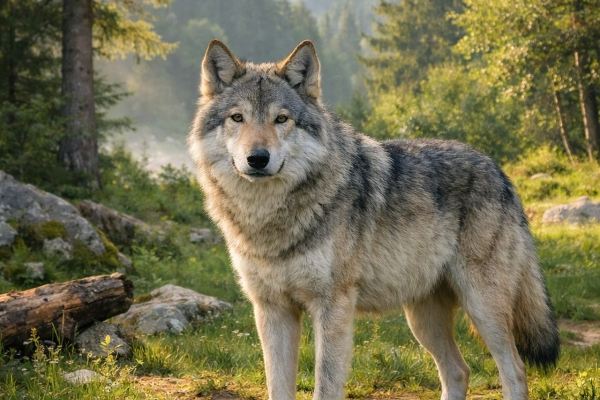
Ecology recognizes a mechanism that is significantly more effective and long-term stable than any form of human regulation: the trophic cascade. When predators like wolves and lynx are present in an ecosystem, they regulate herbivores not only through direct predation, but primarily through the 'ecosystem of fear' – behavioral changes in prey animals that lead to altered spatial use.
The best-known example: After the reintroduction of wolves in Yellowstone National Park (USA, from 1995), elk changed their grazing routes. Riverbanks that had previously been heavily browsed recovered. Vegetation returned, which promoted beavers, fish and birds. This cascade effect transformed the entire ecosystem – without human intervention, solely through the return of the predator.
In Switzerland, wolves and lynx have already returned naturally. The lynx efficiently regulates deer populations in parts of northwestern Switzerland. Where wolves are present, spatial use and behavior of ungulates change measurably. This is ecology in action – and it works without shots and without stress hormones in the game meat.
Instead of regulating predators (as the revised hunting law of 2025 allows), Switzerland should strengthen its natural regulatory capacity. More on this in the dossier Alternatives to recreational hunting.
Livestock protection: Effective, scalable, future-oriented
A common argument for predator culls is: They protect livestock from attacks. This is empirically untenable. Livestock protection is the most effective and cost-efficient method to prevent attacks. Switzerland subsidizes livestock protection measures, and the results are clear:
- Correctly installed electric fences reduce wolf attacks by 58 to 100 percent, depending on configuration and terrain.
- Livestock protection dogs (e.g. Kangal, Maremmano) reduce attacks in hilly to alpine areas by up to 76 percent.
- Shepherding (constant presence of shepherds) significantly increases the effectiveness of all other measures and is historically deeply rooted in alpine agriculture.
The central problem is not effectiveness, but implementation: In many alpine valleys, infrastructure, knowledge and financial incentives for consistent livestock protection are lacking. This represents a societal investment challenge. The Livestock Protection Dossier in Switzerland analyzes the state of implementation and why culling is not a permanent solution.
Wildlife corridors and spatial planning: Solving conflicts structurally
Many wildlife conflicts have structural causes: Habitat fragmentation through roads, settlements and barriers forces wildlife to migrate into human-inhabited areas. The solution lies not in culling, but in spatial planning.
Wildlife corridors – connecting green strips between habitat islands – enable migration without road contact. Wildlife overpasses and underpasses reduce traffic casualties. Buffer zones around residential and agricultural areas reduce conflicts. The revised Hunting Act of 2025 has formally strengthened wildlife corridors – but simultaneously opens the door for more culling. A contradiction that must be explained politically.
In Switzerland, around 300 wildlife corridors are mapped as nationally significant – over half of them are still severely impaired or interrupted. Investments in connecting these corridors would have more long-term effect on wildlife populations than any hunting season.
Immunocontraception: Birth control instead of culling
For situations where wildlife populations actually become locally excessive, science offers an alternative method: immunocontraception. Animals are treated with vaccines that temporarily inhibit reproduction without killing the animal.
Two preparations are most advanced:
- PZP (Porcine Zona Pellucida): A protein derived from pig ovary cells, administered as a vaccine that temporarily prevents fertilization in female animals. Used in the USA since the 1990s on wild horses, white-tailed deer and elk, with demonstrably stabilizing effects on populations.
- GonaCon: A vaccine developed by the US Fish & Wildlife Service that inhibits gonadotropins and can be used on both female and male animals. Effectiveness has been shown over several years with a single injection.
The method is scalable for urban and suburban wildlife populations (e.g. deer in residential areas), where hunting is not possible for safety reasons anyway. In Switzerland, field trials with immunocontraception have barely been conducted – a research deficit that requires political will.
Deterrence: Keeping wildlife away without harm
Deterrence refers to all methods that prevent wildlife from using certain areas – without killing them. The spectrum ranges from simple to technical:
- Visual deterrence: Reflectors, flutter tape, predator silhouettes
- Acoustic deterrence: Gas cannons, ultrasonic devices, bird of prey calls
- Scent deterrence: Predator scents (e.g. wolf hair)
- Mechanical barriers: Electric fences, nets, deer fencing
- Light barriers and wildlife warning devices on roads
Deterrence is not a permanent solution, but a valuable temporary instrument – particularly in agriculture, orchards and at critical wildlife accident sites. Combined with spatial planning and livestock protection, it can make culling unnecessary in many situations.
Luxembourg: Fox hunting banned since 2015
A rarely cited European example: Luxembourg completely banned fox hunting in 2015. The justification was factual: there was no scientific basis for the necessity of regulation. In the years since the ban, it has been shown that the fox population has not developed uncontrollably. Natural factors (mange, territoriality) and the increasing lynx regulate the density.
Luxembourg shows: bans can be implemented gradually, species-specifically and accompanied by science. Switzerland could introduce similar species-specific moratoriums – for example for foxes, badgers or certain bird species – without immediately overhauling the entire hunting system.
National parks: What happens without hunting?
The Swiss National Park in the Engadin has been Switzerland's oldest and strictest protected zone since 1914. No hunting, no forestry, no agriculture. What has happened since then?
Red deer, chamois, red deer and ibex have developed naturally. The forest has recovered and changed. Predators like lynx and wolf have settled or visit the area. No ecosystem collapse. No wildlife chaos. Instead: a self-regulating system that serves researchers from around the world as a reference area.
The example of the national park shows what happens when nature is given the space it needs. The lesson from this is not that national parks should be created everywhere – but that the argument that everything would collapse without hunting is not empirically tenable.
Quiet zones: When nature is simply left in peace
One of the simplest and at the same time most effective alternatives to hunting is the concept of the quiet zone: areas where no recreational activities – and no hunting – take place. This sounds banal, but its effectiveness is documented. Studies from Switzerland and Scandinavia show that wildlife in quiet zones exhibit lower stress hormone levels, are more active during the day and achieve significantly higher reproductive success than in intensively frequented areas.
Quiet zones for wildlife are occasionally implemented in Switzerland in protected areas and forest reserve areas. A legal obligation is lacking. The hunting lobby consistently rejects comprehensive quiet zones – because they would increase the remaining hunting pressure, so the argument goes. The actual conclusion, however, is: less hunting means more space for wildlife, more stability and fewer conflicts.
Wildlife monitoring as a basis for evidence-based management
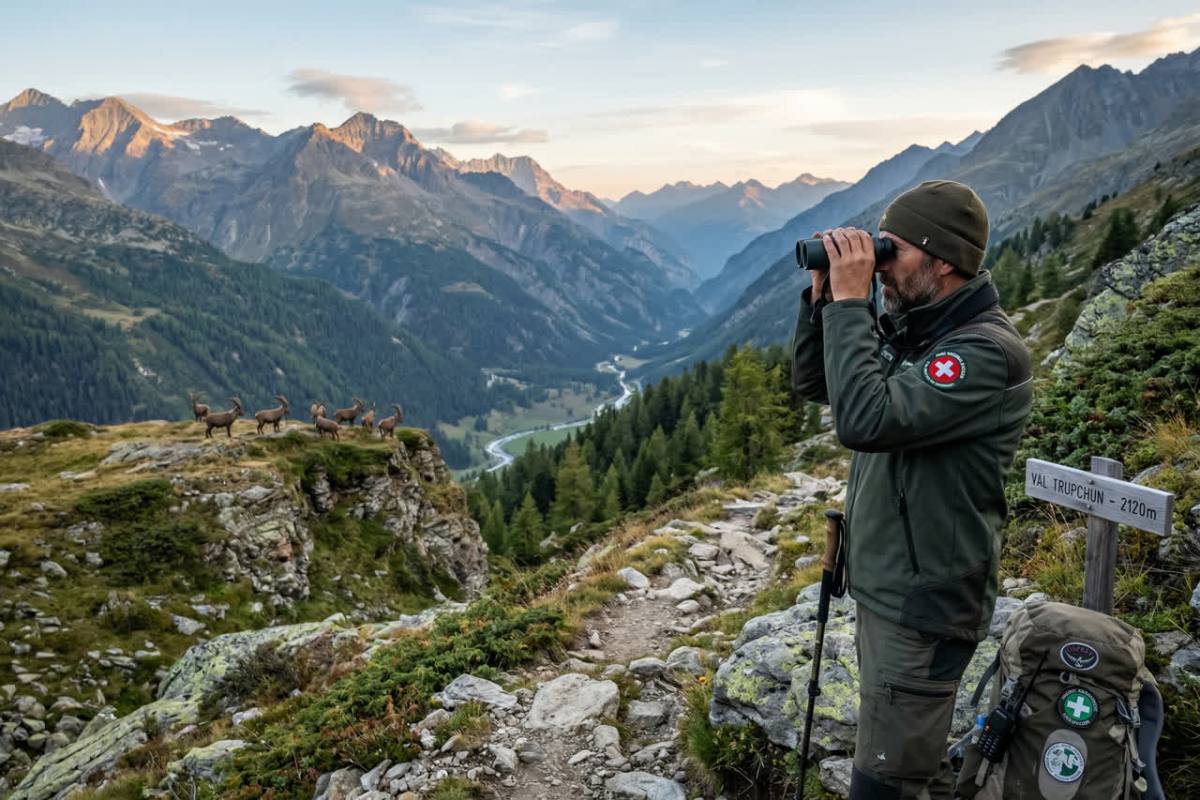
Any serious alternative to recreational hunting requires a foundation that today's hunting policy lacks: reliable population data. Without systematic wildlife monitoring, no one knows exactly how many animals of a species live in an area, what trend the population shows and whether interventions are actually necessary.
Professional wildlife management therefore relies on standardized counting methods: camera trap monitoring, GPS tracking, genetic sampling, transect counts. These methods provide more objective data than the assessments of recreational hunters, who have a vested interest in the largest possible harvest quotas.
Wildtier Schweiz itself notes that from current hunting statistics 'no reliable conclusions can be drawn about the status of wildlife species.' This is an admission that undermines the entire justification of today's hunting practice: if we don't know how wildlife is doing, we also can't say for certain whether hunting is necessary.
The cost calculation: What alternative management really costs
Opponents of alternatives to recreational hunting often argue based on cost: professional wildlife wardens would be more expensive than the current system. This is only true if external costs are ignored. In reality, recreational hunting generates substantial social costs: wildlife accident follow-up costs due to hunting-induced stress pressure, costs for wildlife damage interference, administrative overhead, costs from browsing damage in hunting-stressed populations, health costs from lead exposure through game meat consumption.
The Geneva model costs around 1.2 million francs per year for a canton with 282 km² area and approximately 500,000 inhabitants. Extrapolated nationwide to 41,285 habitable area, a professional wildlife management system according to the Geneva model would be financeable with an estimated 150 to 200 million francs annually – compared to what hunting costs Switzerland overall when external costs are factored in, not an overwhelming sum. The Dossier What recreational hunting really costs Switzerland calculates this through.
Conclusion: The alternatives exist – what's missing is political will
The alternatives to recreational hunting are scientifically documented, tested in practice, and already successfully implemented in individual areas. What's missing is not knowledge – it's the political will to replace a practice over a hundred years old in favor of contemporary, animal-appropriate and ecologically sound methods. Geneva shows the way. Luxembourg shows the way. The National Park shows the way. The question is when Switzerland as a whole will find the courage to follow.
Further content on wildbeimwild.com:
- Dossier: Alternatives to recreational hunting
- Dossier: Geneva and the hunting ban
- Dossier: Arguments for professional wildlife wardens
- Dossier: Livestock protection in Switzerland
- Dossier: Hunting ban Switzerland
- Dossier: The wildlife warden model
More background on current hunting politics in Switzerland can be found in our Dossier on wildbeimwild.com.
Support our work
With your donation you help protect animals and give voice to their concerns.
Donate now →More on the subject of recreational hunting: All Dossiers at a glance bring together fact checks, analyses and background reports. The scientific evidence is presented in the overview Studies on the Effects of Recreational Hunting.
The position of IG Wild beim Wild: IG Wild beim Wild rejects recreational hunting. Our model is the canton of Geneva, which has managed without recreational hunting since 1974: without hunting seasons, without hunting dogs, without driven hunts, without high seats, without the animal cruelty and crime that go hand in hand with hunting season elsewhere. What has worked there for over fifty years disproves every position paper by JagdSchweiz. An association that bases its policy on claims it refutes in its own documents is not a professional organisation, but a factory for misinformation.