Deterring wildlife instead of killing
Deterring wildlife instead of killing is the more effective method. Non-lethal measures protect livestock and preserve wildlife populations.

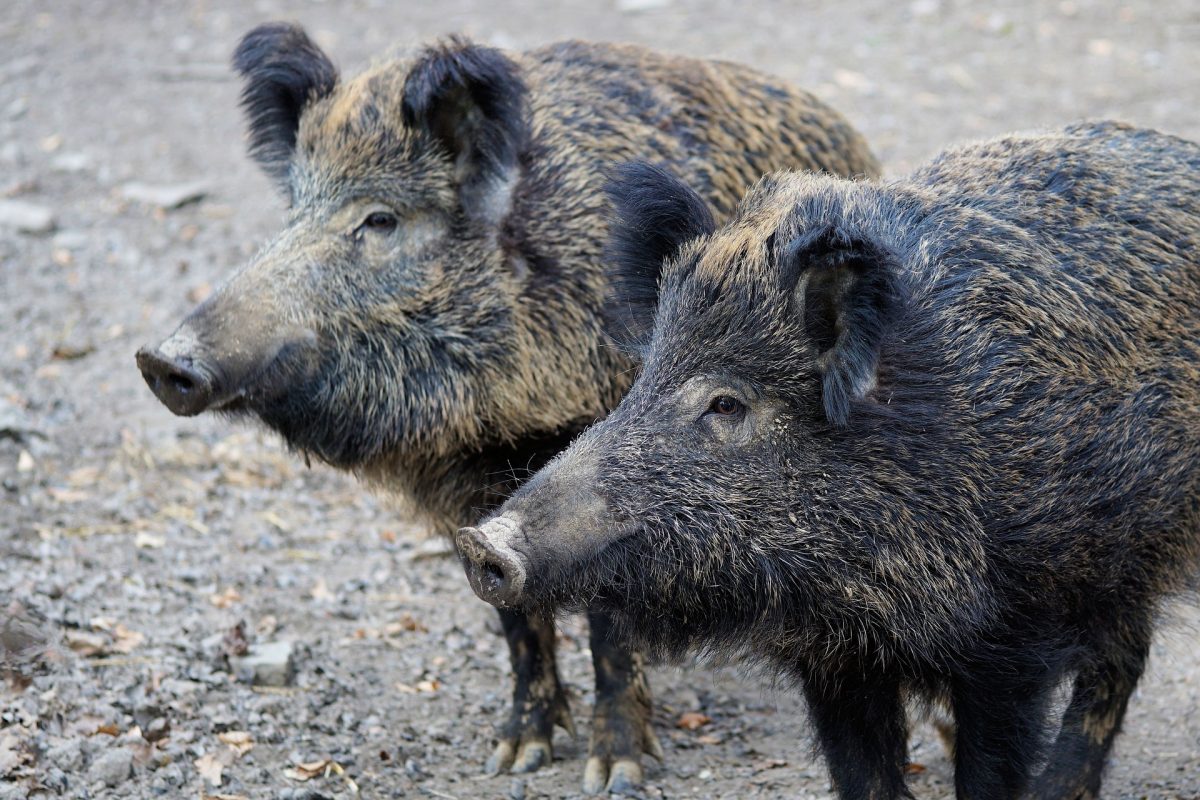
wild boars
“Ceasefire”
As a matter of principle, every animal keeper must also adequately protect the animals in their care that are at risk, whether by means of a fence, herding activity, or fixed installations.
Chickens, rabbits, etc. should be protected at night in a securely closed stable.
Compost heaps are always an attraction and meeting point for wildlife and should be covered where necessary. Avoid leaving fallen fruit on the ground as much as possible, net berry bushes. Household waste, garden waste, etc. belong in solidly sealed containers or dustbins. Rubbish bags should not stand on the street for days on end, but only be placed out on the day of collection. Food bowls belonging to domestic cats are also attractive to wildlife.
Should an intrusive visitor nevertheless take up residence in the garden, there is, for example, the option of relocation using live traps available in all sizes. However, traps are not selective. As a result, animals other than those causing the damage are often caught (cats, polecats, martens, etc.). This problem can be minimised by placing the traps directly in front of, or in the immediate vicinity of, the hiding places of the wildlife to be caught.
When foxes, badgers and the like are caught and released somewhere else, they suffer fear and stress during the trapping process. If they then find themselves in a completely unfamiliar environment, this causes further stress, among other things: they cannot find their bearings in an unfamiliar territory and must defend themselves against established residents.
Sooner or later, the young animals will disperse and seek a new territory; parent animals move on as well.
The trapping method is always preferable to the recreational hunter, because the wildlife has a real chance. The recreational hunter usually arrives with a rifle and wants to kill!
IG Wild beim Wild
Shooting animals in a residential area can be extremely dangerous. People (including children!) or pets may be put at risk. Time and again, we hear reports in the media of recreational hunters mistaking a fox for a cat, or a llama for a deer. A considerable number of recreational hunters suffer from psychological problems and are unable to properly assess the situation.
The topic of disease in wild animals is grossly exaggerated by recreational hunters. More people are struck by lightning or injured in hunting accidents than are infected with a disease by wild animals. In most cases, it is recreational hunters themselves who contract a zoonosis!
Trapped and removed animals are often replaced by members of the same species who either do not yet have their own territory or are expanding their range. The newcomers use the scent markings left by their predecessor, which show them exactly where the escape routes or feeding spots are. Seal off potential hiding places, for example near garden sheds (first make sure no animals are sheltering inside). Immediately close up any freshly started digging activity (holes)!
Another solution is deterrence. Deterrence refers to the permanent displacement (frightening away) or exclusion of wild animals – either unintentionally or as a deliberate non-lethal method to bring about a corresponding change in behaviour in wild animals. Exploiting innate behavioural patterns to influence the targeted wild animals in an environmentally neutral way by simulating natural predators is playing an increasingly important role in this approach.
- Electric fences can keep wild animals away
- Repellent substances are used to deter wild animals.
- Radios and motion detectors with sound/light effects are used to deter wild animals.
- Crow clappers are used to deter ravens and crows.
- Spikes are installed on particularly architecturally protected buildings to deter pigeons.
- Compressed-air blank cartridge devices are used in vineyards.
- Ultrasound is used to repel martens or voles underground.
- Scent substances (toilet blocks, synthetic products, sweat, etc.) are used to repel wild animals.
- A dog in the garden deters wild animals.
- Dog and human hair deters wild animals.
- Aluminium strips that create noise through wind and produce light reflections deter wild animals and birds.
- Scarecrows are intended to keep birds such as crows away.
- Water spray with a garden hose drives away wildlife
- Thriller whistles drive away wildlife
To protect free-roaming rabbits, ducks, rabbits, etc. in the garden from foxes, martens or other predators, they should be kept at night in a secure, spacious enclosure. The free-roaming area should be secured during the day and night with an electrifiable pasture fence. Nowadays, fine-meshed, flexible small animal fences in various heights (50 – 170 cm) are available in stores, specially designed for use near the home, providing protection for free-roaming small animals.

When foxes are removed from an area, the remaining foxes respond by producing more offspring, and the vacated area is quickly reoccupied by new foxes. It is also well established that fox populations cannot be permanently reduced even through intensive hunting.
Many people enjoy the presence of wildlife and are willing to share their habitat with them. Wildlife enriches the fauna and quality of life even in our residential areas, just as blackbirds, frogs and hedgehogs have long done. Enjoy the opportunity to share your habitat with a wild animal and perhaps observe it. You will be fascinated! With a little tolerance and the right behaviour, a peaceful coexistence between wildlife and humans should be entirely possible. IG Wild beim Wild
Fragrances:
Due to the pungent odour, application in inhabited areas is often not possible.
Hukinol: Reliably repels all wildlife species from areas where they are unwanted, using a concentrated human sweat odour. Hukinol has a very persistent and long-lasting scent, so that just 1 bottle per hectare is sufficient for effective protection. Hukinol is applied like conventional repellents — dripped onto rags and hung on posts at intervals of approximately 10 – 20 metres. The use of this product is not recommended in inhabited areas due to the strong odour impact. Hukinol is suitable for preventing wildlife damage in forests and fields, for saving fawns in meadows, and for protecting poultry from predators.
Antibissan: Keeps away crows, roe deer, wild boar, birds of prey, foxes, martens, voles, moles, snails and ants — ideal wildlife crossing barrier; the scent and active substances are perceived by the animal, creating an enemy image (human) in the subconscious and thus driving the animal to flee; long-lasting effectiveness; the active substances used are harmless to humans, animals and the environment.
Limses: For reducing ungulate accidents in road traffic and for wildlife deterrence on smaller cultivated areas. Limes works exclusively through scent, creating heightened alertness or irritation in wildlife. Limes dispensers are hung on both sides along roads or around cultivated areas on trees, shrubs or posts. The distance between dispensers should be 10 – 20 metres.
Porocol: A synthetic aromatic active substance housed in a weather-resistant plastic evaporator column. Porocol is used on roads with heavy wildlife crossing activity, to protect against browsing damage in forest areas with young plants, or in fields — for example maize fields — to prevent wild boar from entering. In addition, Porocol is excellently suited for fawn rescue (mowing casualties). For fawn rescue, the evaporator columns should be placed 1 – 2 days before mowing the meadow.
Armacol: Following multi-month applications in European big game areas, Armacol has proven extraordinarily effective in wildlife management and wildlife deterrence. Armacol reliably drives away all wildlife species from areas where wildlife is unwanted, through concentrated human sweat odour. Armacol has a very adhesive and lasting scent, so that just 1 bottle per hectare is sufficient for adequate effectiveness. Armacol is applied like conventional repellents — dripped onto rags and hung on posts at intervals of approximately 10 – 20 metres. The use of this product is not recommended in inhabited areas due to the strong odour nuisance! Armacol is suitable for wildlife management in forest and field (forced crossing), for fawn rescue in meadows and for the protection of poultry from predators.
Fowikal: Available at Landi in Switzerland for badger, deer, roe deer, fox, etc.
Zoonoses in foxes:
As independent studies by the Friedrich Loeffler Institute for Animal Virus Diseases and the Helmholtz Centre for Environmental Research have shown, it is not possible to influence sylvatic rabies through hunting measures. As experience from the 1970s demonstrated, this could not even be achieved through the unprecedented campaign of extermination, during which all accessible fox dens across the country were treated with poison gas and foxes were relentlessly pursued with traps and rifles. Only the large-scale distribution of vaccine baits led to the eradication of rabies.
Hunting foxes also has no influence on the prevalence of the small fox tapeworm. The latest research from the University of Hohenheim, the Technical University of Munich, and the University of Zurich suggests that hunting foxes could actually be counterproductive with regard to the occurrence of the small fox tapeworm, as hunting affects the age structure of populations.

Even the argument of protecting ground-nesting birds and small game by sounding the great halali for foxes does not appear to hold up, as surveys from unhunted habitats have shown. The relationship between predators and their prey has been established and proven since time immemorial, and no case has ever been documented in which native predators have wiped out native prey species. The cause of the endangerment or even extinction of populations has never been our native predators such as foxes, martens, or birds of prey, but always human interference in the environment and, through hunting, in the habitats of species.
More on the subject of recreational hunting: In our dossiers on recreational hunting gather fact-checks, analyses and background reports. What the research says about this is shown by Hunting fact-checked: the state of research.
The position of IG Wild beim Wild: IG Wild beim Wild rejects recreational hunting. Our model is the canton of Geneva, which has managed without recreational hunting since 1974: without hunting seasons, without hunting dogs, without driven hunts, without high seats, without the animal cruelty and crime that go hand in hand with hunting season elsewhere. What has worked there for over fifty years disproves every position paper by JagdSchweiz. An association that bases its policy on claims it refutes in its own documents is not a professional organisation, but a factory for misinformation.