Recreational Hunter Politics in Italy on Thin Ice
On 24 October 2025, La Sentinella del Canavese reported on two recent surveys indicating that a clear majority of Italians are opposed to recreational hunting — and to any expansion of hunting rights.


For our readers, this means: we are entering a critical phase — not only in Italy, but also in Central Europe — in which critical voices on hunting are no longer a minority.
This article examines what the survey results mean, how the recreational hunting lobby is positioning itself, and why politics and society must act now.
What do the figures show?
According to the two commissioned polling institutes, the following key findings were identified:
- Safety risks: In the Ipsos survey, 85% of respondents stated that they associate hunting with “considerable safety risks.” The Istituto Piepoli confirmed a similar figure of 71%.
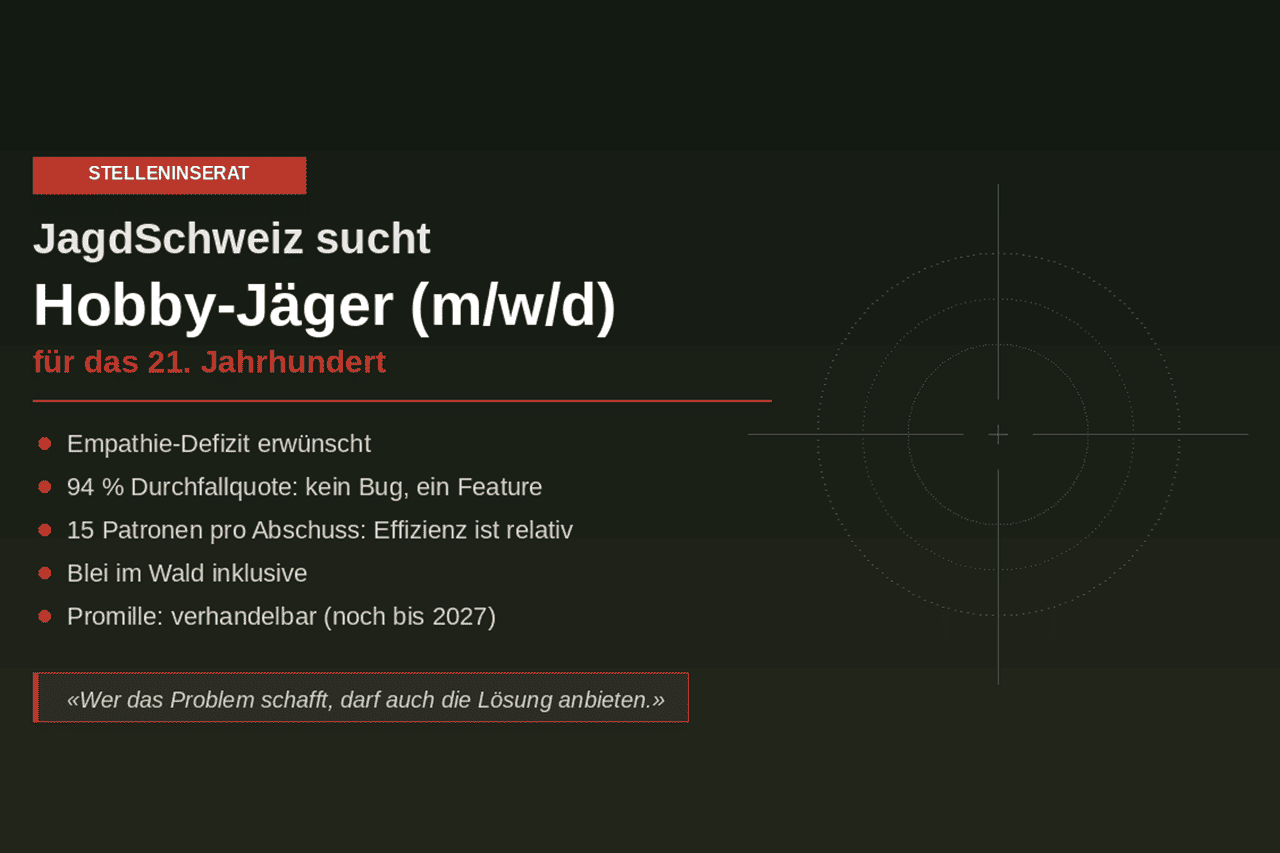
- Ethical rejection: According to Ipsos, 78% consider hunting ethically unacceptable due to “animal suffering.” Piepoli placed the figure even higher, with 94% wanting hunting to be abolished, severely restricted, or at the very least not expanded further.
- Threat to biodiversity: Between 68 and 69% of respondents consider recreational hunting to be a threat to biodiversity.
- Legislative reform under pressure: Regarding the proposed bill “DDL 1552” to reform hunting law, 61% of respondents stated they were opposed to it (Ipsos). With Piepoli, only 24% expressed support. Furthermore, 77% of respondents said they would be willing to sign a petition to abolish or restrict hunting.
These results are not merely noteworthy — they are alarming for a hunting practice that has until now enjoyed broad public support.
Why is this relevant — including for Germany and Switzerland?
- Social change
The fact that a clear majority in Italy opposes hunting points to a broader European trend: animal and nature conservation concerns are gaining stronger public prominence. When the hunting lobby loses its narrative foundation, the balance of power shifts — here in Switzerland as well. - Legislative Precedent
The aforementioned bill DDL 1552 aims to expand the rights of recreational hunters, for example regarding culling or private use. The broad rejection this step has encountered shows: politicians can no longer pursue the expansion of hunting unchecked. Comparable reforms could be initiated in Germany and Switzerland, but without careful legitimation, a backlash looms. - Contested Ground: Species, Animal, and Nature Protection
When nearly 70% of respondents view hunting as a threat to biodiversity, hunting policy must answer the question: whom does it actually serve? Recreational hunters or nature conservation? This approach carries explosive potential for debates ranging from wolf and wild boar policy to territory sizes and culling quotas.
What Is Problematic in Practice?
- Hunting as Recreational Sport Rather Than a Conservation Tool
Many hunters see themselves as guardians of nature — yet when such a large majority ethically rejects hunting (e.g. 78% according to Ipsos), it stands to reason that the practice is, for many people, incompatible with these ideals. - Expansion of Rights Without Legitimation
The Italian article criticises the fact that the bill would expand the rights of recreational hunters against the will of the Italian majority. Those seeking legitimation — politically and socially — must be in dialogue with the population, not act behind its back. - Nature Conservation Versus Hunting
When people view recreational hunting as a risk to biodiversity, the hunting movement must redefine its role: will it continue to be a steward of wildlife populations or become part of the problem? Otherwise, public isolation threatens.
What Should Happen Now?
- Transparency and Dialogue
Hunting associations and authorities should not operate in closed circles. The public, NGOs, and animal and nature conservation organisations must be included. The survey results show: the majority wishes to have a say. - Establishing Social Legitimation
These surveys alone show that hunting practices are no longer accepted without reservation. Hunting policy should therefore listen less to lobbying interests and more to societal values such as ethics and biodiversity. - Don't just push through reforms — justify them
When changes to hunting law are planned — as in Italy through DDL 1552 — they must be comprehensible: Why? To what extent? With what risks? For whom? Without this justification, rejection is likely. - Give greater weight to animal and nature conservation
If people see hunting as a threat to biodiversity, hunting can no longer be primarily a shooting and recreational sport. It must fit into a nature conservation concept — with clear objectives, oversight, and feedback mechanisms.
The surveys in Italy send a clear signal: society is turning away from an uncritical attitude toward recreational hunting. For organisations such as wildbeimwild.com, this represents both an opportunity and an obligation. An opportunity, because the issue can be more broadly anchored in public discourse; an obligation, because it is no longer only a minority raising its voice.
Hunting has its historical role — but it must redefine itself: as a partner of animal and nature conservation, not as a competitor. If this fails, its social support is at risk — particularly in times of species extinction, climate change, and ethical reassessment.
It remains to be seen how politicians, authorities, and interest groups will respond. But one thing is clear: those who continue as before risk not only public acceptance, but losing touch altogether.
More on the subject of recreational hunting: In our dossiers on the criticism of recreational hunting gather fact-checks, analyses and background reports. What the research says about this is shown by Hunting fact-checked: the state of research.
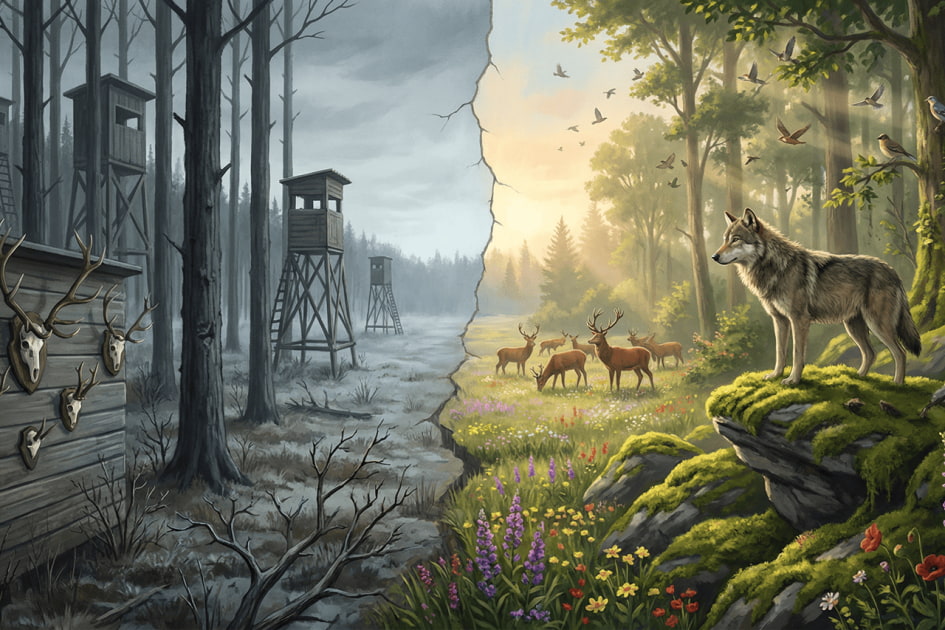
The position of IG Wild beim Wild: IG Wild beim Wild rejects recreational hunting. Our model is the canton of Geneva, which has managed without recreational hunting since 1974: without hunting seasons, without hunting dogs, without driven hunts, without high seats, without the animal cruelty and crime that go hand in hand with hunting season elsewhere. What has worked there for over fifty years disproves every position paper by JagdSchweiz. An association that bases its policy on claims it refutes in its own documents is not a professional organisation, but a factory for misinformation.