Common marmoset freed from bird cage
Veterinary office seizes animal following tip-off from PETA

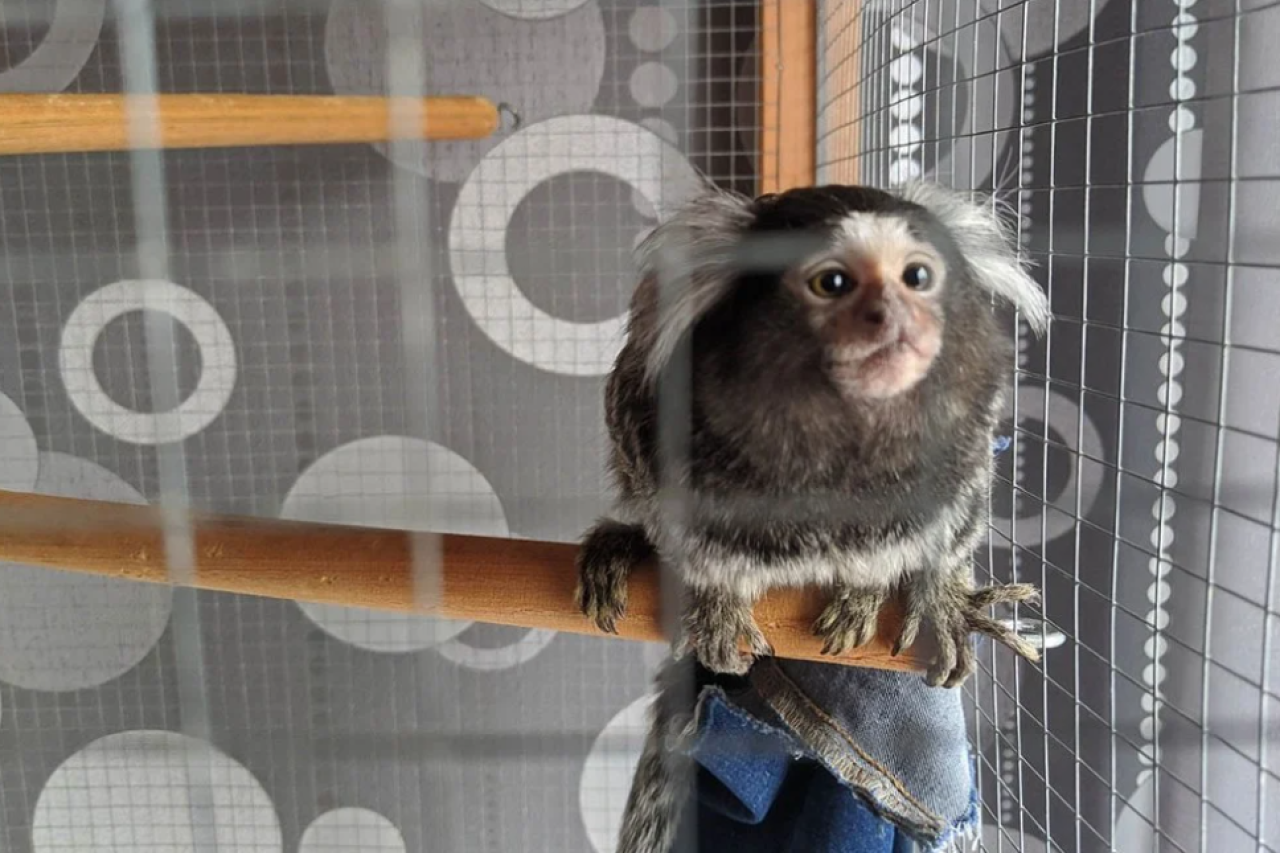
In September, PETA became aware of an advertisement on a well-known online platform offering a small common marmoset for sale.
Posing as prospective buyers, a researcher from the animal rights organisation, together with animal welfare detective Judith Pein from the TV programme «hundkatzemaus», managed to make video recordings during a meeting with the sellers.
The monkey Gucci had been kept for over a year largely in a bird cage in the family’s living room, and was fed in a manner completely contrary to his natural needs — with beer, sausage, and pasta. The research team immediately notified the responsible veterinary office for the Rhein-Erft district. On the basis of the documented serious animal welfare violations, the authority inspected the keeping conditions on site and seized the frightened animal. Gucci was temporarily housed at the Bergheim animal shelter, where it was discovered that he was suffering from intestinal parasites that can also pose a danger to humans. In addition, due to being kept in isolation, he was initially unable to live alongside other monkeys. The socialisation process took several weeks. Gucci has since found a home at Brückenkopf-Park Jülich, where he now lives together with others of his species.
Gucci’s story is not an isolated case: the trade in exotic animals is unfortunately widespread in Germany, even though animals such as monkeys, snakes, or tigers can never be kept in a species-appropriate manner — least of all by private individuals. Through online platforms, sensitive living creatures of every kind are sold even to complete amateurs. Animals are not commodities. The sale and private keeping of exotic animals must finally be prohibited in Germany.
Jana Hoger, specialist adviser for animal companions at PETA
The trade in exotic animals
In Germany, there is currently no uniform regulation governing the trade in and keeping of exotic animals. This opens the door to unscrupulous dealers. Only a small proportion of the species traded worldwide are protected by law. Many animal species are effectively abducted from their countries of origin to be offered for sale in Germany and other EU countries through online platforms and at trade fairs. Such cases of wildlife crime are a global problem.
The exotic animal trade threatens biodiversity
The findings of a new study presented by the Federal Ministry for the Environment (BMU) in March 2020 further confirm that the trade in exotic wild animals contributes to the worldwide extinction of species, and that urgent action is needed, particularly for the sake of species and nature conservation. «Germany and Europe also play a role in the growing endangerment of species in their countries of origin. This directly concerns the demand for exotic wild animals for the German pet market,» said Federal Environment Minister Svenja Schulze.
Even when the animals in question are non-venomous, exotic species can be dangerous to humans: animals such as monkeys, snakes, and tortoises are frequently infected with contagious intestinal parasites such as worms or giardia, which can also be transmitted to humans. According to estimates by the Robert Koch Institute, one in three salmonella infections in young children originates from exotic animals. More on the topic of animal rights and wildlife protection.
A feature about the rescue of the monkey Gucci was broadcast on 31 October 2020 at 6:00 pm on VOX in the television programme «hundkatzemaus».
More on the subject of recreational hunting: In our dossiers on recreational hunting gather fact-checks, analyses and background reports. What the research says about this is shown by Hunting fact-checked: the state of research.
The position of IG Wild beim Wild: IG Wild beim Wild rejects recreational hunting. Our model is the canton of Geneva, which has managed without recreational hunting since 1974: without hunting seasons, without hunting dogs, without driven hunts, without high seats, without the animal cruelty and crime that go hand in hand with hunting season elsewhere. What has worked there for over fifty years disproves every position paper by JagdSchweiz. An association that bases its policy on claims it refutes in its own documents is not a professional organisation, but a factory for misinformation.