Northern Bald Ibis breeds again in Germany
The Northern Bald Ibis is breeding in the wild in Germany for the first time in over 400 years. A reintroduction project is bearing fruit.

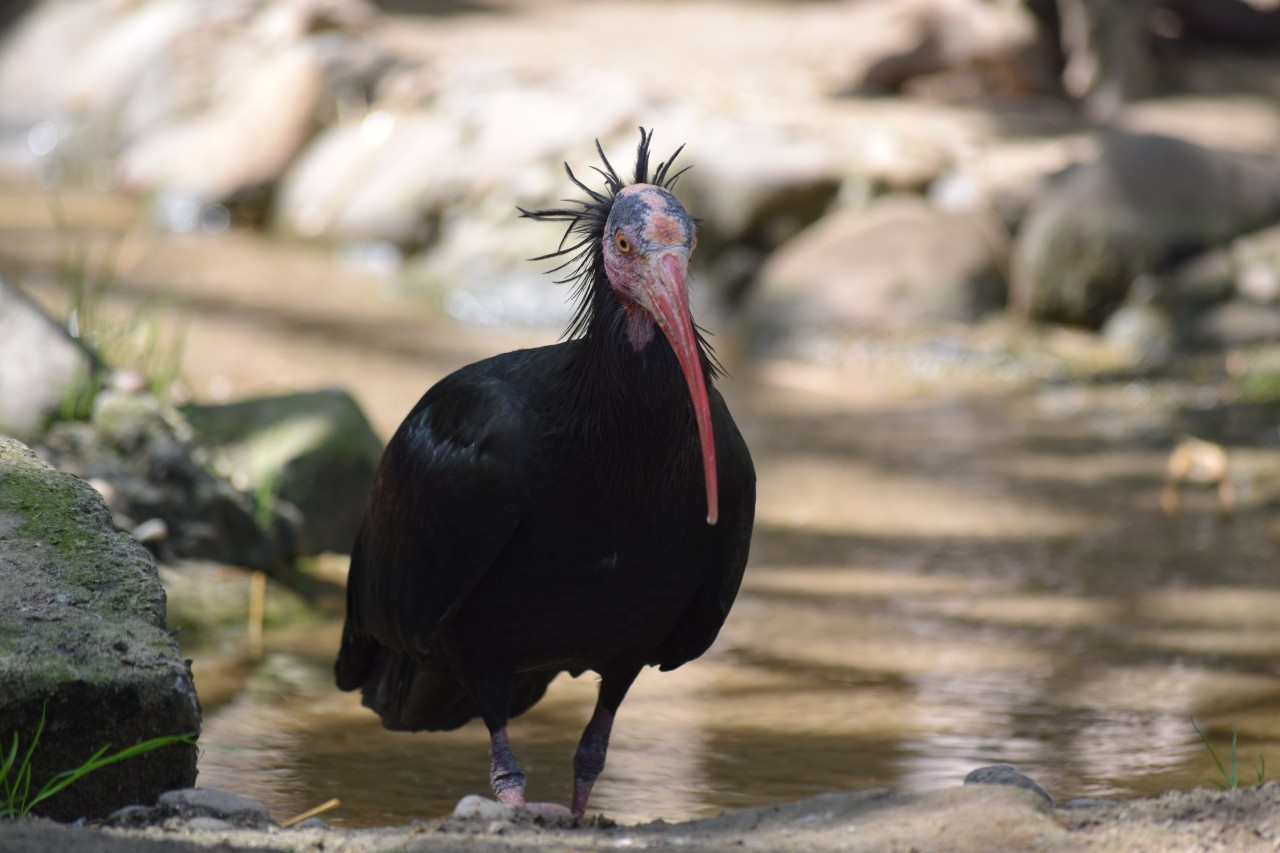
Wild hair, but with poise – the Northern Bald Ibis has something of a gifted concert pianist who has been playing through the night.
It remains courteous: when one Northern Bald Ibis encounters another, both tilt their heads back and bow. As they do so, they emit a hoarse «ChruuChruu» from their unfeathered, red-coloured throats. The bill, up to 15 centimetres long, is highly sensitive: it contains tactile organs that detect worms & other creatures in the soil. 400 years ago, the Northern Bald Ibis, also known as the Waldrapp or hermit ibis, was extinct across all of Europe – but now it is returning. As part of a European LIFE joint project, breeding colonies of this migratory bird species – listed as endangered on the IUCN Red List – are to be established in Germany, Austria, Italy, and Switzerland.
For the Northern Bald Ibis to feel at home with us as a wild cultural follower, it must first relearn its old behavior – namely migrating south in winter. If a young Northern Bald Ibis does not find the migration route to its wintering grounds in Tuscany during its first year of life, the learning window closes and it will never manage to stand on its own two feet.
Professor Dr. Klaus Hackländer, Chairman of the Deutsche Wildtier Stiftung
In order to track the flight of each individual Geronticus eremita precisely, the Northern Bald Ibises carry small backpack transmitters during flight. «We support the fitting of transmitters and hope that everything goes well for every bird», says Professor Hackländer.
Power lines can mean death for the birds, as can poor weather conditions or illegal shooting over Mediterranean countries, which still occurs to this day! Partners of the Deutsche Wildtier Stiftung include Schönbrunn Zoo in Vienna and the Austrian Waldrapp Team. «Here, the 11th generation of chicks has already been hand-reared and later released into the wild«, says Hackländer. In the meantime, however, the project also includes wild-living Northern Bald Ibises that are breeding in nesting areas in Bavaria, Salzburg, and Baden-Württemberg. This year looks promising. For instance, 16 chicks have hatched in five nests in the niches of the castle wall at Burghausen. Meanwhile, in Überlingen on Lake Constance, eggs are still being incubated in three nests. But the first chicks there will hatch soon. «If they are doing well, we are one step closer to our goal of establishing the magnificent Northern Bald Ibis«, says Hackländer.