Remedial Lessons for Wildlife Management in Graubünden
The wolf population is growing. Wildlife density in Graubünden is three times higher than elsewhere. Wildlife management needs remedial lessons.


Switzerland's wolf population is growing, and the formation of new packs is foreseeable again this year.
The size of the wolf population is determined primarily by the number of prey animals. Human settlement density has only a minor influence. Wildlife density in Switzerland is exceptionally high. In the canton of Graubünden, for example, it is more than three times as high as in the often-cited Yellowstone National Park or in Sweden. As a result, wolf densities are developing in Switzerland in a completely natural way that exceed those in these regions. The principle holds: Those who sow deer will reap wolves. Anyone who wants to slow the growth of the wolf population must be willing to accept a significant reduction in ungulate densities, explains Groupe Loup Suisse.
Opponents of wolves, and sometimes even government authorities, point with concern to the fact that wolf densities in parts of Switzerland have now reached levels higher than those in Yellowstone National Park in North America. Yet this comparison is entirely misleading and ignores the key factor determining wolf population size: the number of prey animals. An analysis shows: The density of ungulates (wild-living cloven-hoofed animals such as roe deer, chamois and red deer) is, for example, three times higher in the canton of Graubünden than in Yellowstone National Park and also than in Sweden. This high wildlife density poses an existential threat to several important native tree species in the forest and thereby endangers the forest's function as a protective forest in mountain areas and the resilience of the forest in the face of climate change.
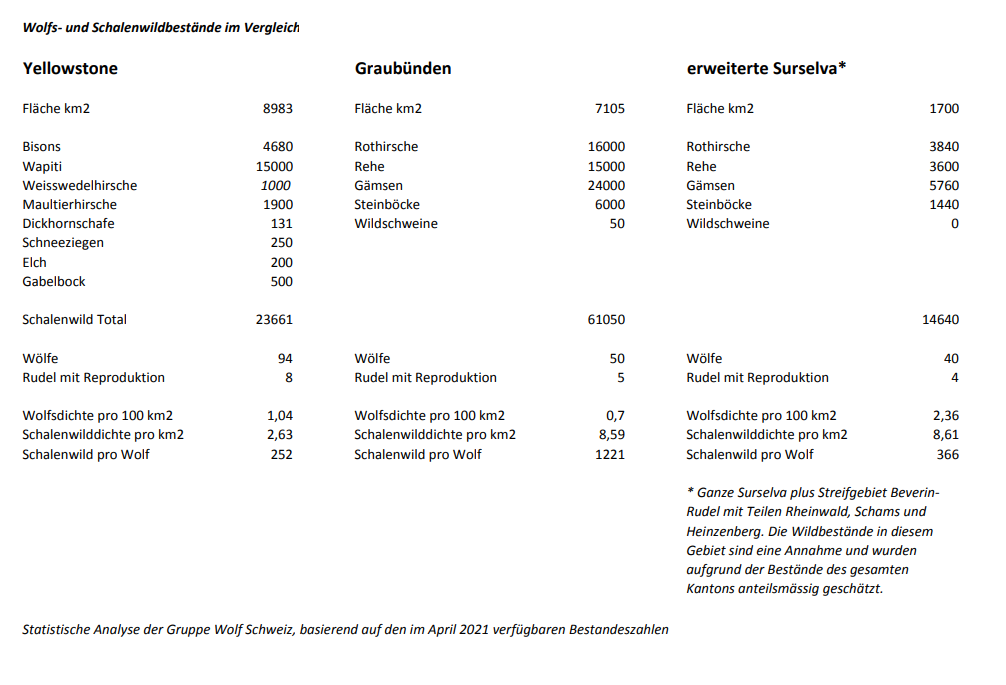
How quickly wolf populations grow and how large they can become is largely determined by the number of prey animals. The large litter sizes of wolf packs (litters of up to nine pups) and the high survival rate (no juvenile losses in some packs through to autumn) attest to the excellent living conditions for wolves in Switzerland. Even increased regulatory culls will hardly be able to change this biological reality, as the wolf, with its adaptability and high reproductive rate, can quickly compensate for losses. With such high game densities, it is therefore difficult to reduce predator density even with intensive regulation.
Regulating the wolf will therefore not be successful without a significant reduction in ungulate populations.The key to controlling wolf populations is not shooting wolves, but regulating ungulate populations.
Hunting Initiative
For many years, all of Switzerland has seen that Graubünden politicians and hobby hunters are mistaken in their hunting misconduct. Their views have been corrected on multiple occasions by legislators, the Federal Supreme Court, BAFU, and others.
And it is precisely these circles on the committee against the hunting initiative that are now once again attempting to mislead the public with hair-splitting wordplay.
It has been documented for decades that Graubünden gun-wavers are neither well-trained nor possessed of sound moral integrity. And now these individuals are beating the drum for alcohol, child abuse, and appalling violence. According to the Office for Hunting and Fishing, there are more than 1,000 reports and/or fines against these perpetrators of violence every year, as the IG Wild beim Wild notes.
Thomas Roffler, President of the Graubünden Farmers' Association, and others are complaining, once again against law and order, «that children under 12 would no longer be allowed to go hunting.» The UN Committee on the Rights of the Child advocates, pursuant to Art. 19, for the protection of minors from the harmful effects of violence. The Convention on the Rights of the Child includes, among other things, the right of all minors to physical and mental integrity, as well as the obligation of the state to guarantee the protection of those rights.

Wildlife has long since ceased to be mere property that can simply be used or «harvested» under the law. Yet the Office of Hunting and Fisheries fails to produce any output that reflects this modern reality. It is therefore clear that genuine animal welfare advocates are needed on the hunting commission.
Graubünden’s hobby hunters don’t only cause serious, deliberate disruptions to the natural balance of species through small game hunting. Addressing this requires a comprehensive ecological understanding as well as ethical knowledge and a conscience regarding the highly complex processes in nature — qualities that the average Graubünden hobby hunter entirely lacks.
Small game hunting is not necessary, but it is permitted. One might equally ask whether it makes sense to collect berries and mushrooms in the forest.
Robert Brunold, former president of the BKPJV.
The marksmanship of hobby hunters, alcohol consumption, and the many hunting accidents themselves all give serious cause for concern.
The persistently high hunting pressure — particularly through special hunts — has not regulated stock levels to the desired size, but has instead kept populations highly productive at a high level. In other words: the more roe deer or red deer that are shot, the more rapidly they reproduce, according to modern wildlife biology research. And that is precisely where the real problem lies.
Added value: