Turtle Dove in Switzerland
The turtle dove is a fascinating bird that plays a special role in Switzerland. With its gentle, melancholic call and its characteristic slender build, it attracts the attention of nature lovers and ornithologists alike.

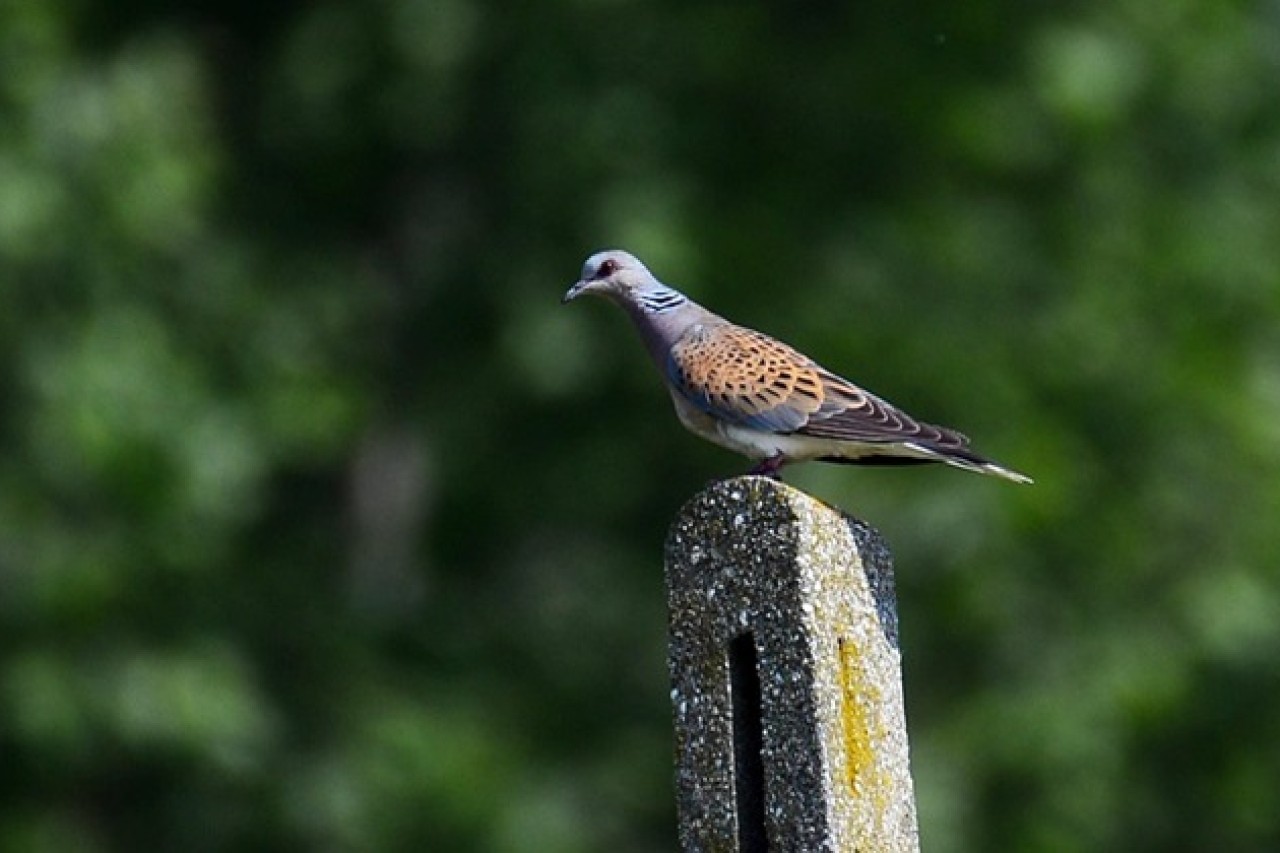
The turtle dove is approximately 30 to 33 cm long and weighs around 120 to 200 grams.
Its plumage is predominantly brown and grey, with slightly reddish hues. Particularly striking are the black neck feathers, which are arranged in a characteristic striped pattern around the neck. Its eyes are large and bright, giving it a particularly gentle expression.
In Switzerland, the turtle dove is found primarily in open woodlands, open landscapes and at forest edges. It favours areas with abundant shrubs and hedgerows that provide cover while also offering nearby feeding sites. As a migratory bird, it spends the winter months in Africa and returns to its breeding grounds in spring. The total population in Switzerland has shrunk by 40% since the 1990s. Since 2010, it has been listed on the Red List in Switzerland. The remaining populations are concentrated in a few regions at low altitudes, primarily in western Switzerland, the Rhône Valley, southern Ticino and northern Switzerland.
The turtle dove's breeding season begins in April and can extend into August. The female normally lays two eggs in a simple nest made of twigs and grasses. Both parents participate in incubation and in feeding the chicks, which hatch after approximately 14 to 15 days.
The turtle dove feeds mainly on seeds, fruits and berries. In particular, the seeds of wild herbs and cereals are an important food source for the bird. It forages in open fields and gardens, where it is often found in small groups.
Over recent decades, the turtle dove has declined in population across many parts of Europe, including Switzerland. The main reasons for this decline are the loss of habitat, increasingly intensive agriculture and recreationalhunting. To protect the turtle dove, various conservation measures are necessary, such as the creation and preservation of suitable habitats as well as regulated hunting practices.
The turtle dove may be hunted in some European countries, mainly in the Mediterranean region, for example in Spain, Portugal, France, Italy, Malta, Cyprus, Greece, Bulgaria, and Romania, even though the EU Birds Directive effectively prohibits hunting of endangered species. Hunting seasons vary by country and federal state. In Austria, turtle doves may be shot in Burgenland from mid-August, and in Vienna and Lower Austria from September. Over 2 million of these birds are legally shot — every year.