Tiger Mafia in Asia and Europe
The global animal welfare organisation FOUR PAWS complements Ammann's research with its own investigations in Europe, where an estimated 1'600 tigers live in captivity. FOUR PAWS investigations reveal an active trade between EU countries and China, Vietnam and Thailand.

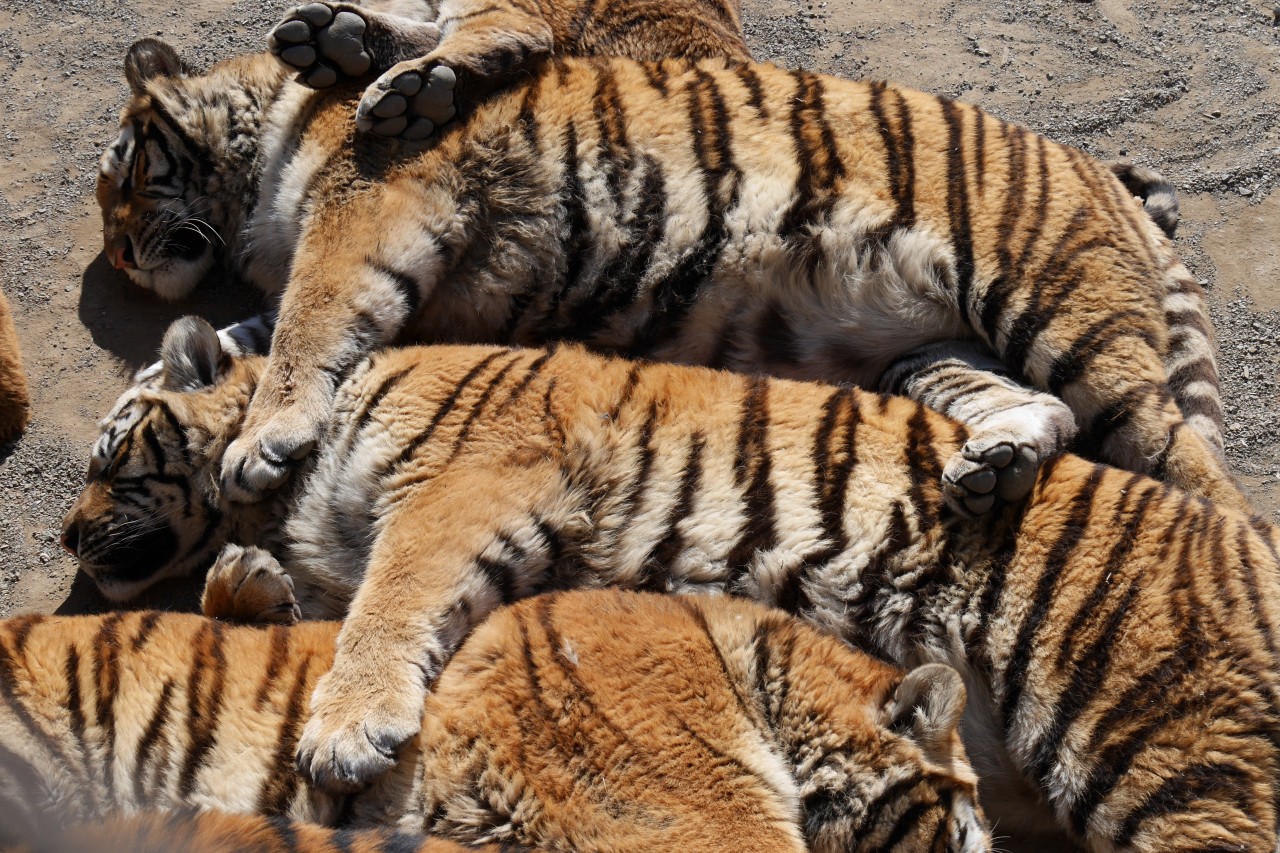
Breeding farms with thousands of tigers, tiger petting zoos, and jewellery as well as traditional medicine made from their body parts: the new documentary «The Tiger Mafia» by Swiss filmmaker Karl Ammann brings shocking discoveries from ten years of research into the tiger trade in Asia to light.
According to the Convention on International Trade in Endangered Species (CITES), between 2014 and 2018 alone, 120 import and export transactions involving live tigers and their body parts were legally concluded between EU member states and Asia. The actual number of illegal trades is likely far higher. To protect tigers in the wild as well as in captivity from cruel exploitation, FOUR PAWS is calling on the European Commission to permanently ban the commercial trade in the endangered tiger and its body parts.
For the documentary «The Tiger Mafia», which celebrates its virtual world premiere on 12 November, Karl Ammann spent a decade investigating the mafia-like structures of the tiger trade, particularly in China and Southeast Asia. There, tigers are legally bred on a large scale, as evidenced by Ammann's discovery of over 200 Chinese tiger farms housing a total of around 6’000 big cats. Among these are intensive factory-farming operations each holding an estimated 1’000 tigers under conditions of severe animal cruelty. By comparison, only around 3’900 tigers remain in the wild. To maximise profits, many of the tiger farms operate petting zoos where young animals are offered for interaction with visitors. Once the tigers reach two years of age, they become dangerous and zoo operators can no longer use them as tourist attractions. The big cats are then typically killed and processed either for traditional medicine or for luxury goods such as jewellery and rugs.
The captive tigers suffer from psychological and physical damage. In the wild, tigers stay with their mothers for up to two years. In most facilities, however, they are torn away from their mothers at just two months old to entertain tourists and pose for photos. Any natural behavior is denied to them on tiger farms and in petting zoos. In China, tigers living in captivity are often deliberately starved, because only if they die a natural death is it legal to use their body parts.
Kieran Harkin, International Campaign Manager for Wildlife Trade at FOUR PAWS
Lucrative trade in an endangered species
A living tiger bred in Europe fetches up to 22’000 euros according to FOUR PAWS research, but even dead, these wild animals are highly valuable. A small tiger tooth costs around 800 euros, a small bottle of tiger wine approximately 220 euros. Claws, eyeballs, brain, tail, organs, and fur are also processed, primarily for traditional medicine and as jewelry. Tiger products are not only in demand in Asia — European authorities also regularly report seizures. FOUR PAWS research shows that over 8’000 illegal tiger products were confiscated in the EU between 1998 and 2017. The Washington Convention on International Trade in Endangered Species, signed by 183 countries, officially prohibits trade in tiger parts. However, this ban has so far done little to reduce the number of tigers bred in captivity. More on the topic of wildlife trade as an animal welfare problem at wildbeimwild.com.
Similar developments in Europe as well
Ammann's documentation and research by FOUR PAWS show that the tiger mafia operates with an extensive network that reaches into the heart of Europe. “It is legal in the EU to breed tigers for commercial trade. In a number of EU countries there are dubious petting zoos that offer interactions with big cats. What happens to the tigers when they get too old, nobody knows for certain,” says Harkin. Most EU member states have no central registries, tiger breeders can easily forge official documents or in some cases don't record cubs at all. “In Europe, too, tigers are treated as commodities. They are passed around for breeding, trading, and exploitation. Only by banning the commercial tiger trade in Europe can we deal the globally operating tiger mafia a first blow,” says Harkin. More on the topic Wildlife trade and species conservation on wildbeimwild.com.
More on the subject of recreational hunting: In the dossier Poaching and hunting crime in Switzerland we document cases, legal questions and recurring patterns. The scientific evidence is presented in the overview Studies on the Effects of Recreational Hunting.
The position of IG Wild beim Wild: IG Wild beim Wild rejects recreational hunting. Our model is the canton of Geneva, which has managed without recreational hunting since 1974: without hunting seasons, without hunting dogs, without driven hunts, without high seats, without the animal cruelty and crime that go hand in hand with hunting season elsewhere. What has worked there for over fifty years disproves every position paper by JagdSchweiz. An association that bases its policy on claims it refutes in its own documents is not a professional organisation, but a factory for misinformation.