Psychopaths, Sadists, and Hobby Hunters: The D-Factor
According to a study, there is a connection between dark personality traits and the tendency to always prioritize one's own interests above everything else. People such as hobby hunters often torment others — and enjoy doing so.


According to a study, there is a connection between dark personality traits and the tendency to always prioritize one's own interests above everything else. People such as hobby hunters often torment others — and enjoy doing so.
Sadism, Psychopathy or even meanness and malice: The traits that reveal the darker side of humanity share a “dark core,” yet they are not identical in everyone. And anyone who exhibits one of these tendencies is likely to display several others as well. Egoism may not seem as extreme as psychopathy. But a new study concludes that people with these so-called dark personality traits have a tendency to always and above all pursue their own interests. In many cases, such individuals also take pleasure in tormenting others.
The dark side of human nature has many facets. Psychologists from Ulm, Landau, and Copenhagen have now demonstrated that egoists, Machiavellians, narcissists, psychopaths, and sadists have more in common than what separates them. The researchers succeeded in tracing many of these problematic personality traits back to a few fundamental principles: the «dark factor» (D-factor) of personality. The study was published in the internationally renowned journal Psychological Review.

«The core component of this dark factor of personality is an exaggerated egoism that has negative effects on others or society in general. This is accompanied by beliefs that prevent feelings of guilt, remorse, and moral scruples», explains Professor Morten Moshagen. The scientists explicitly describe the D-factor as an extreme form of individual utility maximization that literally walks over dead bodies — willingly accepting harm to others or even deliberately causing it. This tendency is accompanied by an inclination to justify one's own behavior to oneself and others.
The D-factor broken down
The study defines the common denominator of all dark traits. The researchers call it the 'D-factor' and conclude that it underlies the dark side of human personality.
In their analyzes, the scientists examined nine personality traits.These include egoism, spite, Machiavellianism, moral disengagement, narcissism,psychopathy, sadism, self-centeredness, and an exaggerated sense of entitlement. The researchers found that virtually all of these traits can be traced back to the D-factor as the dark core of personality.In practical terms, this means that, for example, people with a high tendency toward narcissism are very likely to also exhibit pronounced Machiavellian and psychopathic personality traits.
Furthermore, according to the researchers, people with a strong D-factor are statistically much more likely to become criminal or violent, or to otherwise violate social rules.

The 'D-factor' connects all of these tendencies. It involves the inclination to ignore or even cause the suffering of others in order to pursue one's own goals and interests. According to the researchers, this also includes the conviction of always being in the right.
The scientist Spearman was the first to demonstrate that these traits resemble a kind of intelligence.The dark aspects of human character also have a common denominator. This means that, similar to intelligence, they all express the same inclinations and tendencies" says Ingo Zettler, professor of psychology at the University of Copenhagen.
This term combines the three character traits of narcissism, psychopathy, and Machiavellianism.When all three traits are found in a single person, it indicates a malevolent personality.

Although the three traits are distinct, they often overlap. Narcissism is characterized by grandiosity, pride, egoism, and a lack of empathy. Machiavellianism manifests in manipulation and the exploitation of others. It often goes hand in hand with a cynical disregard for morality, a focus on one's own interests, and deception. Psychopathy manifests in persistently antisocial behavior, impulsivity, selfishness, callousness, and ruthlessness — which are typical characteristics of hobby hunters.
The D-factor may manifest in one person as narcissism and psychopathy, in another as a different dark trait, or as a combination of all three. But when we examine the common denominator of the various dark character traits, it also becomes apparent when a person has a high D-factor.
The D-factor indicates how likely it is that a person will behave in ways typical of one or more of these dark traits. Traits such as egoism may not seem as extreme as psychopathy. But a new study revealed that these three so-called dark character traits share a general tendency to place one's own interests above everything else. The researchers note, however, that there are some important differences between the dark traits that can lead to drastic differences in behavior.
In the treatment of such individuals, identifying a common denominator can play an important role."We see this, for example, in cases of extreme violence, disregard for rules, lying and deception in companies as well as in the community" Zettler adds.Compassion is the cornerstone of every good character.
Their personality is actually fragile; such people constantly need to prove to themselves that they are better than others. Put simply, a kind of inferiority complex combined with simultaneous delusions of grandeur lies at the root, explains Christian Fichter (51) is a Professor of Social and Economic Psychology and Research Director at Kalaidos University of Applied Sciences.
“This is where recognizing the D-factor in a person can be important, for example to determine whether there is a likelihood that someone will relapse or could behave even more dangerously.“
People with a high D-factor are more prone to breaking rules
Of particularly fundamental interest in the eyes of the researchers is the analogy to the «G Factor» – a concept developed by the famous British intelligence researcher and psychologist Professor Charles Spearman. This «general factor of intelligence» explains that people who show good results in a particular form of intelligence test also perform well in other types of intelligence tests. «Like the g-factor, the D-factor is a general concept that can manifest in various ways«, explains Professor Benjamin Hilbig from the University of Koblenz-Landau. Conversely, this means that a high Dark Factor can manifest itself in a wide variety of problematic behaviors and personalities. «To put it bluntly, one could say that if a boss takes pleasure in dressing down his employees, there is a high probability that he also exploits his business partners, evades taxes, or cheats on his wife», illustrates the Ulm psychologist Morten Moshagen.
Hobby hunters take pleasure in killing animals while hunting
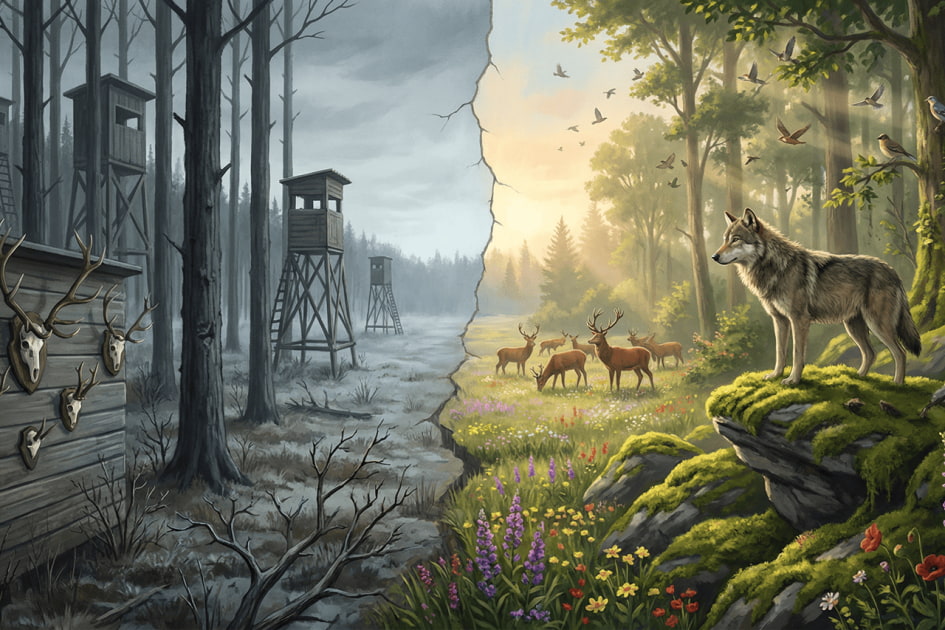
What makes hobby hunters tick? According to a study presented by scientist Marc Bekoff in “Psychology Today”, it is also about signaling costs. Large sums are paid to hunt the biggest and most difficult-to-hunt animals, and people want to show that they can afford to pay an exorbitant price for a photograph of a killed animal. It is about status and showing off: A lion is like a Cadillac, a yacht, or a mansion with the heads of shot animals on the walls.

And how better to display one's status than with pictures on social media, standing with a macabre grin next to a dead animal? But upon closer examination, there is more behind this display than a stupid grin. Because according to a study hunters who display their "joyful smile" next to animal carcasses want to express that the danger of hunting and the killing of animals are far greater than commonly assumed. Researcher Chris Darimont states: "You cannot fake a joyful smile; you cannot do it on command. Of course, killing an animal makes a hunter very happy, but they are even happier when they have killed not a small, but a really large animal of a species.“
Criminologist Xanthe Mallett also studied people for whom hunting is a hobby and concluded that they exhibit a 'dark triad' of personality traits. These include narcissism, Machiavellianism, and psychopathy – the same character traits found in people who murder other humans. And there are even more similarities: hobby hunters plan their hunts very meticulously – and they extinguish one life after another with great joy to fulfill their own abnormal desires. When hobby hunters encounter opposition, they quickly resort to terms like "population management," "environmental protection," and "deceleration." But those who genuinely love animals and want them to be left in peace rather than dismembered do not believe that. These people are killers; they collect corpses as trophies. All they "gain" is the disgust of other people when they see how hobby hunters glorify themselves for the joyful killing of animals.
Anyone who wants to know how much D-factor resides in their own body can now find out. For the self-test, the researchers have created an online questionnaire with evaluation available free of charge in English on the internet.
More on this in the dossier: Psychology of Hunting
Support our work
With your donation, you help protect animals and give their voice a hearing.
Donate now →