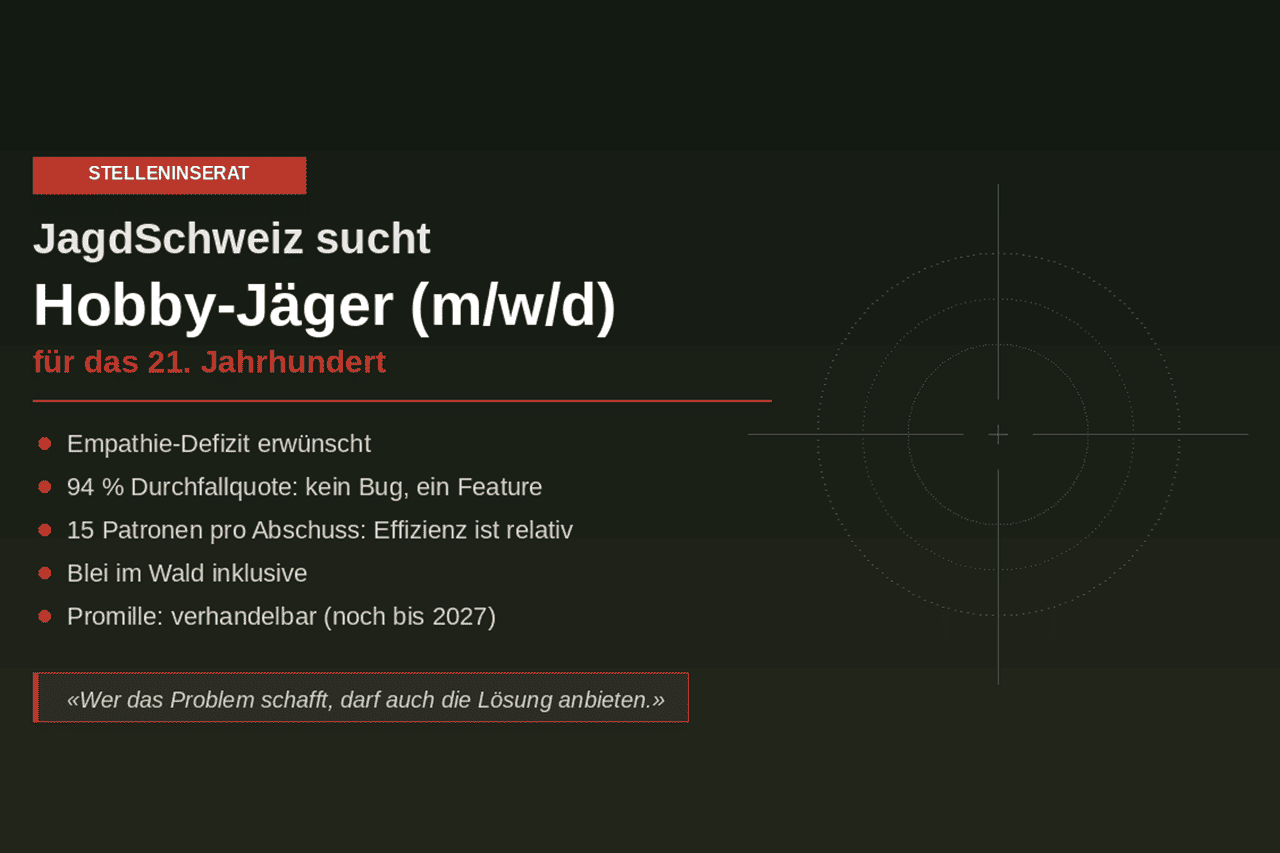
PETA calls hobby hunters «sociopaths»
A single sentence can derail an entire debate. In early January, PETA France published a post on X about hunting, describing hobby hunters as people without empathy who shoot «for pleasure» and as «Sociopathes en totale liberté».


Hunting-friendly media in France reacted with predictable outrage.
The portal Chasse Passion spoke of «Injure» and «Provokation» that «does not go down well», and portrayed the post as a blanket insult to over a million hunting license holders. Chasse et Pêche also picked up the topic and emphasized the heated reactions on social networks.

The incident is more than a social media exchange. It shows how quickly hunting conflicts turn into moral labeling, and how the hunting lobby capitalizes on this. At the expense of wildlife, which barely features in this debate.
An image from southwestern France went viral in early January: Several wild boar heads and entrails were found on the banks of a stream near Seyches in the Lot-et-Garonne department. The incident sparked widespread outrage, charges were announced, and within hours PETA picked up the topic on X. In this context, the organization broadly labeled recreational hunters as «sociopaths in complete freedom».
The reaction from hunting-affiliated media followed immediately. The tweet was interpreted as an insult, as an attack on «all recreational hunters». The actual incident quickly faded into the background. Yet this is not about wounded vanity, but about violence against animals, about animal suffering and the question of how dead wild animals are handled.
The Seyches case and the responsibility of recreational hunting
According to reports from the regional newspaper, around ten wild boar heads with entrails were disposed of in a waterway. The organization One Voice filed charges. Violations of environmental law, hygiene regulations and water protection are at stake.
Such incidents are not a marginal issue. They affect nature conservation and public safety equally. A stream is not a slaughterhouse or a garbage dump. Those who kill animals bear responsibility to the very end. This is precisely where hunting ethics begins and does not end with the hunter's greeting.
PETA responded with a pathological analysis of the act. This shifted the debate. For the hunting lobby, this is a gift. Instead of discussing disposal, control and sanctions, it can once again portray itself as a victim and dismiss any hunting criticism as «hate».
The pattern is familiar, also from Switzerland. Factual references to risks, to safety in recreational hunting or to hunting accident statistics are emotionally overshadowed. The discussion revolves around tone rather than content.
Recreational hunting as leisure practice and structural problem
The Seyches case raises fundamental questions. Recreational hunting is often presented as necessary regulation. At the same time, it repeatedly becomes apparent that controls are inadequate and sanctions rarely take effect. When animal waste ends up in the field, this is not an individual mishap, but an indication of enforcement and systemic problems.
The psychology of recreational hunting also plays a role here. Those who normalize killing as leisure shift societal boundaries in dealing with wild animals. This is not a diagnosis, but an observation of practices and rituals. This is precisely why a sober debate about animal welfare and animal rights is necessary.
Assessment for Switzerland and beyond
What happens in France is not an isolated case. Here too, nature is repeatedly degraded. At the same time, any demand for stricter rules is interpreted as an attack on traditions.
This is not about symbolic politics, but about concrete reforms. A reform of recreational hunting would have to include independent controls, transparent procedures and clear consequences. This applies to France as well as to Switzerland.
PETA's tweet may have been pointed. However, it distracts from the actual question. Words on X are not the problem, but real practices in the field. Those who defend recreational hunting must explain why dead animals can end up in streams.
When hunting criticism is effective, it has evidence, clear terms and the courage to stick to reality when facing recreational hunters: Recreational hunting is killing. Seyches is not a tweet. Seyches is a streambank, waste, charges, enforcement. And those who kill animals for fun bear responsibility, also for disposal, environmental consequences and safety.
Because in the end it is not about outrage culture, but about violence, about animals, about environment and about responsibility.
More on this in the dossier: Psychology of hunting
Related articles
- Are recreational hunters psychopaths?
- Recreational hunters on the psycho swing
- Aggression: Understanding hobby hunters better
- Sadism: Understanding hobby hunters better
- Trophies: Recreational hunting
- Alcohol: Hobby hunters and the drinking problem
- Hunting and hunters: Psychoanalysis
- Hobby hunters and violence in our society